
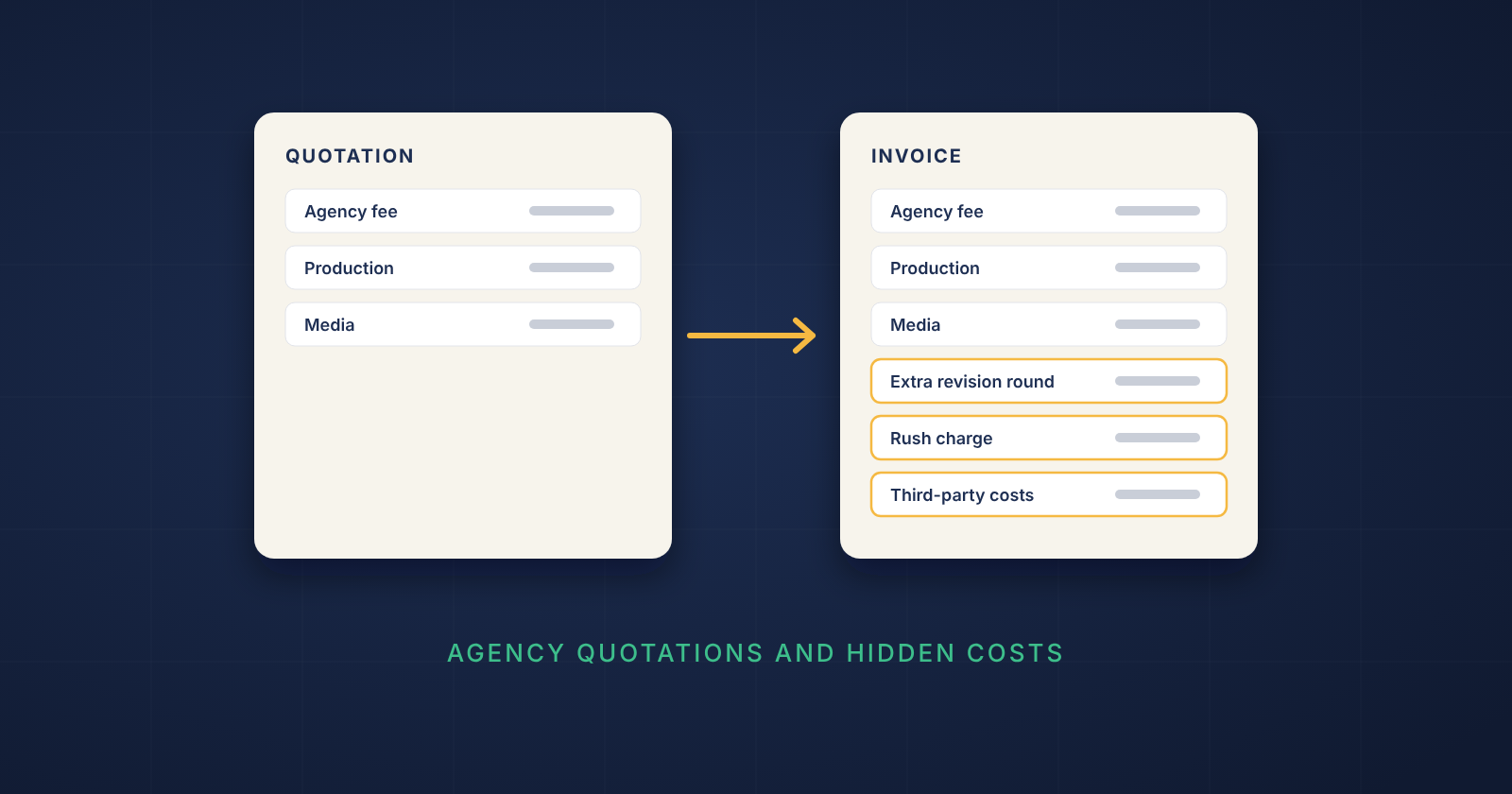
An agency quotation is approved. The campaign moves into production, the deliverables start arriving, and the marketing team is happy with the work. Then the invoice reaches finance, with extra production charges, a revision fee and third-party expenses nobody remembers agreeing to.
The agency may not have made a mistake. The problem often started much earlier, when the quotation was reviewed.
This is the difficulty with comparing marketing agency pricing. A quotation can look commercially reasonable without making the full cost of the engagement clear. The headline fee tells only part of the story. What matters is what that fee includes, what it leaves out, and how additional work will be charged.
So for enterprise marketing teams, evaluating agency pricing has to go beyond comparing totals. It should establish whether the commercial terms will still hold up once the campaign is underway and the invoice arrives.
The headline fee is rarely the whole engagement
Two agencies can propose different pricing models for the same campaign. One offers a monthly retainer covering account management and creative services, with production charged separately. The other quotes a project fee that includes some production but limits the number of revisions.
Neither model is better by default. The difficulty is understanding what the company is actually buying.
A retainer needs to define the work, resources or hours it covers. Without that, a fixed monthly payment leaves open questions about extra requests, unused capacity and work outside the agreed scope.
A project fee needs a clearly defined deliverable. If the campaign changes significantly after approval, both sides need to know what counts as additional work and how it will be priced.
Production needs the same attention. The creative concept may sit inside the agency fee, while photography, printing, fabrication, talent or locations are billed separately. Media buying may carry a commission or a management fee. Third-party services may be passed through at cost, or with a handling charge added.
The commercial question isn't only what each service costs. It's whether the quotation makes the link between the fee and the work clear.
A rate card, a quotation and a purchase order serve different purposes
These three documents are connected, but they are not interchangeable.
A rate card establishes the agency's pricing structure. It may contain role-based fees, production rates, service charges and the commercial terms under which work is priced.
A quotation applies those rates to a particular brief. It sets out the proposed work, expected costs, assumptions and exclusions for a specific engagement.
The purchase order records the company's approved commercial commitment. It connects the agreed scope and costs to the procurement process and provides a reference for checking subsequent delivery and invoices.
The distinction matters. A rate card may establish what an agency charges for a service, but it does not automatically establish what the company has approved for a particular campaign. That needs to be reflected in the quotation, agreed scope and purchase order.
When these documents remain connected, teams have a clearer record of what was priced, what was approved and what should eventually be invoiced.
The cost changes where the scope becomes unclear
The first quotation is built on an expected scope. Real campaigns involve decisions and changes.
A brand asks for more adaptations after seeing the first creative. A campaign expands into more cities. A launch date moves forward and production has to be rushed. A regional campaign needs more language versions or local vendors.
None of this is unreasonable. It's part of running marketing work. The commercial risk appears when nobody has agreed how these changes affect the price.
Take revisions. A quotation with two rounds of changes can look cheaper than one with more flexibility. But if your internal approval process involves several stakeholders, extra rounds are hard to avoid.
Rush charges work the same way. If a deadline moves, the agency may need more people or faster production. The charge should be understood and agreed in advance, not discovered on the invoice.
Third-party expenses need particular care. A quotation might mention talent, music licensing, location hire or local production partners without saying whether those costs are estimates, fixed amounts or pass-through expenses, or what supporting documents the agency will provide.
Regional execution adds another layer. A campaign running across cities, states and languages can involve different production needs, suppliers and rates. A quotation that doesn't explain these variations makes the initial budget hard to rely on.
Why comparing quotation totals can lead to the wrong decision
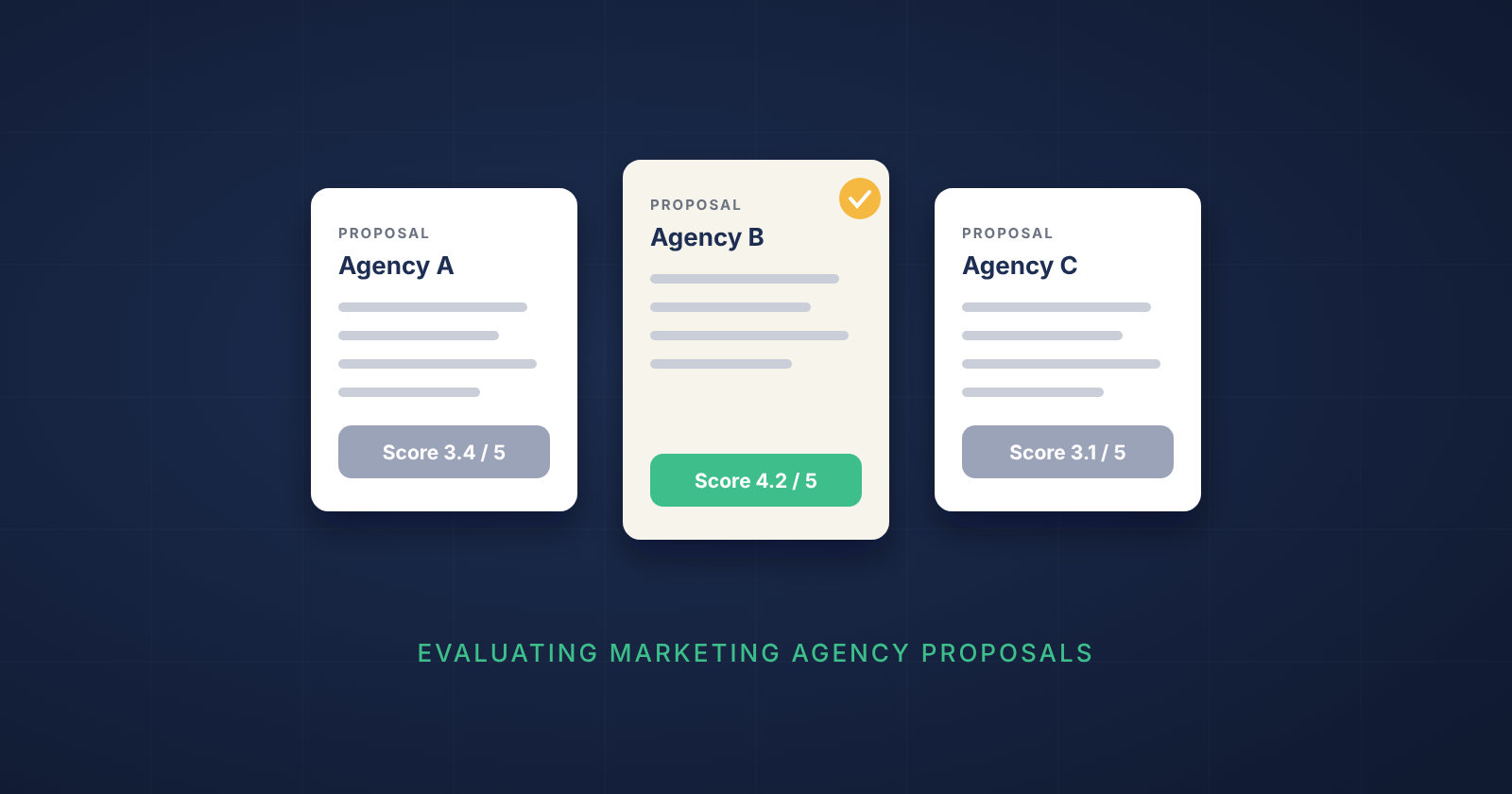
Imagine two agencies quoting for a campaign involving creative development, production and regional adaptations.
Agency A submits a lower project fee. However, production is excluded, additional adaptations are charged separately, and the quotation includes a limited number of revision rounds.
Agency B quotes a higher amount but includes production coordination and more revision flexibility. Some third-party expenses are still billed separately, but these are identified in the quotation.
Looking only at the total makes Agency A appear less expensive. Looking at the actual commitment reveals a different picture.
Before making a decision, the marketing and procurement teams need to establish:
Which deliverables are included in each agency's fee?
Which production activities are separately chargeable?
How many adaptations and revisions are covered?
Which third-party expenses remain outside the quotation?
How will additional work be approved and priced?
The objective is not to force both agencies into identical pricing models. It is to understand what each agency is offering for the work the business actually needs.
A higher quotation may represent a more complete scope. A lower quotation may still be commercially preferable, provided the excluded work is understood and budgeted for.
The decision should be based on the complete engagement, not simply the first number on the page.
The invoice is where weak commercial agreements become visible
Consider what happens when a campaign is complete.
The agency submits its invoice. Marketing recognises the campaign and confirms that the work was delivered. But finance notices that the invoice includes additional production charges and a revision fee.
The questions now become difficult to answer. Was the extra production approved? Was the revision outside the original scope? Did the agency communicate the additional cost before carrying out the work?
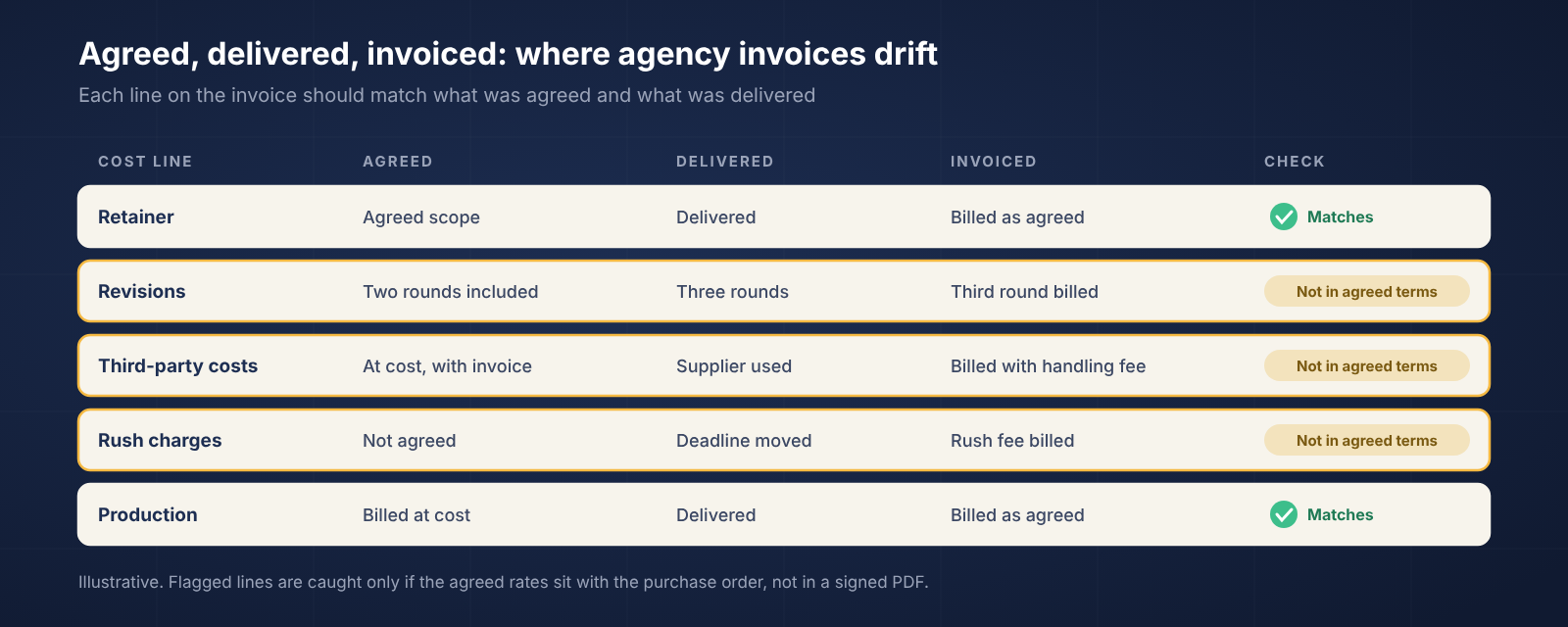
These are not simply invoice-processing questions. They are questions about whether the commercial agreement was maintained throughout execution.
When approvals, scope changes and supporting documents are scattered across emails and separate files, teams have to reconstruct the agreement after the work has already been completed.
The invoice should be the point at which the agreed commercial terms are verified, not the first time anyone tries to establish what those terms were.
An approved rate should remain connected to the work
Once an agency is selected, its approved rates should shape the scope of work and the purchase order. If the campaign changes, the revised terms should be documented and approved before the extra work is treated as part of the commitment.
When the agency completes the work, delivery should be checked against the approved scope. The invoice can then be reviewed against the purchase order, the agreed rates and the delivery records.
This creates a clear commercial trail:
Agreed quotation → approved scope → purchase order → verified delivery → invoice reconciliation.
Each stage refers back to the one before. That makes it easy to spot a charge that wasn't approved, a rate that has changed, or a deliverable that can't be verified.
Brandintellé's sourcing and plan approvals keeps every approval with the rate it was approved at, and invoice reconciliation checks each invoice against the purchase order and the proof of delivery before it reaches finance, so a charge outside the agreed terms is caught before payment rather than argued about after it.
A rate card is useful only when the business can refer back to it throughout the agency relationship. Approved changes, additional services and revised rates should remain documented, so the final invoice can be understood against the original commercial agreement.
The aim isn't to prevent agencies from charging for additional work. It's to ensure that both sides understand what was agreed, what changed and why.