
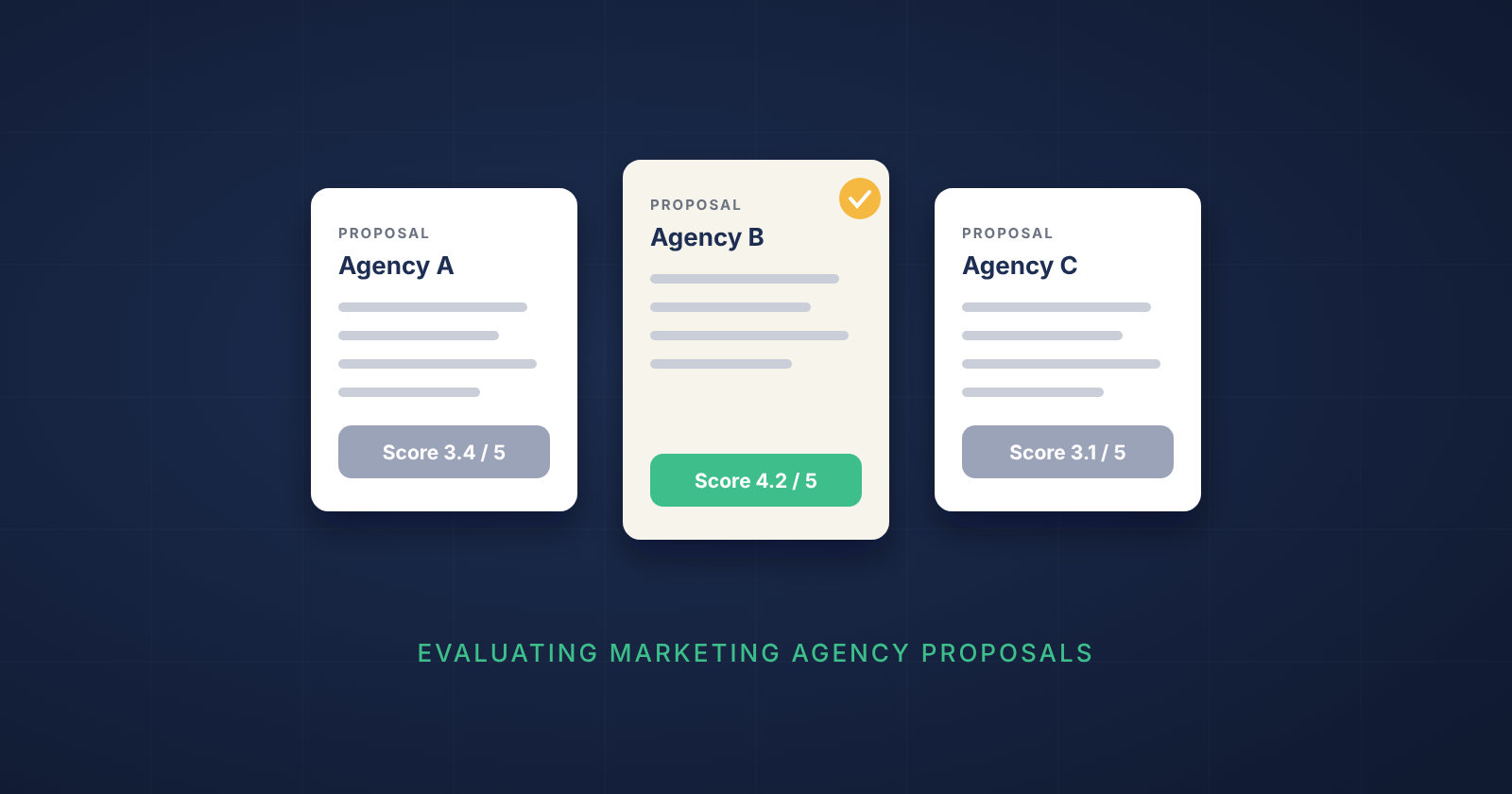
To evaluate marketing agency proposals, compare every agency against the same requirements, scored the same way: strategic understanding, execution capability, measurement, the team that will actually deliver, commercial transparency and governance. Then keep the winning proposal on record. Its rates, deliverables and KPIs are what the purchase order, the delivery check and the invoice should be measured against.
Choosing a marketing agency isn't about the most creative pitch or the lowest quotation. For a large company, it means finding a partner that understands the business objective, can deliver consistently across brands and regions, and can work within your procurement, approval and audit processes.
A structured evaluation helps marketing, procurement and finance decide on the merits rather than on presentation quality or one stakeholder's preference. This guide sets out what to evaluate, how to compare quotations like for like, who should score what, and a scoring sheet your team can use on the next pitch.
Why are marketing agency proposals hard to compare?
Because each agency answers the brief in its own way, prices it in its own format, and leaves out different things.
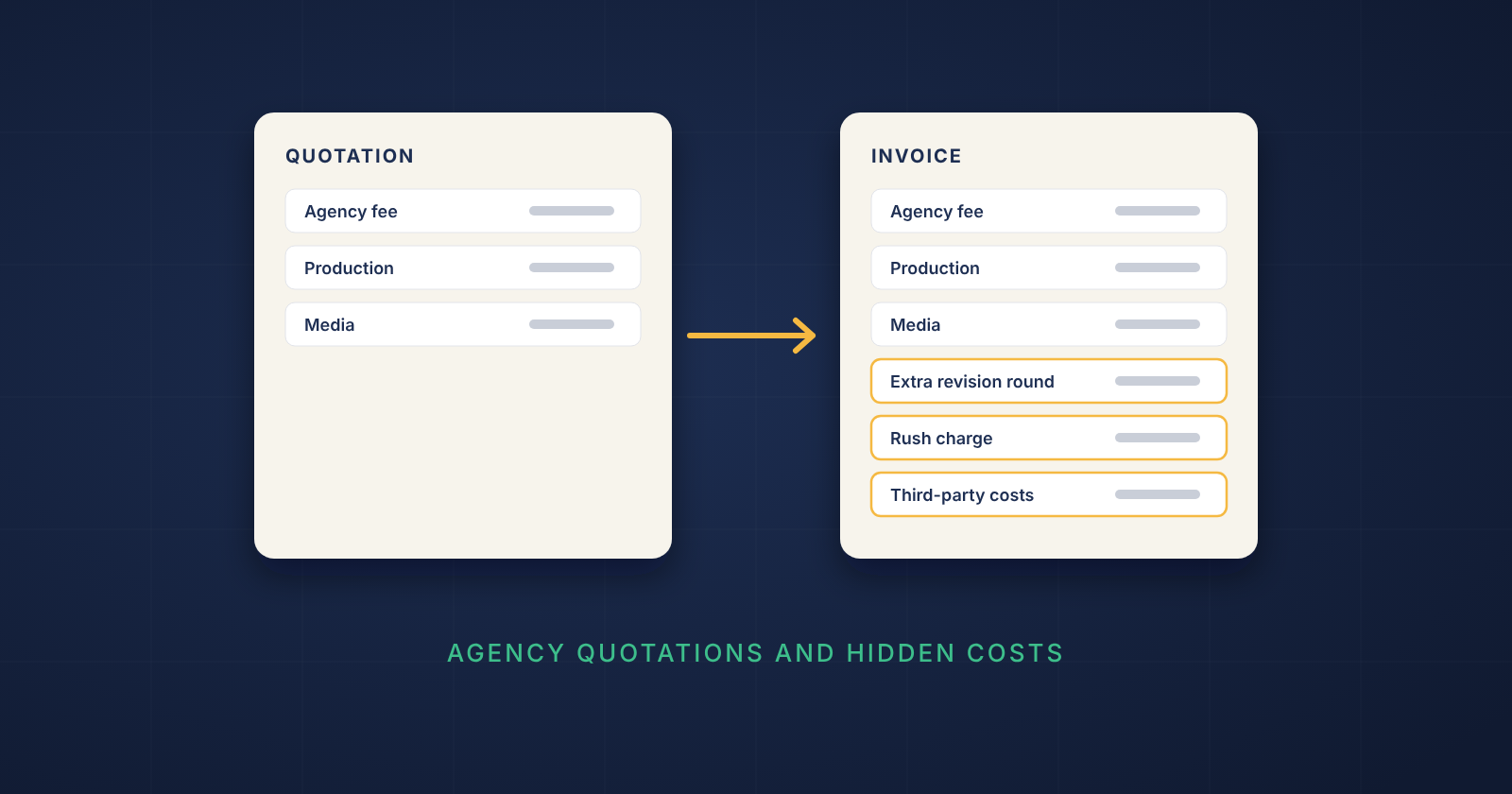
One agency leads with creative strategy, another with media planning, a third with on-ground execution. One quotation includes production and management fees; another lists them separately, or not at all. That creates four problems:
Inconsistent scope: agencies interpret the brief differently and propose different deliverables.
Unclear pricing: quotations include different services, assumptions and exclusions.
Subjective evaluation: the best presentation wins, not the best plan.
Limited accountability: responsibilities, reporting and approvals are left vague until after the contract is signed.
A common framework, agreed before the proposals arrive, is what makes them comparable.
What should you evaluate in a marketing agency proposal?
Six things: strategic understanding, creative and execution capability, measurement and reporting, the delivery team, commercial transparency, and governance.
Strategic understanding
Look beyond whether the agency has repeated the brief back to you. Does it identify the business problem behind it? Are its recommendations relevant to the audience, the markets and the outcome you need?
Creative and execution capability
Creative ideas need a realistic plan behind them. Assess relevant experience, production capability, geographic coverage and the ability to coordinate many activities at once. For campaigns run across regions through local vendors, which is common in India, ask how the agency will keep execution consistent and how it will prove each activity ran.
Measurement and reporting
The proposal should name the KPIs, who reports them, how they'll be measured and what happens when performance falls short. "Regular reporting" isn't enough: your team should know what it will receive, in what format and when.
Team and resource availability
The people presenting the pitch may not be the people running the account. Ask who will manage it day to day, who will oversee execution and whether any work will be subcontracted. Clear responsibilities and escalation routes prevent confusion once the campaign starts.
Commercial transparency
Review agency fees, production costs, media charges, third-party expenses, exclusions and payment terms, against the same scope of work. A lower quotation isn't better value if essential services are missing or extra charges are likely during execution.
Governance and compliance
Large campaigns involve several approvers and many vendors. The agency should explain how it will handle documentation, approvals, change requests, confidentiality and proof of execution, and how its invoices will carry the PO number and correct GST details. These matter most when the work has to stand up to internal procurement and audit.
How do you compare marketing agency quotations?
Put every quotation into the same structure, line by line, before comparing totals.
Use this: a quotation comparison table. Ask agencies to fill it in themselves, or fill it in from their proposals and ask them to confirm.
Cost line | Agency A | Agency B | Agency C |
|---|---|---|---|
Agency fee (retainer, project or commission) | |||
Production | |||
Media (and whether it's billed through the agency) | |||
Third-party and vendor costs | |||
Regional execution costs | |||
Revisions included | |||
Exclusions | |||
Payment terms | |||
How changes will be priced | |||
Comparable total |
Gaps in the table are the point. A row one agency leaves blank is a cost you'll meet later, or a service you won't get.
Comparing agency quotations is only part of the commercial evaluation. Understanding how retainers, production charges, revision limits and additional costs affect the final commitment is equally important. See our guide to comparing marketing agency rate cards and identifying hidden costs.
Who should evaluate a marketing agency proposal?
Marketing, procurement and finance, each scoring what they're best placed to judge.
Marketing assesses strategic fit, creative quality and execution capability.
Procurement checks vendor suitability, sourcing process and commercial terms, and whether the agency is already on your roster (empanelled) or needs onboarding.
Finance reviews budget fit, payment terms and how the spend will be tracked and accounted for.
Other stakeholders, such as legal or regional sales, contribute where the brief needs them.
Document the final decision with its reasoning. If an agency wins on execution capability rather than price, that reasoning should sit alongside the commercial evaluation, where an auditor or a new CMO can find it.
Why is the lowest quotation not always the best choice?
Because a low quotation often leaves out costs that arrive later: production, extra revisions, regional execution or reporting.
Compare the complete scope, not the total. Ask every agency to state its assumptions, exclusions, additional charges and how changes will be priced. That makes negotiation about the same work, and reduces the chance of surprises once the campaign is running.
What happens after you choose a marketing agency?
The winning proposal should become the baseline for everything that follows: the scope of work, the purchase order, the check on what was delivered, and the invoice.
This is where most agency selections lose their value. The proposal is approved in a meeting, the PO is raised from a summary, and the detail (rates, deliverables, KPIs, exclusions) stays in an email attachment. Months later, when the invoice arrives, nobody can easily check whether what ran matches what was promised.
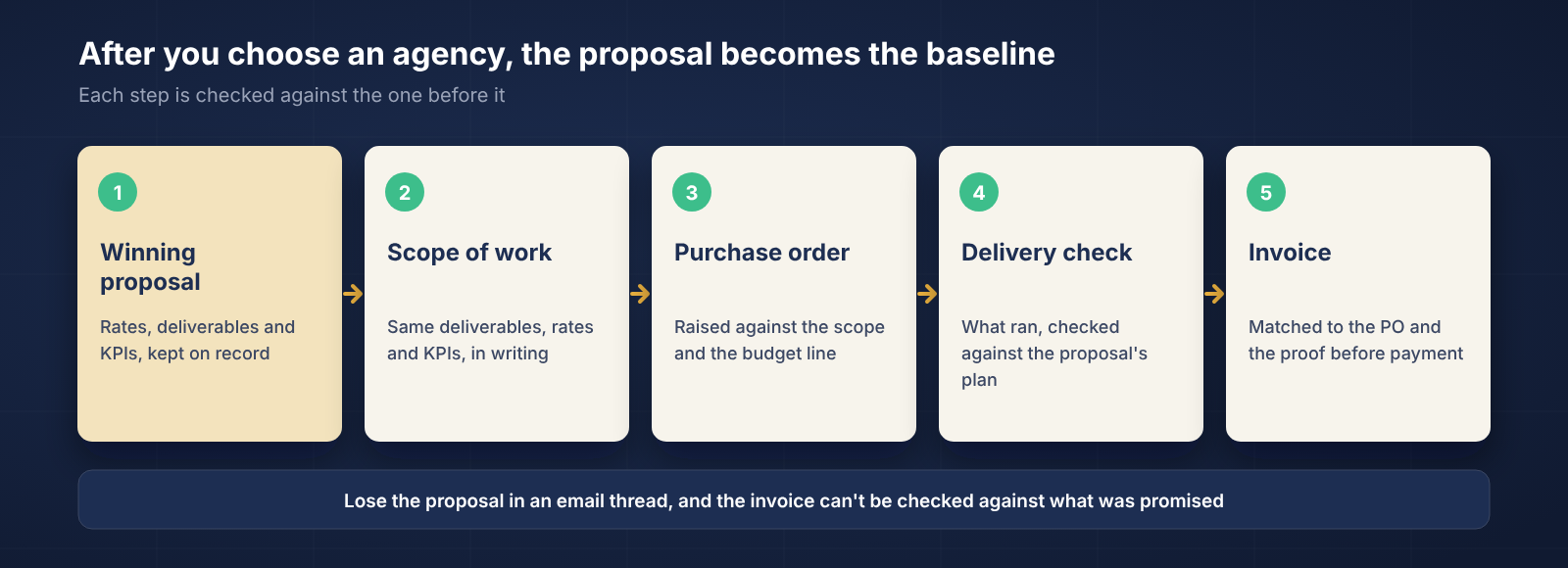
Keep the chain connected:
Proposal to scope: turn the winning proposal into a written scope with the same deliverables, rates and KPIs.
Scope to PO: raise the purchase order against that scope and the budget line it belongs to.
PO to delivery: check what was delivered against the proposal's plan and KPIs, medium by medium.
Delivery to invoice: match the invoice to the PO and the proof before it's paid.
Brandintellé's sourcing and plan approvals workflow runs this from the start: RFPs go to agencies from the system, proposals and rates are compared side by side, vendors can be recommended from their past work, and every approval is kept with the rate it was approved at. The approved plan then carries through to execution and invoice reconciliation, so the proposal you chose is the one the invoice is checked against. It's one part of marketing operations governance: control of marketing spend from plan to payment.
The right agency is the one whose proposal you can still hold them to six months later. Score it fairly, and keep it on the record.