

In large companies, marketing teams lose most of their time to manual work in five places: chasing approvals, retyping vendor and agency files, matching plans to what actually ran, checking invoices field by field, and rebuilding the same reports every month. None of these is marketing work. A good marketing spend platform should take all five off the team, and the quickest way to see where your own hours go is a one-week manual work audit.
Ask a brand manager what they did last week and the honest answer often includes very little marketing. They followed up on two approvals, reformatted an agency estimate, reconciled a post-campaign report against the plan, answered finance's questions about three invoices, and rebuilt the monthly spend deck.
Each task is small. Together, across a marketing team, they add up to a significant share of the week. This article sets out where the time goes, what should replace each task, and a simple way to measure it in your own team.
Where do marketing teams lose the most time to manual work?
In five recurring tasks. Each one exists because information moves between people by email and spreadsheet instead of through one system.
Chasing approvals. A plan waits in someone's inbox. Nobody knows where it is, so following up becomes the status system.
Retyping vendor and agency files. Estimates, schedules and invoices arrive in each vendor's own format and are copied into the company's template by hand.
Matching plan to actual. After every campaign, someone lines up the plan against the post-campaign report, medium by medium, in a spreadsheet.
Checking invoices field by field. PO number, tax details, amounts and dates are checked by eye, and errors go back to the vendor by email.
Rebuilding the same report. The monthly spend report for leadership is assembled from scratch every month, from the same sources.
What should a platform take off a marketing team's plate?
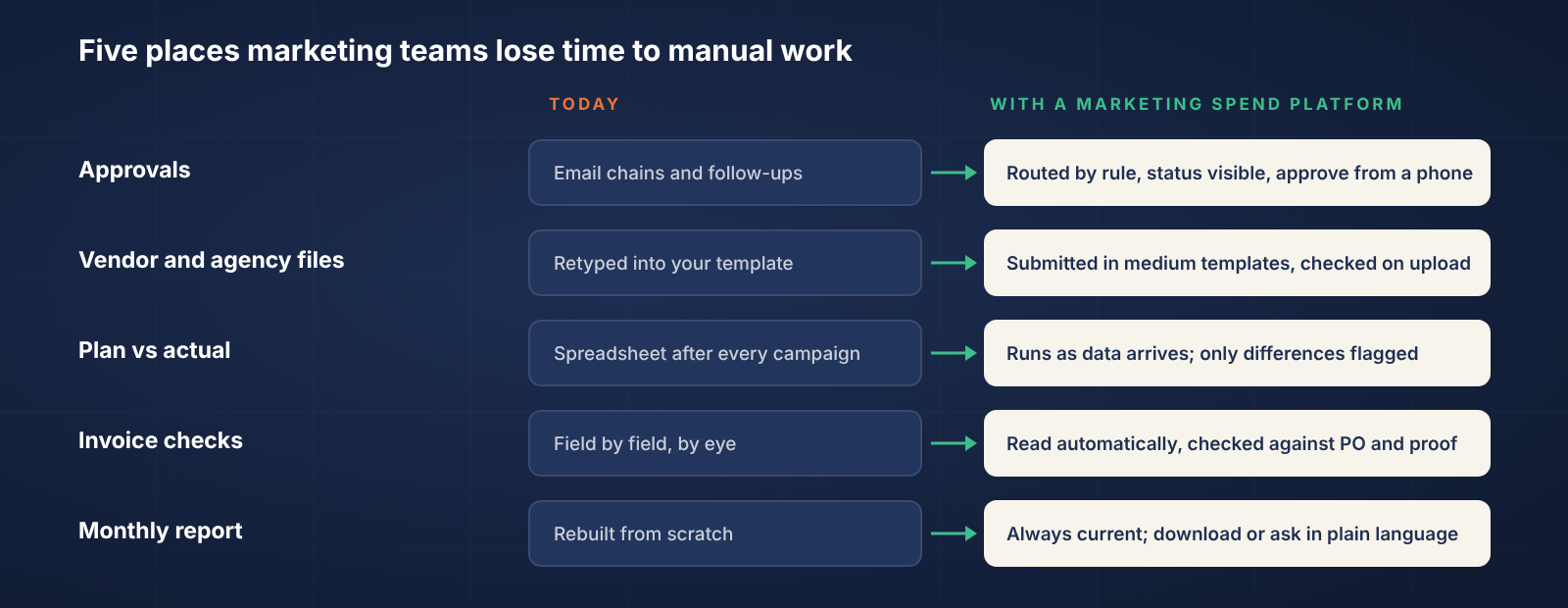
Each of the five tasks has a direct replacement. The test is whether the person still has to touch it at all.
Task | How it works today | How it should work |
|---|---|---|
Approvals | Email chains and follow-up calls | The request goes to the right approver by rule, with a status everyone can see, and can be approved from a phone |
Vendor and agency files | Retyped into your template | Vendors submit in a template built for each medium, and the file is read and checked as it's uploaded |
Plan vs actual | A spreadsheet after every campaign | The comparison runs as delivery data arrives, and only differences need attention |
Invoice checks | Field by field, by eye | The invoice is read automatically, checked against the PO and proof, and errors go back to the vendor before anyone in marketing sees it |
Monthly report | Rebuilt from scratch | The report is always current and can be downloaded or asked for in plain language |
How do you measure how much manual work your marketing team does?
Run a one-week manual work audit. It takes ten minutes a day per person and gives you a list of where to start.
Use this: ask everyone in the marketing team, and your marketing finance partner, to fill in one row for each manual task they do during one ordinary week.
Task | Which of the five? (approvals / files / plan vs actual / invoices / reports / other) | Time spent this week | Who else had to be involved | Could a system have done it? (yes / partly / no) |
|---|---|---|---|---|
Example: followed up on the Q3 digital plan approval | Approvals | Brand head, marketing finance | Yes | |
How to read it:
Add up the time by category, not by person. The largest category is where to start.
Count how many other people each task pulled in. A task that involves three people costs three times what it appears to.
Look at the "yes" rows. Those are the hours a platform should give back, and the list to take into any vendor demo: "show me how this task disappears."
Repeat the audit three months after any change, with the same people, to see what actually came back.
Why does user experience decide whether a marketing platform gets used?
Because the people who touch it most aren't the people who buy it.
Finance and marketing leaders choose the platform, but brand managers, regional teams and vendors use it every day. If approving a plan takes longer in the platform than by email, people go back to email. If a vendor needs a licence, a training session and a new format to submit an invoice, they'll send it by email instead. Adoption is decided by small things: approving from a phone, vendors submitting without a login, templates that match how vendors already work, and screens that show only what each role needs.
When you evaluate a platform, ask to see it from the point of view of a brand manager and a vendor, not only the person who sets it up.
How does Brandintellé reduce manual work for marketing teams?
Brandintellé is the system of record for marketing spend, so the manual work that comes from moving information between people largely disappears.
Approvals: requests route to the right approver by budget line and amount, show their status to everyone involved, and can be approved, rejected, commented on or held from a phone.
Vendor files: vendors submit plans through a secure link sent to their email, with no licence or login to set up, and upload estimates and schedules through templates built for each medium, which are read and matched as they arrive.
Plan vs actual: post-campaign evaluation runs automatically, and only deviations are flagged, with the explanation kept against them.
Invoices: invoice PDFs are read automatically, with on-screen correction, and ten checks run on every invoice. Vendors can upload and self-validate several bills at once against the same PO.
Reports: every report can be exported, and the AI Workspace answers questions in plain language from your data.
Marketing teams don't need more time. They need their time back from the work that isn't marketing.
See how Brandintellé takes the manual work out of marketing spend