
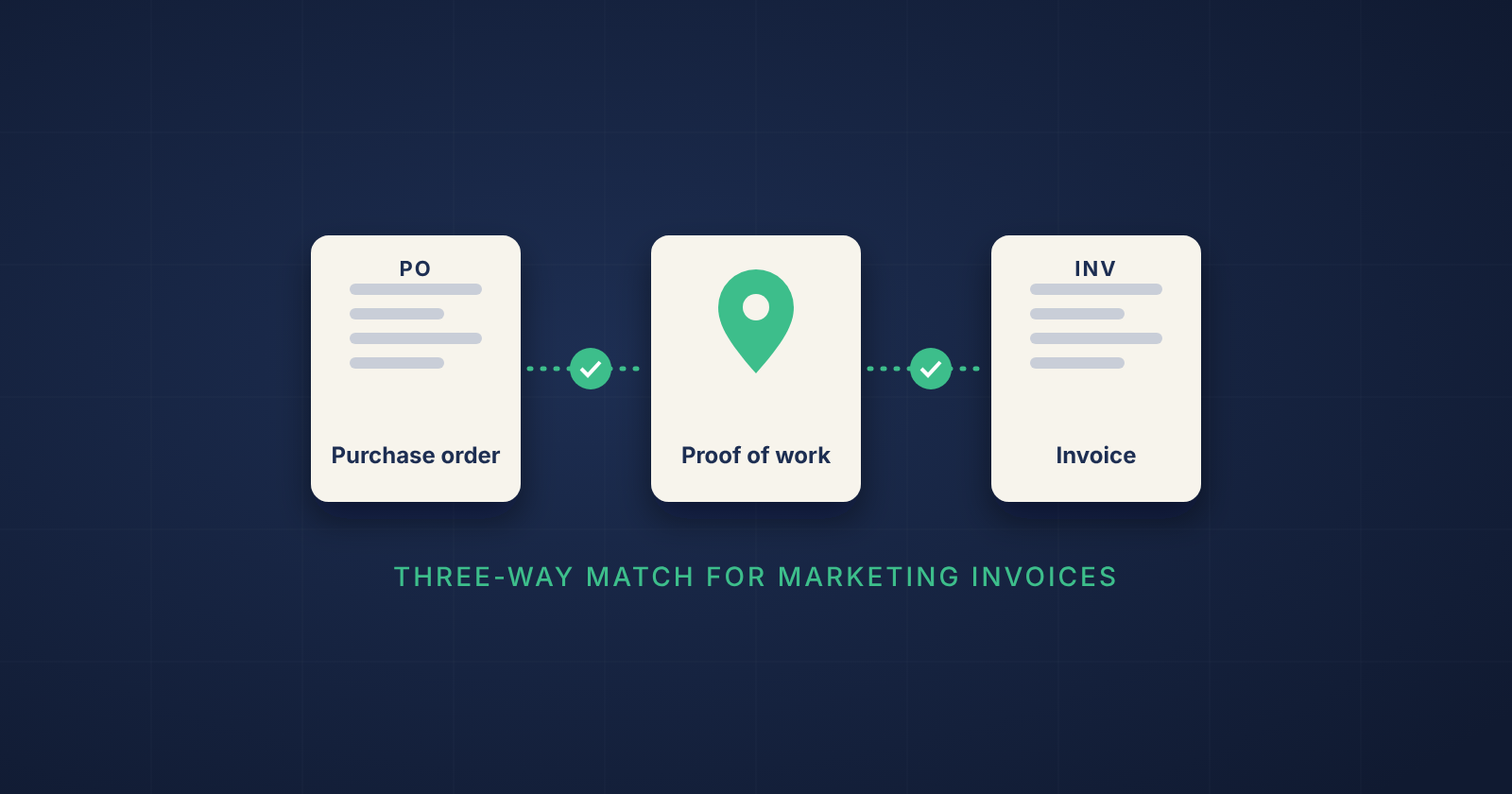
A three-way match checks an invoice against the purchase order and proof that the goods or services were received before it is paid. For marketing invoices, the "receipt" is proof the work happened: what aired, what the platform delivered, or geo-tagged photos of the activation. Without it, finance is only doing a two-way match.
If you run accounts payable or finance operations, you already do three-way matching every day for goods. The purchase order says what was ordered, the goods receipt says what arrived at the warehouse, and the invoice says what the supplier wants to be paid. When all three agree, the invoice is passed.
Then a marketing invoice arrives. Forty days of outdoor activity in twelve towns, a festive TV burst, a month of digital campaigns, two hundred in-store activations. There's a purchase order, and there's an invoice. But there's no delivery note, because nothing was delivered to the warehouse. So the invoice either passes because someone in marketing said "done" in an email, or it sits on hold while your team chases that email. Neither is a match. This guide shows what the third document should be for each kind of marketing spend, and what to do when the three don't agree.
What is three-way matching?
Three-way matching is the accounts payable check that compares three documents before an invoice is paid: the purchase order, the proof of receipt and the supplier's invoice. The quantities, rates and dates should agree across all three. A two-way match compares only the purchase order and the invoice, which confirms that the price and amount were agreed but not that anything was actually received. Some companies add a fourth check, an inspection that the goods met the agreed quality, which is called a four-way match.
Why are marketing invoices usually only two-way matched?
Because marketing services don't arrive at a warehouse, so nobody creates a receipt, and the invoice is checked only against the purchase order.
For goods, the receipt happens almost by itself: the stores team counts what arrived and records it. For a campaign, the "delivery" happens on a TV channel, on a platform, or on a shop front in a town finance has never visited. The person who knows whether it happened is in marketing, and their confirmation usually comes as an email or a message, if it comes at all.
So most companies end up with one of two habits. Either marketing invoices pass on the strength of the purchase order, which means the company pays for whatever is billed up to the PO value. Or they wait on hold until someone confirms, which is how vendor payments slip past their due dates. Some large companies we speak to process thousands of marketing invoices a month with no independent check that the billed work happened at all. That's not a control gap anyone chose; it's simply what happens when the receipt step has nothing to hold on to.
What counts as the receipt for a marketing invoice?
The receipt is whatever proves the work happened, in a form finance can compare with the invoice line by line. It differs by type of spend, and it should be agreed with marketing and vendors before the work starts, not requested after the invoice arrives.
TV: what actually aired
The receipt is the list of spots that aired, with channel, date, time and duration, usually from the broadcaster's telecast certificate or the post-campaign report. Compare it with the planned schedule on the purchase order, not with the invoice total. Spots that didn't air, or aired outside the agreed time band, are the usual reason a TV invoice should be part-paid rather than paid in full.
Digital: what the platform delivered
The receipt is the delivery data from the ad platform itself, such as impressions, clicks or views for the campaign and the period billed. This is the hardest one to check, because invoices often show only aggregated totals. Ask for the platform's own report for the same campaign and dates, and match the delivered quantity against what was billed.
Outdoor and on-ground: geo-tagged, timestamped photos
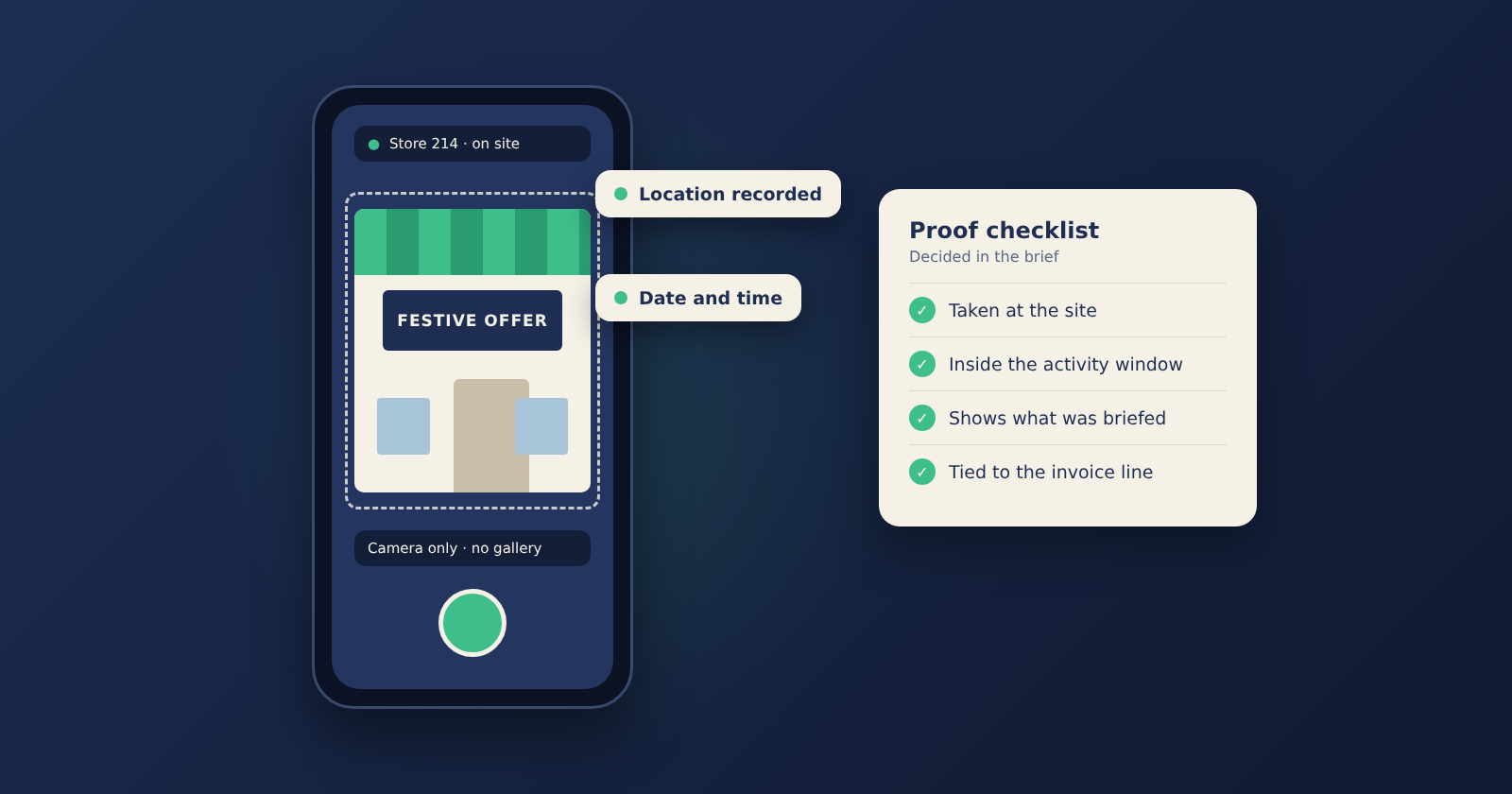
The receipt is a photo of each site or activation, taken on location and stamped with the time and place, linked to the line it proves. A folder of images sent at month-end doesn't count, because it can't be tied to a specific site and date. Our field guide to proof of execution for on-ground activations covers what good proof looks like.
Print: the published page
The receipt is the published page or a tear sheet showing the ad in the agreed publication, edition, date and size. It's the easiest to collect and the easiest to forget.
Production and events: signed-off deliverables
For work that produces something, such as a film, a set of creatives or an event, the receipt is the deliverable itself or a sign-off from the person in marketing who accepted it, recorded against the purchase order line. A sign-off is enough here, as long as it's recorded, dated and attached, not buried in an email thread.
What should finance do when a marketing invoice doesn't match?
Decide by what the mismatch is, not by how big it is: pay what is proven, hold what is unclear, and record any exception.
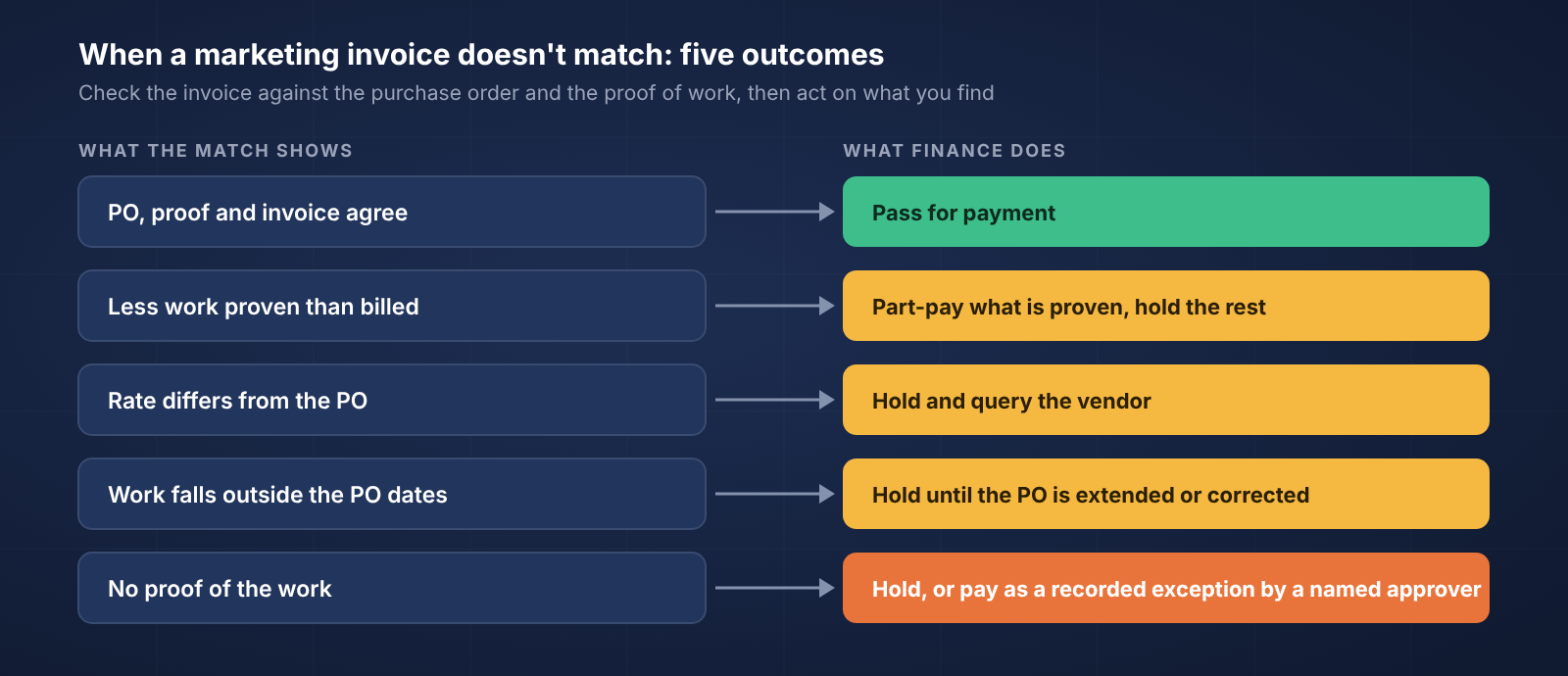
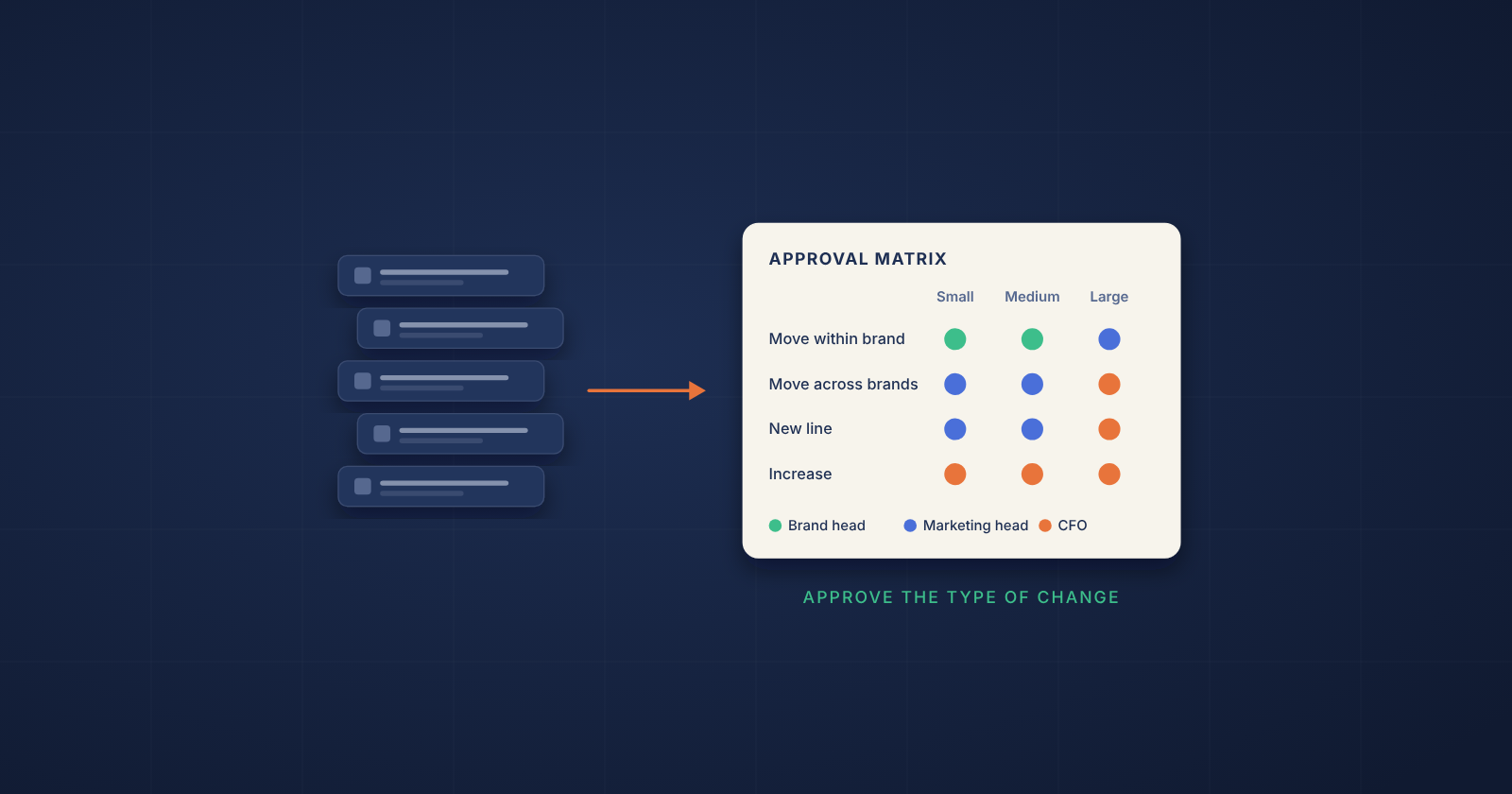
Most mismatches fall into one of four types. When less work is proven than billed, such as 180 of 200 activations or a few TV spots that didn't air, the fair answer is to pay for what is proven and hold the rest until the vendor proves it or credits it. When the rate differs from the purchase order, the invoice should go back to the vendor, because a rate change needs a revised order, not a quiet payment. When the work falls outside the purchase order's dates, check whether the order was extended; if it wasn't, the order should be corrected first. And when there is no proof at all, the invoice should be held, or paid only as a recorded exception approved by a named person with a written reason. Our guide to the marketing budget approval matrix covers who should approve those exceptions.
Agree tolerances with marketing in advance, too. A small difference in delivered impressions or a rounding gap on a large invoice shouldn't stop a payment, but the tolerance should be written down so nobody decides it case by case.
How do you set up three-way matching for marketing invoices in SAP or your ERP?
Treat proof of work as the receipt: the marketing owner confirms delivery against the purchase order line, with the proof attached, and only then can the invoice be matched.
In SAP and most ERPs, services are received through a service entry rather than a goods receipt; in SAP this is usually a service entry sheet. The mechanics already exist. What's usually missing is the rule behind them: who creates the service entry, and what evidence must be attached before they can. A workable rule is "no proof, no service entry". The person in marketing who owns the line confirms that the work was delivered, attaches the proof described above, and only then does the invoice become payable.
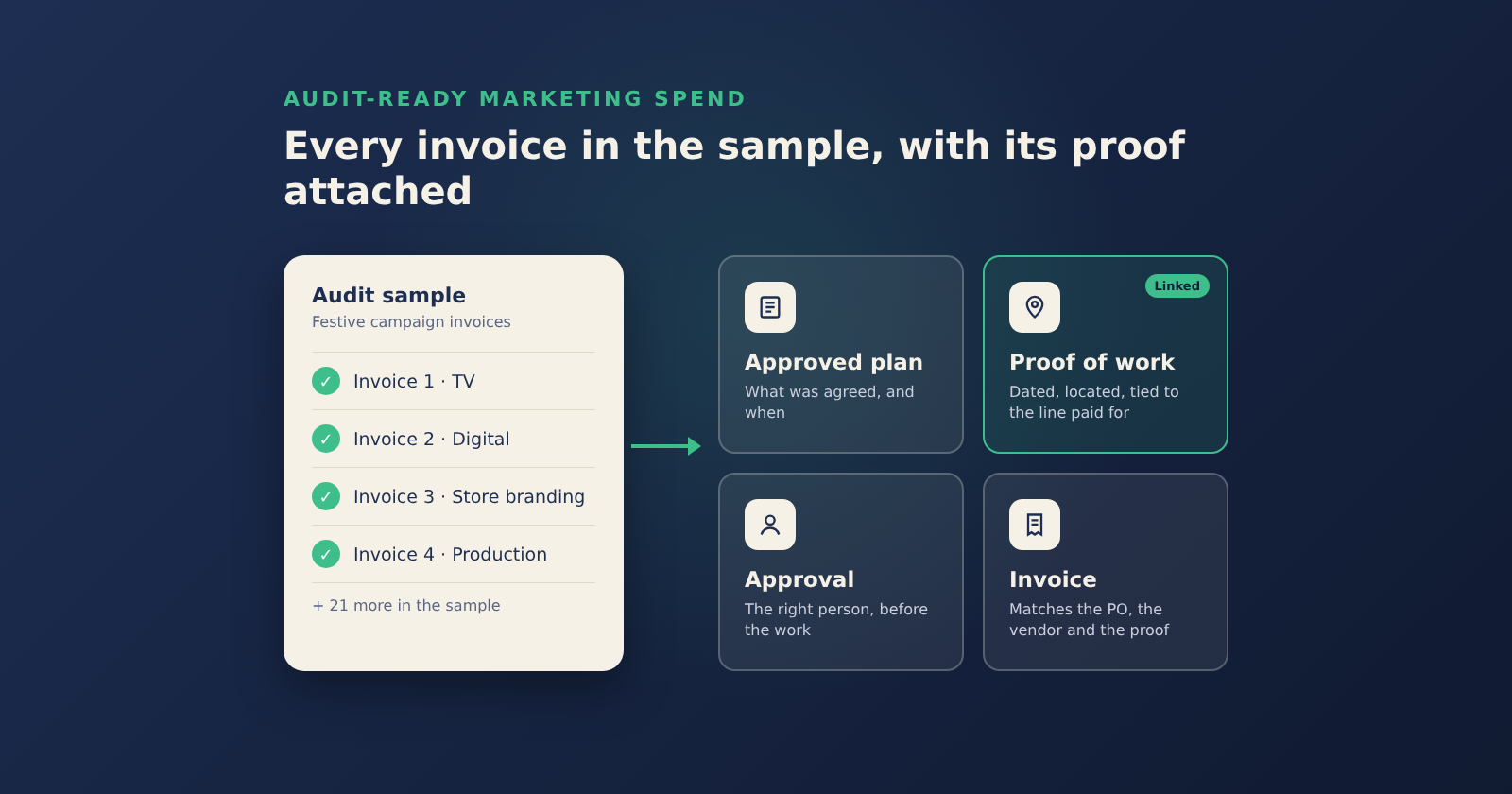
Two things make this stick. First, confirm work as it happens, not when the invoice arrives, so finance isn't chasing proof for invoices that are already due. The same confirmation feeds the month-end provision, which our guide to month-end marketing provisions explains. Second, keep the proof attached to the invoice it supports, so that when an auditor samples it, the evidence is one click away, as our guide to audit-ready marketing spend describes.
In Brandintellé, proof is attached to the line item it was paid for, and every invoice goes through automated checks, including the PO number, client and vendor GST, the e-invoice reference (IRN) and the digital signature, before it reaches the person who passes it.
For goods, the receipt is a delivery note. For a campaign, it's proof the work happened. Ask for it before the invoice arrives, not after.
See how Brandintellé matches marketing invoices to proof of work.