
An audit trail for marketing spend should record every decision that moves money, not just the transactions that reach the ledger: each budget change, approval, reallocation, deviation and payment, with who did it, when, what changed, why, and the evidence behind it. If an auditor can pick any paid invoice and trace it back to the approved plan and the proof that the work was done, without anyone rebuilding the story from emails, the audit trail is doing its job.
Most companies have an audit trail for marketing spend. It just isn't in one place. The approval is in someone's inbox, the plan revision is in a spreadsheet called "final v7", the proof is a photo in a chat group, and the invoice is in the ERP. Every audit, someone spends weeks putting it back together.
When large companies evaluate a marketing spend platform, auditability is usually on the list. This guide sets out what the audit trail should actually capture, the questions it has to answer, and a short test you can run in any demo.
What should an audit trail for marketing spend record?
Eight kinds of event. Each one needs the same five facts.
Event | What changes | Evidence it should link to |
|---|---|---|
Budget created or changed | A line's amount, in the agreed structure | The approval that allowed the change |
Money moved between lines | Two lines, one down and one up | The reason and the approver |
Plan or estimate approved | A commitment against a budget line | The plan version that was approved |
Plan revised after approval | The approved commitment | The revision, and who accepted it |
Purchase order raised | The commitment as finance sees it | The approved plan line it came from |
Work confirmed | What was delivered, and when | Proof of delivery |
Deviation settled | What is paid versus what was planned | The explanation, and the remedy agreed |
Invoice approved for payment | What the company owes | The PO, the proof and the checks that ran |
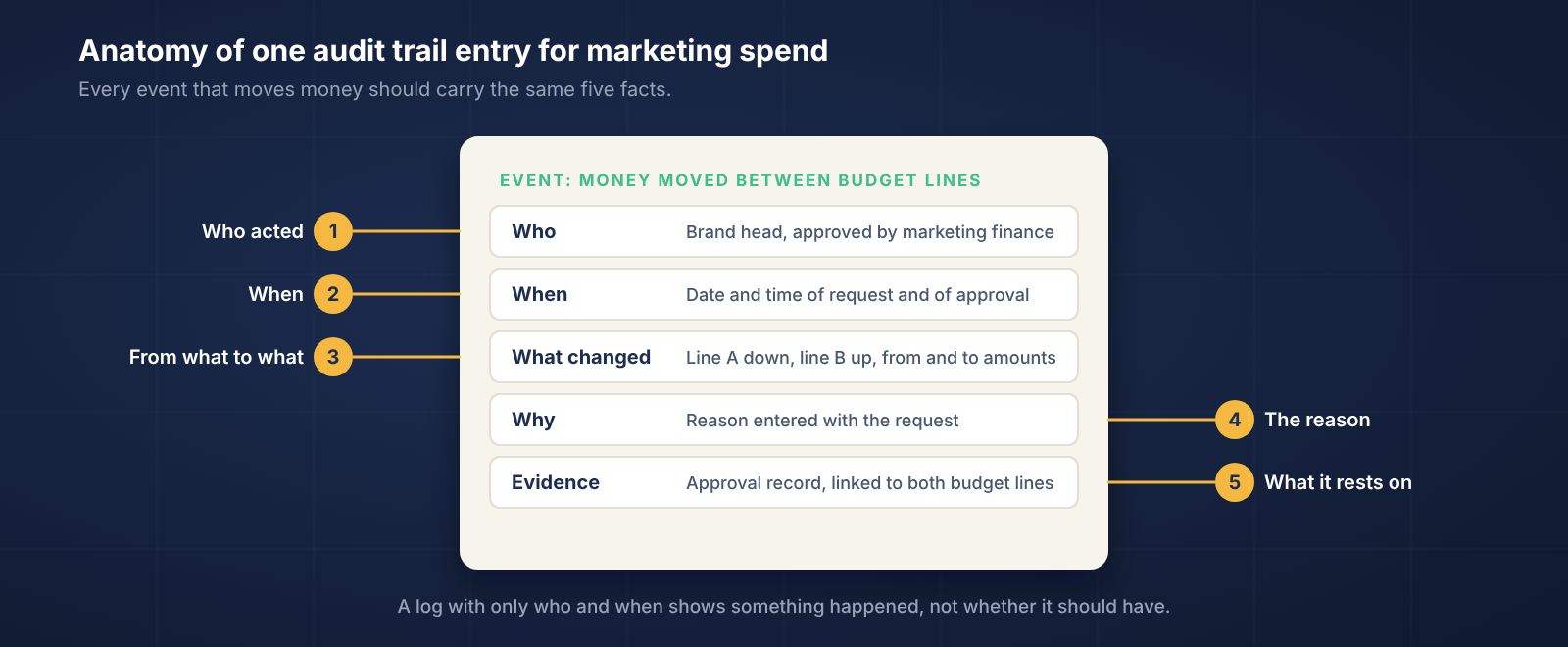
For every one of them, the five facts are the same: who acted, when, what changed (from what to what), why, and which evidence it rests on. A log that records only who and when can show that something happened, but not whether it should have.
What questions does a marketing spend audit trail need to answer?
Five questions come up again and again in audits of marketing spend. The audit trail should answer each one without a meeting.
Was this spend approved, by someone allowed to approve it, before it was committed? The approval record, the approver's limit at the time, and the timestamp against the PO date.
Does what was paid match what was approved? The approved plan line, the PO and the invoice, side by side, with any difference explained.
How do you know the work was done? Proof attached to the line that was paid for, not stored somewhere else.
Why did the budget move during the year? Every reallocation, with its reason and approver.
Who could have changed any of this? Access by role, and a record of every change to the record itself.
Our article on audit evidence for marketing spend covers what auditors test and the evidence that settles each point.
How do you test a spend platform's audit trail in a demo?
Ask for five minutes, and run this sequence.
Pick any paid invoice in the demo environment.
Ask them to open the PO it was paid against, then the approved plan line behind the PO, then the approval of that plan.
Ask to see the proof of delivery attached to that line.
Ask to see every change made to that line since it was created, including any reallocation.
Log in as an auditor with view-only access and repeat step 2.
If any step needs an export, a second system or "we'd pull a report for that", the audit trail isn't joined up. A complete audit trail is one click per step.
What makes an audit trail useful for decisions, not just for auditors?
The same record that satisfies an auditor tells leadership where the money really is.
When every commitment, approval and deviation is recorded against its budget line, finance can see spend at every stage, not just what has been invoiced: approved, committed to a vendor, delivered, and payable. That's the visibility and decision support large companies ask for alongside auditability, and it comes from the same data. A platform that keeps a good audit trail but can't show it as a live view of the budget is only doing half the job.
Where is your marketing spend audit trail today?
Use this: for each event, mark where the record lives today and whether it's linked to the transaction it supports. It takes about half an hour with your marketing finance team.
Event | Where is it recorded today? (system / spreadsheet / email or chat / nowhere) | Linked to the PO or invoice? (yes / no) |
|---|---|---|
Budget created or changed | ||
Money moved between lines | ||
Plan or estimate approved | ||
Plan revised after approval | ||
Purchase order raised | ||
Work confirmed, with proof | ||
Deviation settled | ||
Invoice approved for payment |
How to read it: every "email or chat" or "nowhere" is a record someone will have to rebuild at audit time. Every "no" in the last column is a record that exists but can't be traced. Start with the event that has the highest volume, usually work confirmation and invoice approval.
How does a Marketing Spend Platform like Brandintellé keep the audit trail for marketing spend?
Brandintellé is the system of record for marketing spend, so the audit trail is a by-product of the work, not a separate exercise.
Approvals and requests: every request shows who raised it, who approved, rejected or held it, when, and why. Notes for approval are approved inside the system, with their history.
Plans and revisions: the plan, each revision and the final approved version are kept for each medium.
Budget moves: reallocations, increases and decreases are recorded against the budget lines they affect.
Proof: on-ground proof is captured on location, geo-fenced, timestamped and camera-only, and attached to the line item it proves. Inspections that were scheduled but never captured are counted, not hidden.
Deviations and payments: deviations are flagged with the explanation kept against them, credit notes are tracked, and invoices are checked against the PO and proof before they're posted to the ERP.
Visibility: every budget line shows spend as approved, activated, committed by PO and invoice payable, so the same record serves finance month to month.
Auditor access: auditors can be given their own view-only logins. Brandintellé holds SOC 1 and SOC 2 certifications.
An audit trail isn't a report you run before the auditors arrive. It's what's left behind when every decision is made in the same place.
See how Brandintellé records every step from budget to payment