

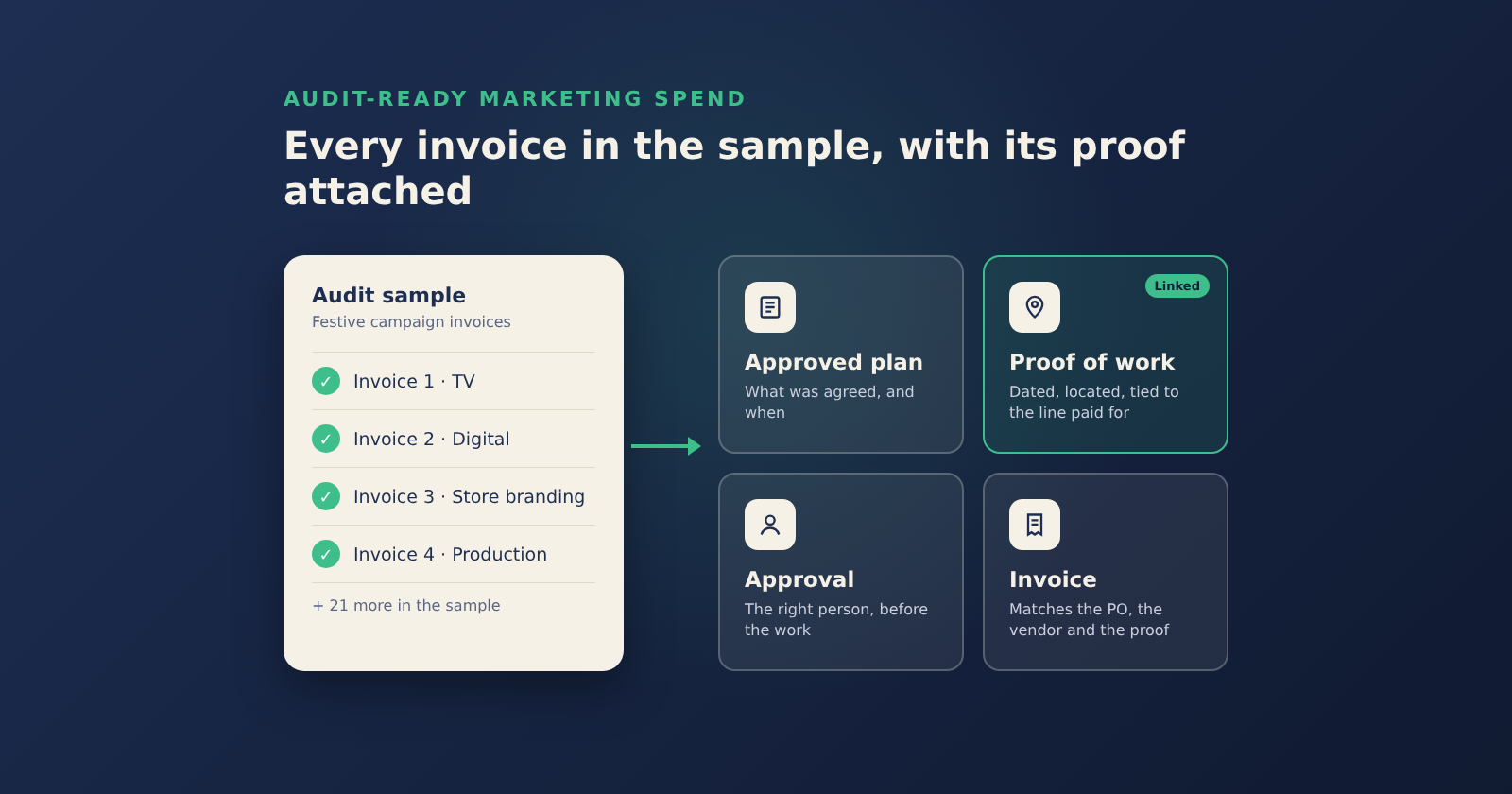
The email usually arrives on an ordinary weekday afternoon, a few weeks after the books have closed. The auditor has picked a sample of 25 marketing invoices, most of them from the festive campaign, and would like the supporting evidence for each one within two weeks. If you run marketing finance, you already know what the next two weeks look like. The invoice is in SAP, the approval is somewhere in an email thread, the photos of the store branding are sitting in a chat group, and the plan that justified the spend went through so many versions that nobody is quite sure which one was final.
None of this means the money was spent badly. Most of the time it means the evidence was never attached to the invoice it proves, so your team spends days rebuilding a story that was true all along. This guide walks through what auditors actually ask of a marketing invoice, the evidence that answers them for each kind of spend, and a simple routine that keeps the next audit sample from taking weeks.
Key takeaways
Auditors ask four things of any marketing invoice: did the work happen, in which period, who approved it, and were the vendor and tax details right.
The evidence usually exists; the delay comes from it sitting in four different places instead of with the invoice.
Each kind of spend, whether TV, digital, outdoor and on-ground, or production, has its own proof, and knowing it in advance is half the job.
The fix is to attach proof when the work is done, at the same moment work completion is confirmed for the month-end provision, not when the auditor asks.
This matters more for the festive quarter than for any other. It's the busiest stretch of the year for marketing invoices: TV, digital, outdoor and store campaigns all run at once, vendors bill in batches across several weeks, and a large share of the year's spend is approved, executed and invoiced in a short window. It isn't unusual for a large consumer company to handle a couple of thousand marketing invoices in a month like this. Those are the invoices raised fastest, across the most vendors and towns, and they are the ones most likely to land in the year-end sample.
To keep things concrete, we'll follow one illustrative company: a consumer brand that ran its festive campaign across TV, digital, outdoor and store branding in 120 towns, billed through October and November. Four of the 25 invoices the auditor picked will carry us through the rest of this guide.
What do auditors check in marketing expenses?
Auditors ask four questions of every marketing invoice: did the work happen, in which period did it happen, who approved it, and were the vendor and tax details right.
Whatever the invoice is for, the auditor's questions come down to these four:
Did the work happen? A raw-material invoice has a goods receipt behind it, but a campaign invoice only has a promise that something aired, ran or went up on a wall. So the auditor wants to see proof of the work itself.
In which period? The work has to belong to the financial year the expense is booked in. That's why a campaign that runs across year-end gets so much attention.
Who approved it? Someone with the right approval limit agreed to the spend, ideally before the work started rather than after the invoice arrived.
Were the vendor and tax details right? A genuine vendor, GST details that match, and the right tax deducted at source. For micro and small vendors, the payment date matters too, because payments owed to them beyond 45 days are allowed as a tax deduction only in the year they are actually paid.
Keep one more thing in mind as you answer them. The statutory auditor also reports on whether your internal financial controls are adequate and actually working. So the auditor is not only asking whether a document can be found today; they are asking whether the approval and the proof existed when the invoice was paid. That's a much harder thing to show with evidence gathered in a hurry.
Why does pulling marketing audit evidence take so long?
Because the proof usually exists but lives in four places, the ERP, email, chat groups and old spreadsheets, and none of them is linked to the invoice.
Think about where each piece of our festive campaign's evidence sits today. The purchase order and the invoice are in SAP. The approval for the plan, and for every change to it, is in email.
The photos and reports that show the work happened were sent by vendors to the marketing team on chat, or as PDFs attached to emails. And the plan itself lives in a spreadsheet that has been saved, renamed and forwarded many times since it was approved. Marketing owns the proof that its spend happened, and your team needs that proof to answer the auditor, so every sampled invoice turns into a request to marketing, which turns into a request to a regional team or a vendor.
By the time the auditor asks, some of the people who handled the work have moved on, and the evidence that was clear in October now takes a day per invoice to reconstruct. It's not that anyone's controls failed; the link between the proof and the payment was simply never made.
Here is what answers the auditor for each kind of spend in our sample:
What the auditor asks | TV | Digital | Outdoor and on-ground | Production and services |
|---|---|---|---|---|
Did the work happen? | The telecast report from the media partner, matched to the plan | The platform report for the campaign | A dated, located photo of each site, tied to the invoice line | The delivered work and a sign-off accepting it |
In which period? | Air dates on the telecast report | Report dates that match the invoice period | Photo dates and times | Delivery and sign-off dates |
Who approved it? | The approved plan and any approved revision | The approved plan or insertion order | The approved site list and the PO | The approved brief and estimate, dated before the work started |
Were the vendor and tax details right? | Invoice matches the PO; GST details, e-invoice number (IRN) and tax deducted at source are correct | Same checks, plus the billed quantity matches the platform report | Same checks, plus billed only for the sites with proof | Same checks, plus the payment date on record for small vendors |
What evidence does a TV or digital marketing invoice need?
The approved plan, a record of what actually aired or was delivered, and an invoice that matches both.
Invoice 1 in the sample is for the festive TV flight. The plan approved in September listed the channels and the number of spots, and the media partner's telecast report shows what actually went on air. In practice the two rarely match perfectly: a cricket match moves a slot, some spots are run again later to make up for ones that were missed, and the final invoice reflects all of that. The auditor doesn't expect plan and telecast to be identical; they expect the difference to be explained and the person who agreed to it to be visible. If that agreement lives in an email thread between the brand manager and the media partner, it's evidence, but it's evidence nobody in finance can find.
Invoice 2 is the digital campaign, and it's usually the hardest to support. The invoice shows a single total for impressions or clicks across several platforms, while the proof sits in platform dashboards that were never exported. The evidence you want is the platform report for exactly the dates on the invoice, saved at the time, with the approved plan or insertion order beside it. When the invoice period and the report period don't line up, the auditor has a timing question you can't answer from the invoice alone.
What evidence does an outdoor or on-ground activation invoice need?
Dated, located photos of each site, tied to the line on the invoice that pays for them.
Invoice 3 covers store branding across 120 towns. The vendor billed for every store on the approved site list, and the proof is a few hundred photos shared in chat groups by regional teams. Some photos have no date, some could be from last year's campaign, and almost none say which store, or which line of the invoice, they belong to. That's the gap the auditor will find, because a photo only proves something when it shows where and when it was taken and is attached to the line it pays for. The evidence that settles it is simple to describe: the approved site list, one dated and located photo per site, a note on any site that wasn't done, and the invoice paid only for the sites that were. Collecting that proof in the field is the regional marketing head's job, and we've written a separate guide for them on how to check that on-ground activations actually happened before they're paid.
What evidence does a production or services invoice need?
The brief, the approved estimate, the delivered work, and a sign-off that says it was accepted.
Invoice 4 is for the production of the festive film. The evidence is straightforward on paper, the brief, the estimate, the final film and someone's acceptance of it, but the dates are where audits get stuck. Production often starts on a verbal go-ahead because the festive deadline won't wait, and the PO is raised weeks later, sometimes after the invoice. When the auditor sees an invoice dated before its purchase order, they're right to ask who approved the work and when. Many finance teams already hold invoices that arrive without a PO and check invoice dates against PO dates for exactly this reason. The same applies to changes along the way: an extra edit or a second version adds cost, and the approval for that extra cost should be on file before the work, not reconstructed after the invoice.
Which gaps cause the most trouble in a marketing audit?
Three gaps cause most of the trouble: proof that isn't linked to the invoice, approvals that exist only in email, and work that started before the purchase order.
Each one creates a different problem. Proof that isn't linked to the invoice costs time, because someone has to match photos and reports to invoice lines by hand, and it costs confidence, because a match made months later looks like what it is. Approvals that live only in email are hard to find and harder to show as a control that was working at the time, which is exactly what the auditor's report on internal financial controls is about. And work that started before the PO makes the approval look like an afterthought, even when the brand head genuinely agreed to it on day one. The same gaps matter beyond the statutory audit: if a tax officer later questions a marketing expense, an internal voucher on its own is weak support, while a PO, a matching invoice and proof of the work are much harder to argue with.
How do you keep marketing spend audit-ready all year?
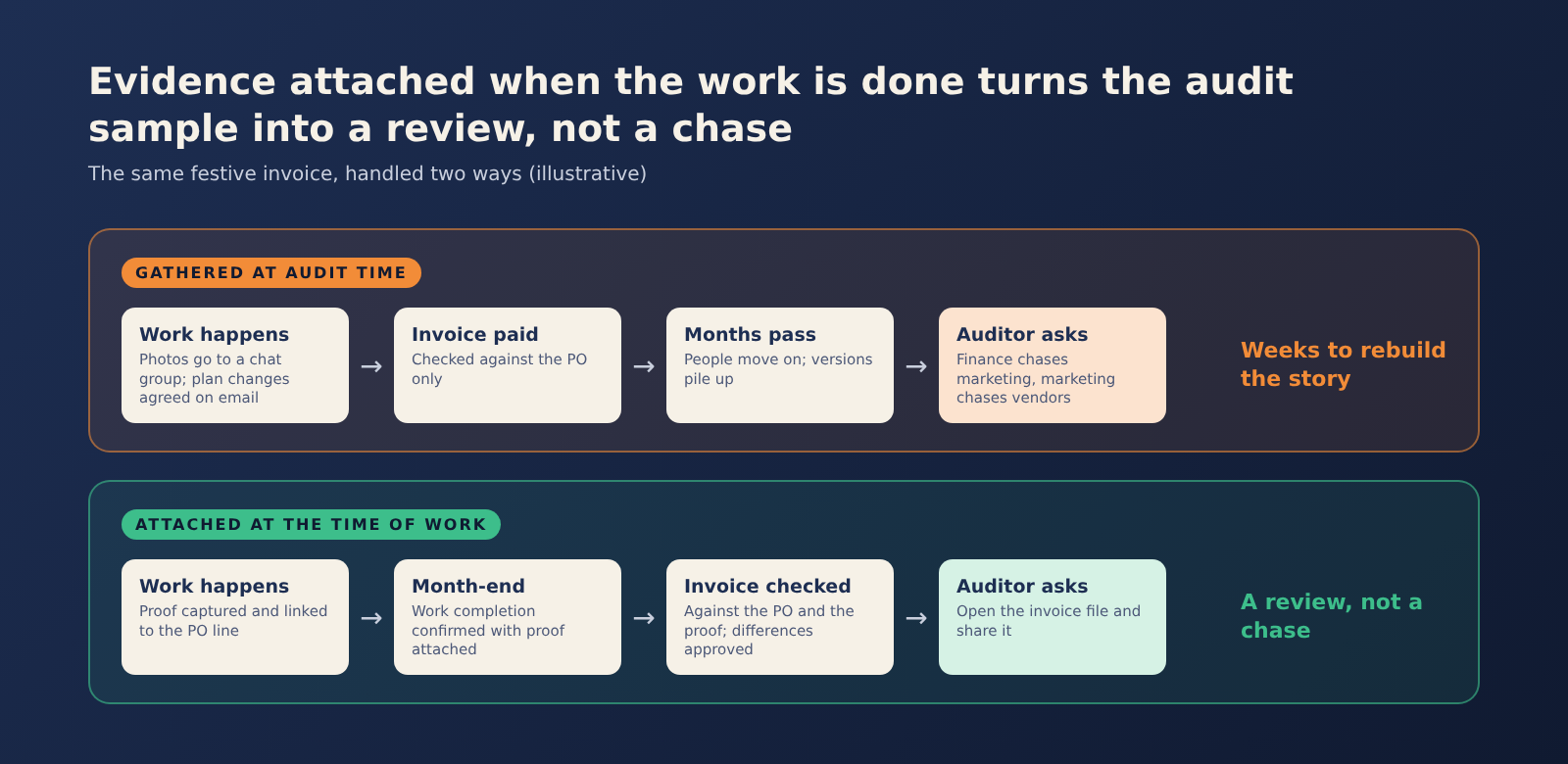
Attach the evidence when the work is done, at the same moment work completion is confirmed for the month-end provision, so every invoice arrives to proof that's already waiting for it.
You already have a moment every month when marketing tells finance what work was done: the month-end provision for work done but not yet billed. We've written about building an accurate month-end marketing provision before, and that same confirmation is the natural place to collect the proof. The routine is short.
First, agree with marketing which proof each kind of spend needs, using the table above, and make it part of the purchase order so vendors know it in advance.
Second, when marketing confirms work completion at month-end, the proof is attached to the same PO line, not sent separately.
Third, when the invoice arrives, it's checked against the PO and the proof before payment, and any difference gets a written approval right then, while everyone still remembers why.
Done this way, any invoice the auditor picks can be opened and shared as one file, and the audit sample becomes a review rather than a chase.
This is also what your CFO needs between audits, and it's the thread behind our guide on marketing spend visibility for CFOs: spend that can be explained invoice by invoice is spend nobody has to defend in a hurry.
Where Brandintellé fits
Everything above can be run with spreadsheets and shared folders, and plenty of teams start that way. The hard part is running it across thousands of invoices, hundreds of vendors and many towns, every month, which is where Brandintellé, a marketing spend governance tool, comes in.
In Brandintellé, the proof of work sits on the line item it pays for, so when you open an invoice, the plan, the approval and the evidence are already there. Field photos are taken inside the app, geo-fenced to the site and timestamped, from the camera only, with no gallery uploads and no editing. Approvals, and the notes that explain them, are recorded in the system instead of an email. Every invoice is checked automatically against the PO, the e-invoice number, the digital signature and the vendor's GST details before it reaches your team. Work completion confirmed against the PO feeds your month-end provision, and auditors can be given their own view-only login, so they can look at the evidence themselves.
There are honest limits. The evidence is only as good as the capture: where there's no one on the ground to take the photos, that proof has to come another way. And for TV, Brandintellé works from the telecast reports vendors submit; it doesn't read broadcast logs itself.
Frequently asked questions
What do statutory auditors check in marketing expenses in India?
Statutory auditors check that each sampled marketing expense really happened, belongs to the financial year it's booked in, was approved by someone with the authority to approve it, and was paid to a genuine vendor with correct GST details and the right tax deducted at source. Because they also report on whether internal financial controls are working, they look at whether the approval and the proof existed when the invoice was paid, not only whether documents can be found later.
What financial controls should exist over marketing spend?
At a minimum: a purchase order raised before the work starts, approval limits that say who can sign off how much, proof of work attached to the line item being paid, a check of every invoice against the PO and that proof before payment, and a written approval for any difference. Marketing confirms that the work happened, and finance pays against that confirmation and closes the books on it, which gives auditors a trail they can follow invoice by invoice.
How can finance improve the audit trail for marketing spending?
Keep the evidence with the invoice instead of in separate systems. Agree with marketing which proof each kind of spend needs, collect it when work completion is confirmed at month-end, and check each invoice against the PO and that proof before paying it. Record approvals, and the reason for any difference, where the invoice lives rather than in email. Then any invoice an auditor picks can be opened and shared as one complete file.
What evidence supports a marketing expense if the tax officer questions it?
Evidence that shows the expense was real and incurred for the business: the purchase order, the vendor's invoice with correct GST details, proof that the work was delivered, such as photos, reports or the finished material, the approval, and the payment record. An internal voucher on its own is weak support. For micro and small vendors, keep the payment dates too, because payments made after the 45-day limit are allowed as a deduction only in the year they're actually paid.
Auditors don't ask whether you spent it. They ask how you know it happened. Audit-ready isn't a season; it's what happens when the proof travels with the invoice.
See how invoices are checked against the PO and the proof of work in Brandintellé's invoice reconciliation.
This article is general information, not tax or legal advice.