
End-to-end marketing spend management means every rupee, dollar or euro can be followed from the priority it was meant to serve to the result it produced: priority, budget line, plan, approval, purchase order, proof of delivery, invoice and outcome, all linked. The link that holds it together is the budget line. If every later record carries it, you can answer "what did we get for this priority?" without a month of reconciliation.
Most large companies have every piece of this. The strategy is in a deck, priorities in a planning workshop, the budget in a spreadsheet, plans in email, purchase orders and invoices in the ERP, proof in a chat group, and results in a dozen dashboards. Each piece is fine on its own. The problem is that nothing connects them, so every question that crosses two pieces becomes a project.
This guide follows one budget line through all eight stages, shows where the link usually breaks and the rules that prevent it, and gives you a ten-invoice trace test and a scorecard to check your own chain this week.
How do you connect marketing strategy to spend and results?
By giving every record a parent. A plan belongs to a budget line, a PO to a plan, proof to a PO line, an invoice to a PO, and a result back to the budget line.
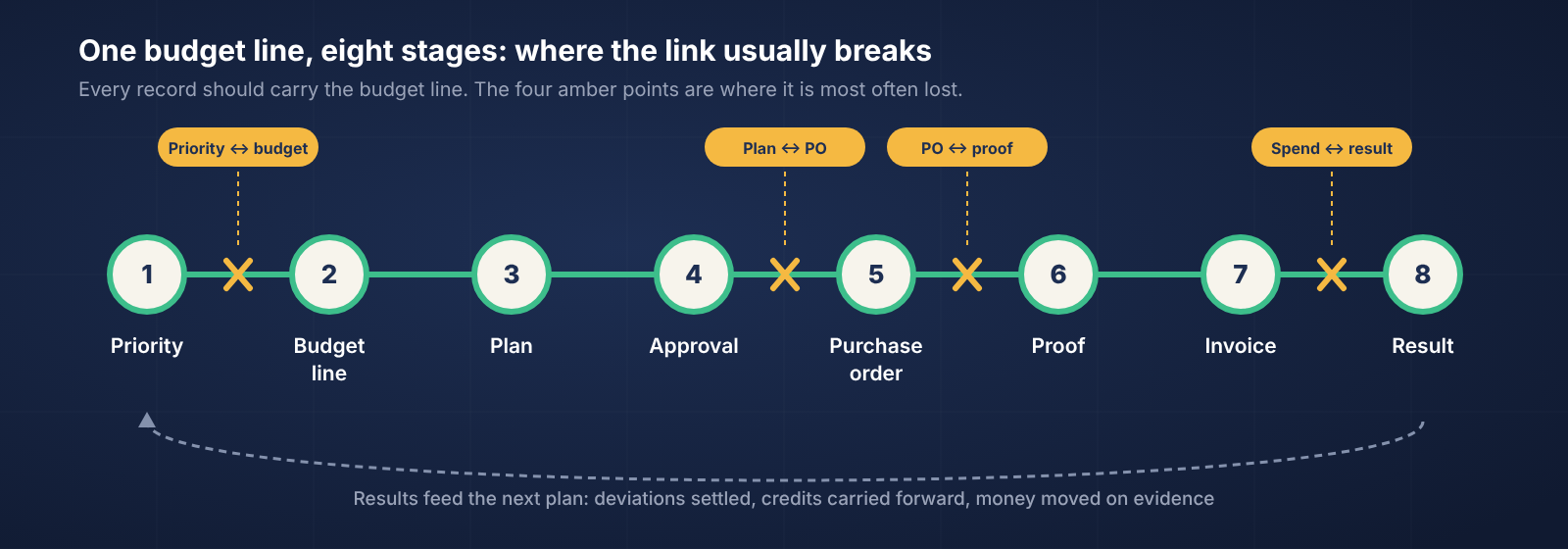
Here's one line, followed from start to finish. The example is illustrative.
Stage | What exists | What it links back to |
|---|---|---|
1. Priority | "Grow the new variant in the South" | The annual plan |
2. Budget line | New variant, South, digital and outdoor, Q2 | The priority |
3. Plan | A launch plan with an estimate from each vendor | The budget line, checked for available money |
4. Approval | The plan approved within the right limit | The plan version that was approved |
5. Purchase order | One PO per vendor | The approved plan line |
6. Execution and proof | Platform delivery data; photos of outdoor sites on location | The PO line it proves |
7. Invoice and payment | Each vendor's invoice, matched and paid | The PO and the proof |
8. Result | Delivery against plan; sales in the South for the variant | The budget line, and through it the priority |
If any row loses its link to the row above, the question "what did the South launch actually cost, and what did it deliver?" goes back to being a spreadsheet exercise.
Where does the link between marketing plans and spend break, and how do you prevent it?
In four places. Each one has a symptom you'll recognise and a rule that prevents it, and you can adopt every rule before you change any software.
Where it breaks | Symptom | Rule that prevents it |
|---|---|---|
Priority → budget line | Nobody can say how much is being spent on a stated priority | Build the budget on the dimensions leadership plans in (brand, region, channel), and give every priority at least one budget line of its own |
Plan → PO | POs nobody can match to a plan; work that started without a PO | No PO without an approved plan line, and every PO quotes that line's ID |
PO → proof | Invoices approved against the vendor's own report | No invoice is checked until the proof is attached to the PO line it proves |
Spend → result | A results dashboard that can't be filtered by budget line | Vendors and platforms report delivery against your plan lines, not in their own structure |
The rules only work if every record carries the same few keys. These are the minimum.
Record | Must carry |
|---|---|
Budget line | Line ID, owner, and the priority it serves |
Plan or estimate | Budget line ID and version number |
Approval | Plan ID, version approved, approver, limit |
Purchase order | Budget line ID and plan ID |
Proof | PO number and PO line |
Invoice | PO number, and the proof it relies on |
Result | Budget line ID, so it can roll up to the priority |
How can you check whether your marketing spend is connected end to end?
Run the ten-invoice trace test, then score the seven links. It takes an afternoon and shows exactly where your chain breaks.
The ten-invoice trace test
Pick ten paid marketing invoices from last quarter, from different vendors and media.
For each, try to find the PO, the approved plan behind the PO, the approval, the proof of delivery, and the budget line it was charged to.
Time how long each one takes, and note where you had to ask someone or search an inbox.
Mark the first link where each trace broke.
The links that break most often in your test are where to start.
The traceability scorecard
Score each link: 2 if it's linked in a system with no manual step, 1 if it can be found but needs a spreadsheet, an email or a person, 0 if it usually can't be found.
Link | Test question | Score (0, 1, 2) |
|---|---|---|
Priority → budget line | Can you show the total budget behind each stated priority today? | |
Budget line → plan | Is every approved plan attached to the budget line that funds it? | |
Plan → approval | Can you see which version of each plan was approved, by whom, within what limit? | |
Approval → PO | Does every PO quote the plan line it was raised from? | |
PO → proof | Is proof of delivery attached to the PO line before the invoice is checked? | |
Proof → invoice | Is each invoice checked against both the PO and the proof? | |
Spend → result | Can results be filtered by the same budget lines as spend? |
12 to 14: your chain is connected; focus on closing the loop below. 7 to 11: the chain holds in places; fix the lowest-scoring link first. 0 to 6: the chain is mostly rebuilt by hand; start with the budget structure and the PO rule, because every other link depends on them.
How do you close the loop from results back to the next plan?
Review delivery against plan line by line, settle the differences, and move money based on what the evidence shows.
Compare plan and delivery automatically at the end of each campaign, by medium, so the review starts from the differences, not from rebuilding the numbers.
Settle every difference. Each deviation gets an explanation and a remedy, such as a credit note or a make-good, recorded against the line.
Carry credits forward into the next campaign, so underdelivery becomes money back, not a write-off.
Use the evidence in the next reallocation. Money moves towards the lines that delivered, through the normal approval rules, so the decision and its reason are recorded.
Our guide to reallocating marketing budget mid-quarter covers how to get those moves approved.
How does Brandintellé connect marketing plans, spend and results?
Brandintellé is the system of record for marketing spend, so every stage lives in one place and carries the budget line with it.
Priorities to budget: the budget is built on your own dimensions (brand, region, channel, activity and any custom dimension), so it matches how leadership sets priorities.
Budget to plan: briefs carry their cost detail and are checked against available budget before they move. Internal and external KPIs are held separately.
Plan to PO: the purchase order is raised against the accepted estimate, and requisitions and POs move to and from SAP.
PO to proof: platform data from Google, Meta, DV360 and LinkedIn is connected live; TV is reconciled four ways; on-ground proof is captured on location and attached to the line it proves.
Proof to invoice: invoices are checked against the PO and proof, and the spend flows back to its budget line.
Result to next plan: post-campaign evaluation runs automatically, deviations are explained and settled in the system, credit notes are carried forward, and dashboards show spend by media, brand and geography, alongside sales where your sales data is connected. AI Insights recommends where to move budget; your team decides.
Strategy doesn't fail in the deck. It fails in the gap between the deck and the purchase order. Close the gaps, and the strategy becomes something you can follow in the numbers.