

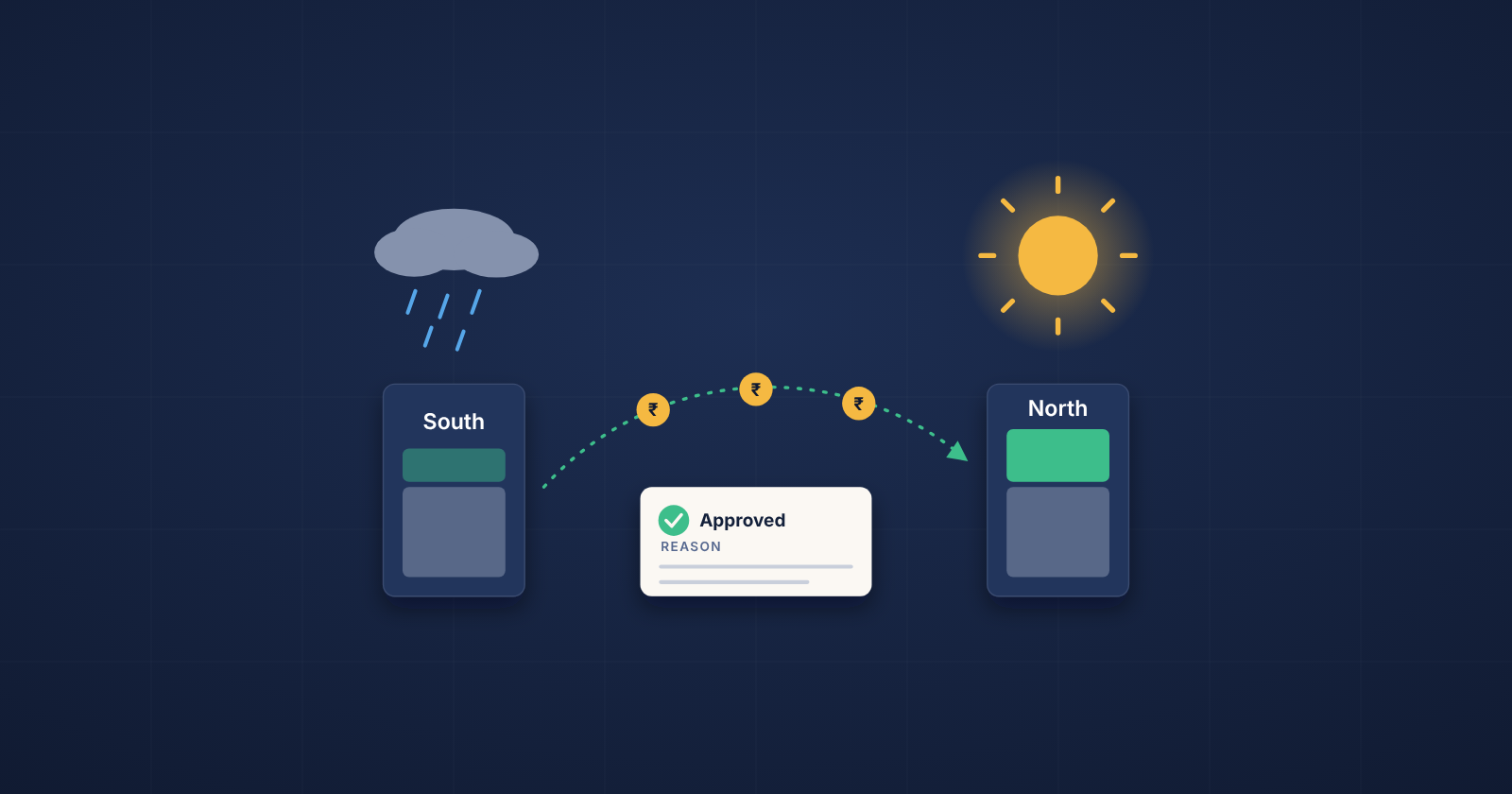
If you run marketing for a brand or a region, you already know that the plan you signed off at the start of the year is, at best, a very good guess. It was built on last year's numbers and weeks of careful work, but the moment the quarter begins, the market starts to argue with it. A campaign does better than anyone expected, a launch gets pushed back by a month, or a competitor goes quiet in one region and suddenly very loud in another, and you can see quite clearly that some of your money is sitting in the wrong place.
The obvious thing to do is to move it. And yet, if you have ever tried to do that in the middle of a quarter, you will know it is rarely as simple as it sounds. This article is about that moment: why moving budget mid-quarter takes so long, and what you can do so that finance can say yes quickly, and nobody has to come back to you with questions about it at month-end.
Key Takeaways
Mid-quarter moves stall because finance only sees the changed number. The reason sits in emails or in someone’s head.
Ask only for money that’s genuinely free: the uncommitted balance on the line, not what the ledger shows as remaining.
Send a decision, not a request: the amount, both lines, the reason, the timing, whether the total changes, and when you’ll report back.
Keep part of the budget at brand or category level, and move large amounts in steps rather than all at once.
Record the reason against both lines when the money moves, so the month-end variance explains itself.
The reason gap
Most of the friction comes down to one thing, which we call the reason gap. Put simply, you know why the money needs to move, but finance only ever sees the number change. The reason lives in your head, in a meeting or in an email, and it rarely travels with the money.
You have probably seen it play out in one of these ways:
Something changes in the market and you know exactly where the money should go, but by the time the approval comes through, the chance has already passed.
The budget file has been edited so many times this quarter that nobody is quite sure which version is the latest one.
At month-end, finance asks why one budget line has gone over, and the explanation is buried in an email from weeks ago that nobody can find.
None of this is anyone's fault. In many large Indian companies, the marketing budget is approved once a year but managed quarter by quarter, so a change in the middle of a quarter means reopening a number that everyone had agreed was final. Each approval step makes sense on its own, but together they take time. And because the reason sits in one place, the number in another and the purchase order somewhere else, finance ends up looking at a variance without the decision behind it, which makes your next request harder rather than easier.
The pressure to move money is not going away either. In Gartner's 2025 CMO Spend Survey of large companies in North America and Europe, 59% of CMOs said their budget was not enough to deliver their strategy. When money is that tight, getting it to where it is working, and getting it there quickly, becomes part of the job.
How to move budget once the quarter is running
So how do you close that gap? In our experience, it comes down to three things: knowing which money is actually free to move, sending finance a decision rather than a request, and making sure the reason stays with the money long after the approval has come through.
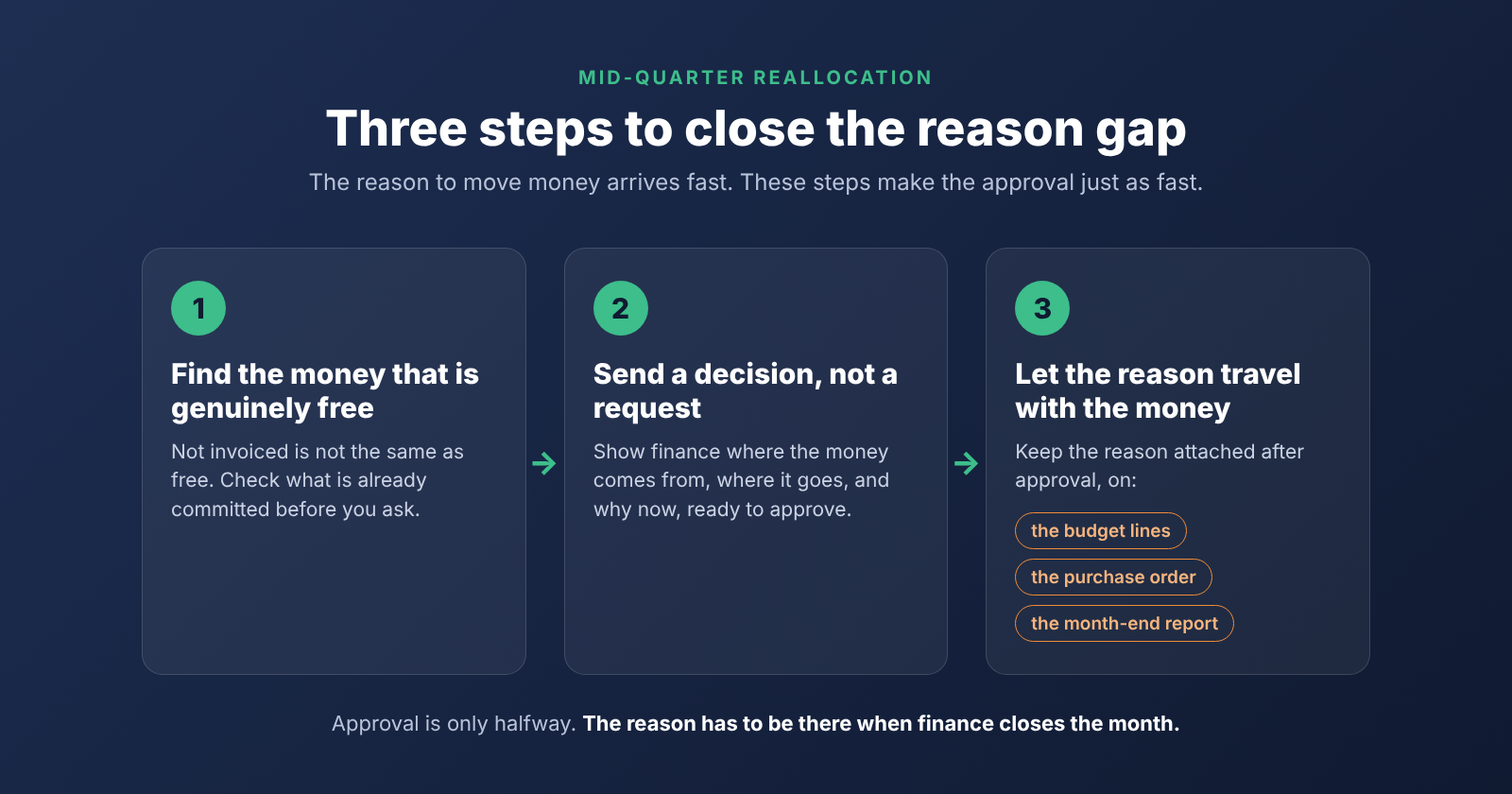
1. Only ask for money that is genuinely free
It is easy to look at a budget line, see that most of it has not been invoiced yet, and assume it is available. But some of that money has already been promised, whether that is a plan you approved last week, an activation that is already running or a purchase order that is open with a vendor. If you ask to move money that is already committed, the request will come back to you, and honestly, it should.
So before you ask, check the uncommitted balance on the line you want to take money from, and work out what it will be after the move. It is the first number finance will look for, and having it ready tells them you have done the homework. We have written about how to find that number in our guide to committed vs actual marketing spend.
2. Send a decision, not a request
There is a big difference between asking finance for something and showing them a decision that has already been thought through. A request leaves finance to work out the details. A decision answers their questions before they ask them: how much is moving and from which line to which, why, what the money will buy and when it will be billed, whether the total budget changes, what happens if the answer is no, and when you will come back to report on how it went.
Here is how that might look right now, in the middle of the festive season. Say your Diwali campaign in the west is doing far better than planned, and you want another ₹1 crore behind it for the next three weeks. At the same time, a digital line planned for after the festive period still has most of its money unspent and uncommitted.
A request would say, "We need ₹1 crore more for the west." A decision would say, "We would like to move ₹1 crore from the post-festive digital line to the western Diwali campaign. The digital line will still have ₹40 lakh free afterwards, nothing already booked is affected, the quarter's total stays the same, and we will report back on results at the December review." The second version is far easier to approve, because finance can see at a glance exactly what changes and what does not.
That last point, the total staying the same, matters more than anything else. Moving money between your own lines is the easiest thing for finance to approve, and giving money back is easy too. Asking for new money is always the hardest conversation, so if you can find the money within your own budget first, start there.
Two habits make all of this easier-
The first is to keep part of each quarter's budget at the brand or category level, instead of dividing all of it between regions and channels on day one, because moving money out of that shared pool usually needs fewer approvals than moving it between two people's lines.
The second is to move large amounts in steps rather than all at once. McKinsey made the same point back in 2015, and it still holds, because a smaller first move with a check-in is easier to approve and easier to undo if it does not work.
3. Let the reason travel with the money
Getting the approval feels like the finish line, but it is really only halfway. If the reason stays in an email, the month-end report will bring the same question straight back to you.
It helps to think about it in three stages:
Before the quarter starts. Do you know which kinds of change need which approvals? Have you agreed with finance on a quicker route for small moves within your own total? And have you decided how much budget to keep at brand or category level?
While the quarter is running. Is each move recorded on both budget lines, and not just in an email thread? Do the purchase orders raised from the moved money carry the same reference, so anyone can trace them back?
At month-end. Can you show what moved, why it moved and what it achieved? Would your CFO understand the variance without having to pick up the phone and ask you?
If you can answer yes to that last question, you are defending your spend before anyone has asked you to. Our guide on how CFOs get real visibility into marketing spend shows what finance looks for in that monthly report.
How Brandintellé can help you
We built budgeting in Brandintellé around exactly this problem, so that the request, the number and the approval all sit on the same budget line instead of in three different places. When you raise a move, it goes from one line to another with the reason attached, and the free balance is checked as you ask, so you never end up requesting money that is already committed. Approvals follow the limits your company has already set, approvers can act from their phones, and everyone can see whether a request is pending, approved, rejected with a reason or on hold. Once it is approved, the move stays on record for month-end. It makes the route faster, but the judgement about whether the money should move is still entirely yours.
Frequently asked questions
How to reallocate marketing budget mid-quarter without losing control?
Move only uncommitted money, and keep the total unchanged wherever you can. Send the move to finance as a decision: the lines it moves between, the amount, the reason with evidence, the new timing of spend and a date to report back. Route it through your company's approval limits, and record the reason on the budget lines so the month-end variance explains itself.
Why do marketing plans change mid-quarter, and how should finance track it?
Plans change because markets move faster than a quarterly plan can. Demand shifts, launches slip, competitors act, and festive or seasonal demand rarely lands exactly where it was forecast. Finance can track these changes when each one is recorded as a move between budget lines, with its reason and approval, rather than as an edit to a spreadsheet.
How should marketing and finance work together on the marketing budget?
Agree the rules before the quarter starts: which changes need which approval, how much budget stays at brand or category level, and when the quarterly review happens. During the quarter, marketing brings decisions backed by numbers, and finance checks where the money comes from and what it does to cash. Both should work from the same view of committed and actual spend.
What should a marketing budget reallocation request include?
Seven things: how much moves and between which lines; the reason, with evidence; the free balance on the source line before and after; what the money will buy and when it will be billed; whether the total changes; what happens if the request is refused; and when you will report back on the result.
The market will keep moving in the middle of the quarter, and your budget can move with it, as long as the reason moves too.
See how Brandintellé moves budget between lines with the reason attached.