

To check that a TV campaign ran as planned, match four documents spot by spot: the approved plan, the release order sent to each channel, the record of what actually aired, and the channel's invoice. Pay for spots that aired as booked, ask for a make-good or credit for those that didn't, and check ratings separately if you bought on GRPs.
If you run media for a large advertiser, you know how a TV campaign usually closes. The flight ends, the post-campaign report arrives as a PDF a few weeks later, the channel invoices follow, and someone is asked to approve them. The report says the campaign delivered. The invoice matches the release order. And nobody has checked, spot by spot, whether what aired was what you bought.
That check is not complicated, but it has to be done the same way every time, and it has to happen before payment, not at year-end. This guide walks through it with one worked example.
What should you check before paying a TV invoice?
Four documents, compared at spot level: the plan, the release order, the aired-spot record and the invoice.
The plan is what was approved: channels, programmes or time bands, spot durations, number of spots, and the cost.
The release order is what was booked with each channel. It should match the plan; when it doesn't, the difference was a buying decision and should have its own approval.
The aired-spot record says what actually went on air: channel, date, time, programme, duration and creative for every spot.
The invoice is what the channel or media partner wants to be paid for.
Many teams compare only the release order and the invoice. That confirms the bill matches the booking, but not that the booking was delivered.
What is a telecast certificate, and is it enough?
A telecast certificate is the channel's own list of the spots it aired. It's necessary, but it comes from the party asking to be paid, so check it against independent data where you can.
The telecast certificate, often called the TC, usually comes with the invoice and lists each aired spot with its date, time and programme. It's the starting point for the check. But for large campaigns, compare it with independent ad-monitoring data, which records what actually appeared on air, and with ratings data from BARC if you bought on audience delivery. When the two sources disagree about a spot, that spot is the one to query.
How do you match the plan with what aired, spot by spot?
Line up every planned spot against the aired record, sort each one into an outcome, and decide what to pay by outcome rather than by total.
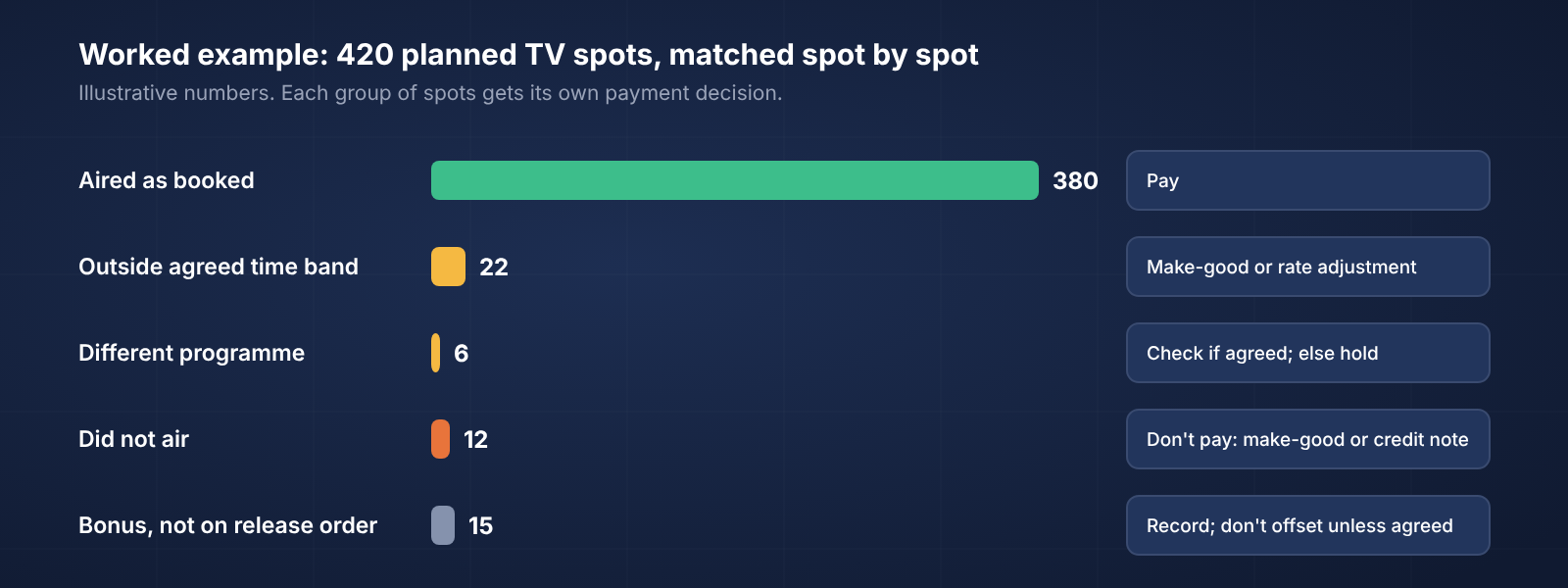
Here's a worked example. The numbers are illustrative. A four-week campaign was booked on three channels for 420 spots of 20 seconds each. After matching the plan, the release orders and the aired-spot records, the spots fall into five groups:
What the match shows | Spots | What to do |
|---|---|---|
Aired as booked: right channel, time band, duration and creative | 380 | Pay |
Aired, but outside the agreed time band | 22 | Ask for a make-good or a rate adjustment; pay only once agreed |
Aired in a different programme from the one booked | 6 | Check whether the swap was agreed; if not, treat as outside the booking |
Did not air | 12 | Don't pay; ask for a make-good in the next flight or a credit note |
Aired as bonus, not on the release order | 15 | Record them, but don't let them offset spots that didn't air unless that was agreed in writing |
The invoice in this example bills for 420 spots. The check says 380 can be paid now, 28 need a decision and 12 shouldn't be paid at all. A single total on the invoice hides all of that; the spot-level match makes it visible before anyone signs off the payment.
What do you do with spots that didn't run as planned?
Pay for what aired as booked, hold the rest, and settle each exception with a make-good, a rate adjustment or a credit note.
The common remedies are:
Make-good: the channel airs a replacement spot of equal value, usually in the next flight. Agree the time band and date before accepting it.
Rate adjustment: for spots that aired but in a weaker slot, a lower rate instead of a replacement.
Credit note: for spots that didn't air and can't be made good in time.
Part-payment: pay the invoice for the spots that are proven, and hold the rest by spot ID until the exception is closed.
Record which remedy was used for each spot and who agreed it. When the auditor samples this invoice next year, that record is the answer.
How do you check GRPs and prime-time share if you bought on ratings?
Compare delivered ratings with what the buy promised, using BARC data for the same channels, markets and audience, and check the share of spots in prime time separately.
If the campaign was bought on audience delivery rather than on a fixed spot list, the spot count matters less than the ratings. Check delivered GRPs against the guarantee for the agreed target audience and markets, the share of spots that fell in prime time against what was promised, and spot position in the break if that was part of the deal. A campaign can air every spot and still fall short on ratings; the reverse is also possible. Agree in the release order which measure governs payment.
How do you make the TV check routine?
Write the rules into the release order, give every spot an ID, and run the check within days of the flight ending.
Agree the terms upfront: time bands, programmes, durations, position in break if bought, make-good rules and which ratings measure applies.
Use a spot ID: every booked spot gets an ID that appears on the release order, the aired record and the invoice. Without it, matching is done by hand.
Fix the data format: ask channels and media partners for aired-spot records in a set format, not as a PDF.
Check before month-end: spots that aired are a cost for that month, so the check also feeds the month-end marketing provision.
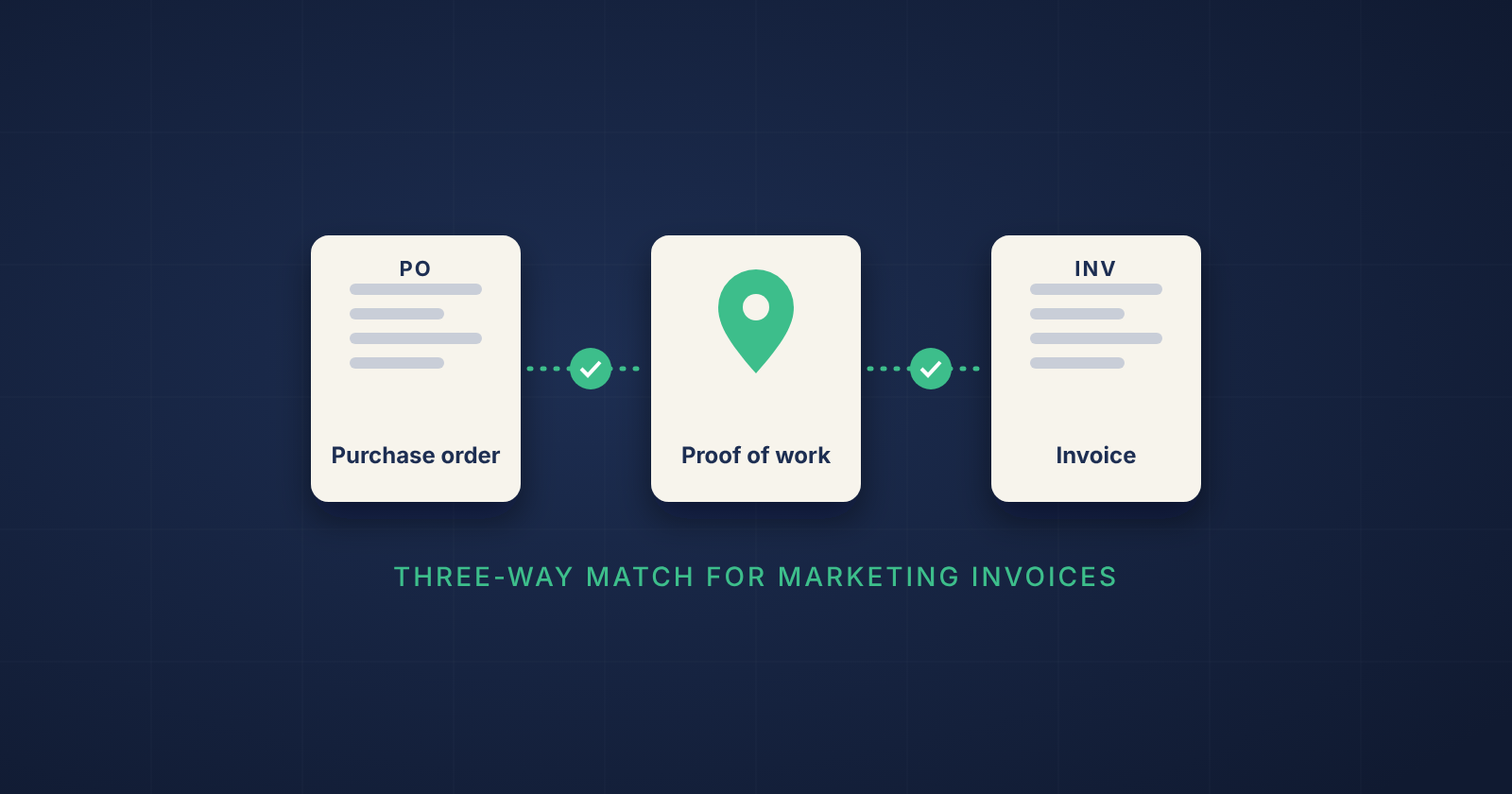
The same logic applies to every kind of marketing spend: the plan, the proof and the invoice should agree before payment. Our guide to three-way matching for marketing invoices covers the general rule.
How does Brandintellé check TV campaigns?
In Brandintellé, a TV campaign is matched four ways: the approved estimate, the schedule, BARC data and the channel invoice. Exceptions are flagged by spot, and the invoice can be part-paid for the spots that are proven while the rest are held.
The invoice tells you what was booked. The aired-spot record tells you what you got. Pay for the second.
See how Brandintellé matches TV plans, aired spots and invoices.