

At every month-end, you have to book the cost of marketing work that is done but not yet billed. This guide shows how to build that number from what was actually delivered, so the books close on time and the number is right the first time.
Key takeaways
A month-end marketing provision is the cost of marketing work already done this month that hasn't been billed yet. It looks back at what happened, not ahead at what is planned.
Booking the PO value, or booking only the invoices, both give the wrong number and make marketing spend swing from month to month.
Count each medium by what was actually delivered, and accept only proof created at the time.
Check every provision against the bill when it arrives. That is also exactly what auditors do.
The last day of the month, and the one number you don't have
As a finance controller or marketing finance lead, you've lived this day. The books close in two working days. Most costs are in. The one number still missing is marketing: what did this month's work actually cost?
You have the POs and a few invoices. Neither tells you what was delivered. The PO says what was agreed. The invoice says what was billed, often 30 to 90 days after the work. What was actually done this month sits with brand managers, media teams, regional teams and vendors, spread across channel confirmations, ad platforms, photos from the field and people's memory.
What a month-end marketing provision is
A month-end marketing provision is the value of marketing work delivered in the month that hasn't been billed yet. It isn't the PO and it isn't the plan. In one line: provision = work done to date − work already billed.
Take a festive campaign at month-end. The POs add up to ₹4 crore. TV has been on air for part of the month, digital runs on accounts that bill a month later, 40 of 120 planned towns have had their activations, and the brand film is delivered while the cutdowns are still in edit. One invoice has arrived: ₹30 lakh for the first production milestone. The work actually done is worth ₹1.67 crore. Take away the ₹30 lakh already billed, and the provision is ₹1.37 crore.
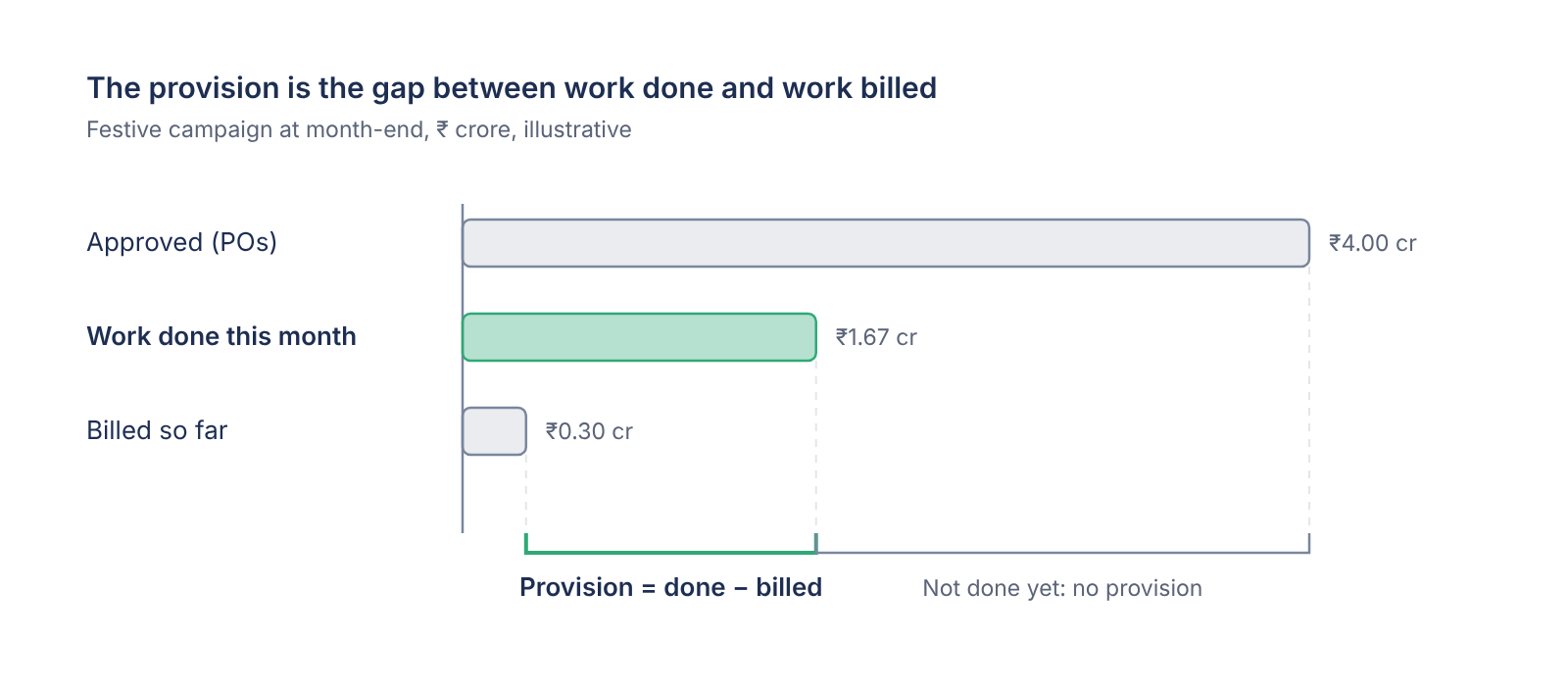
Work that is approved but hasn't started needs no provision, however large the PO. Work that is half done needs a provision for that half only.
Why the two easy shortcuts give the wrong number
There are two shortcuts teams often take, and both give the wrong number.
The first is to book the full PO value. The month then shows ₹4 crore of marketing cost: the ₹30 lakh invoice plus a ₹3.70 crore provision. The work actually done is worth ₹1.67 crore, so the month is overstated by ₹2.33 crore. Next month then looks unusually low, because most of the cost has already been booked.
The second is to book only the invoices that have arrived. The month then shows just ₹30 lakh, which is ₹1.37 crore less than the work done. The rest of the cost turns up in the following months, when the bills come in.
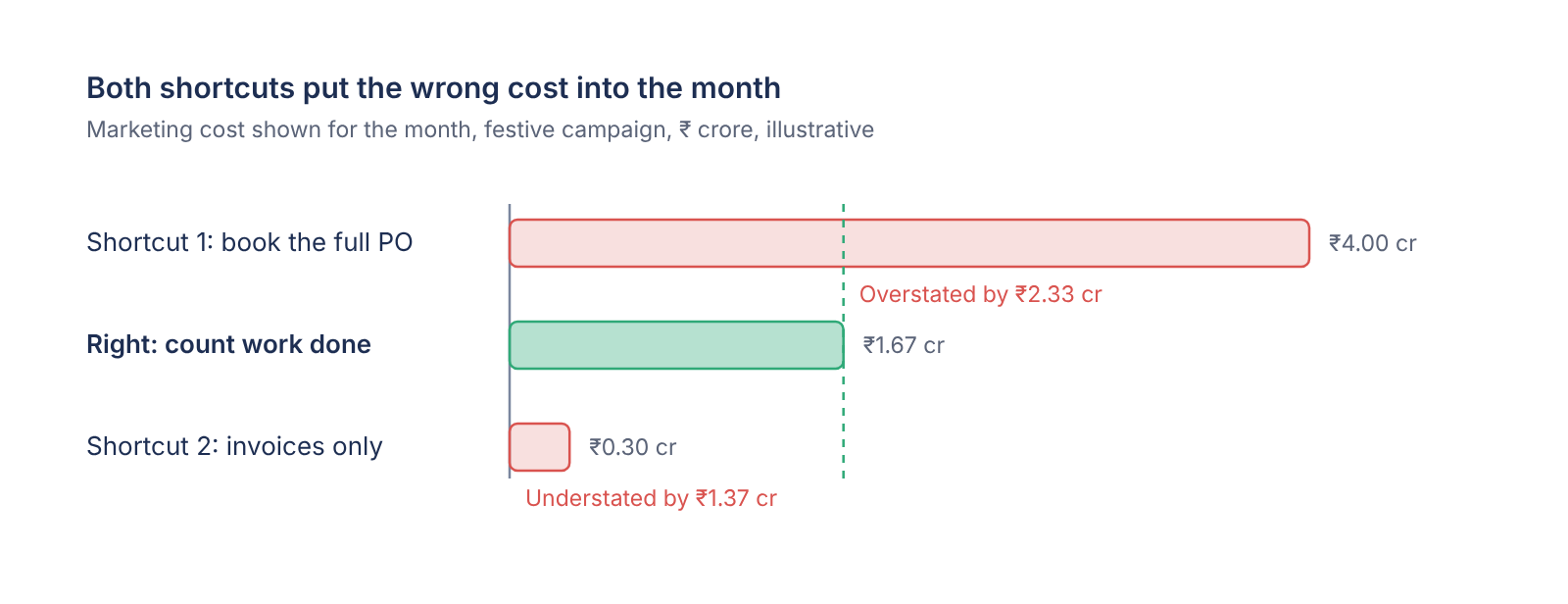
Either way, your CFO sees marketing spend jump up and down from month to month, for reasons that have nothing to do with what marketing actually did. It is the same visibility problem we covered in how CFOs get real visibility into marketing spend.
Count each medium by what was actually delivered
The right way is to count each kind of spend by its own unit of delivery, and to accept only proof created at the time. Spreading the PO evenly across the months rarely works, because marketing work isn't delivered evenly.
Spend type | What you count | Proof that backs it | Festive example |
|---|---|---|---|
TV and radio | Spots aired × agreed rate | Telecast confirmations or spot logs | ₹0.60 CR aired, of a ₹1.50 CR PO |
Digital (billed later) | Spend to date on the last day | Platform spend report exported that day | ₹0.35 CR spent, of ₹1.00 CR |
On-ground activations | Activations done × cost each | Photos, attendance, regional sign-off | 40 of 120 towns × ₹75,000 = ₹0.30 CR |
Production | Share of the job completed | Signed milestones | 70% signed = ₹0.42 CR, of which ₹0.30 CR billed |
Insertions published | Tear sheets | Not in this campaign | |
Outdoor | Sites live × days live | Dated, geo-tagged site photos | Not in this campaign |
Influencers and creators | Posts live | Links and dated screenshots | Not in this campaign |
Dealer and retailer schemes | Activity already run, claimed or not | Claims and activity counts | Not in this campaign |
Retainers and fixed fees | Months of service elapsed | Contract and service confirmation | Not in this campaign |
Festive campaign total | Done ₹1.67 CR − billed ₹0.30 CR = provision ₹1.37 CR |
Figures are illustrative.
Work that is done but not billed doesn't disappear at the end of the month. It stays open, month after month, until the bill arrives. When it does, the open amount closes against the bill, so nothing is counted twice.
Set the dates, and hold one rule
You can't build this number alone. The people who did the work have to confirm it, and that only happens with fixed dates and named owners.
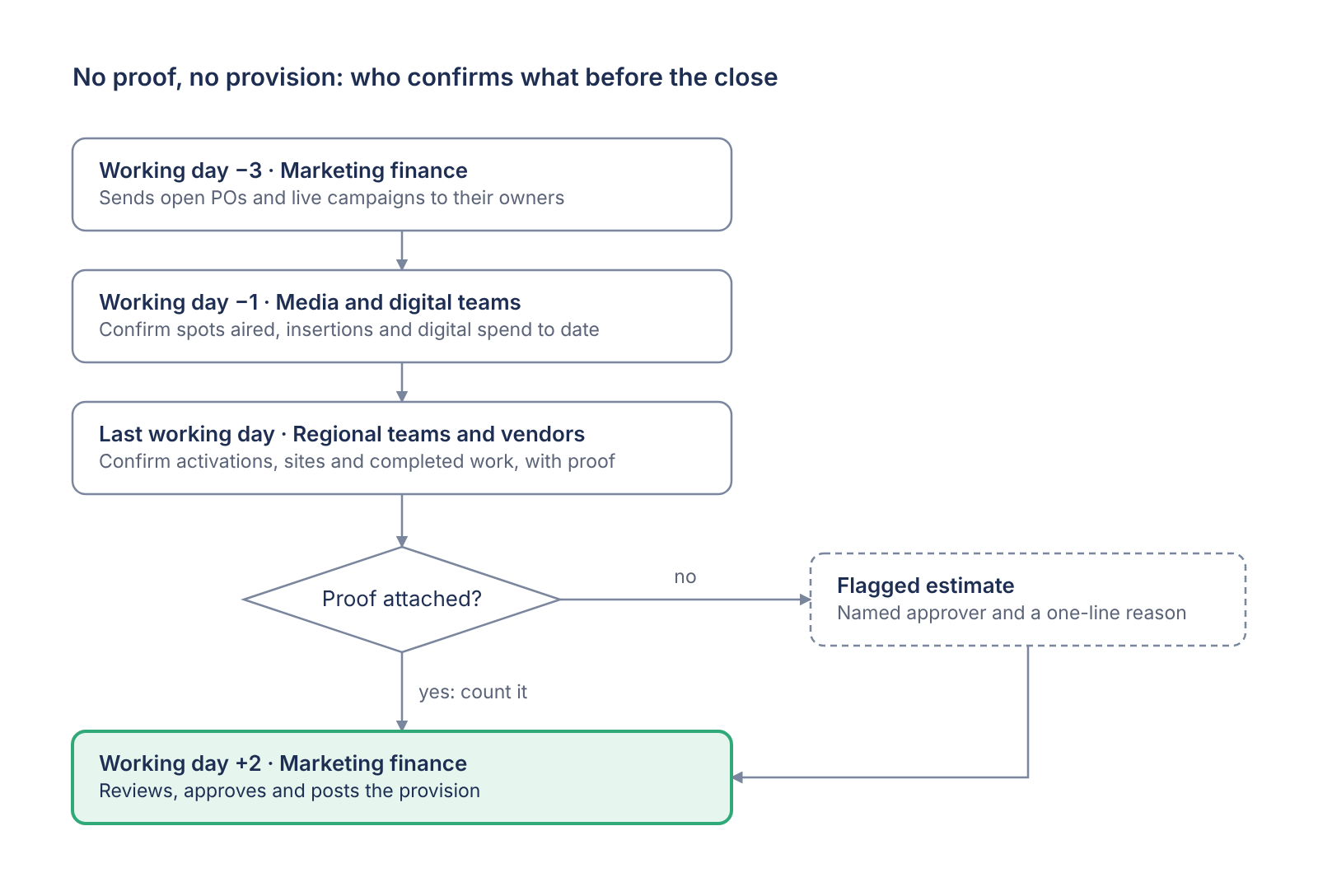
The rule that holds it together is simple: no proof, no provision. Work without proof either waits for next month or goes in as a flagged estimate, with a named approver and a one-line reason. Treat the dates as a starting point. A short close compresses them. Heavy field spend means asking regional teams to report earlier.
Your brand and media teams will find this easier if they know what you need and why. We've written a separate guide for them on how marketing teams can get their work counted without the month-end chase.
Check your number when the bills arrive
You find out whether you were right next month. Compare each provision with the bill for the same work. A small gap on a line backed by telecast confirmations tells you the method held. A large gap on activations, month after month, tells you the count or the cost per town is off.
Then watch the amounts that stay open too long. Anything open for more than 90 days needs a decision: chase the vendor, release it, or record why it is still valid.
How Brandintellé runs month-end provisioning
In Brandintellé, the month-end number is calculated for each PO from work that has already been confirmed: work confirmed, minus what has already been billed, plus anything still open from earlier months. Vendors or the brand team confirm the month, the amount and their remarks, and attach the proof. The amount comes from that confirmation: the system doesn't read telecast logs or ad-platform reports on its own.
Unbilled work carries forward until the bill arrives, so nothing is lost and nothing is counted twice. You review all provisions in one batch, with the right approver at each step, and approved provisions are posted straight to SAP (or Oracle NetSuite, Coupa or SAP Ariba) without re-typing. For any PO, you can see month by month what was done, what was billed and what is still open.
A month-end provision is only as good as the proof behind it. Build it from confirmed work, and month-end becomes a review instead of a chase.
See how month-end provisioning runs in Brandintellé →
Frequently Asked Questions -
Do prepaid digital budgets need a provision?
No, not for the amount already paid. You only provision spend on accounts that bill later, based on spend to date at month-end.
What if the bill comes in higher than the provision?
Book the difference in the month the bill arrives and note the reason. If one spend type misses regularly, fix how you count it rather than adjusting bill by bill.
How long should a marketing provision stay open?
As long as you genuinely expect a bill for that work. Most should clear within one or two closes. Anything past 90 days needs a decision.