

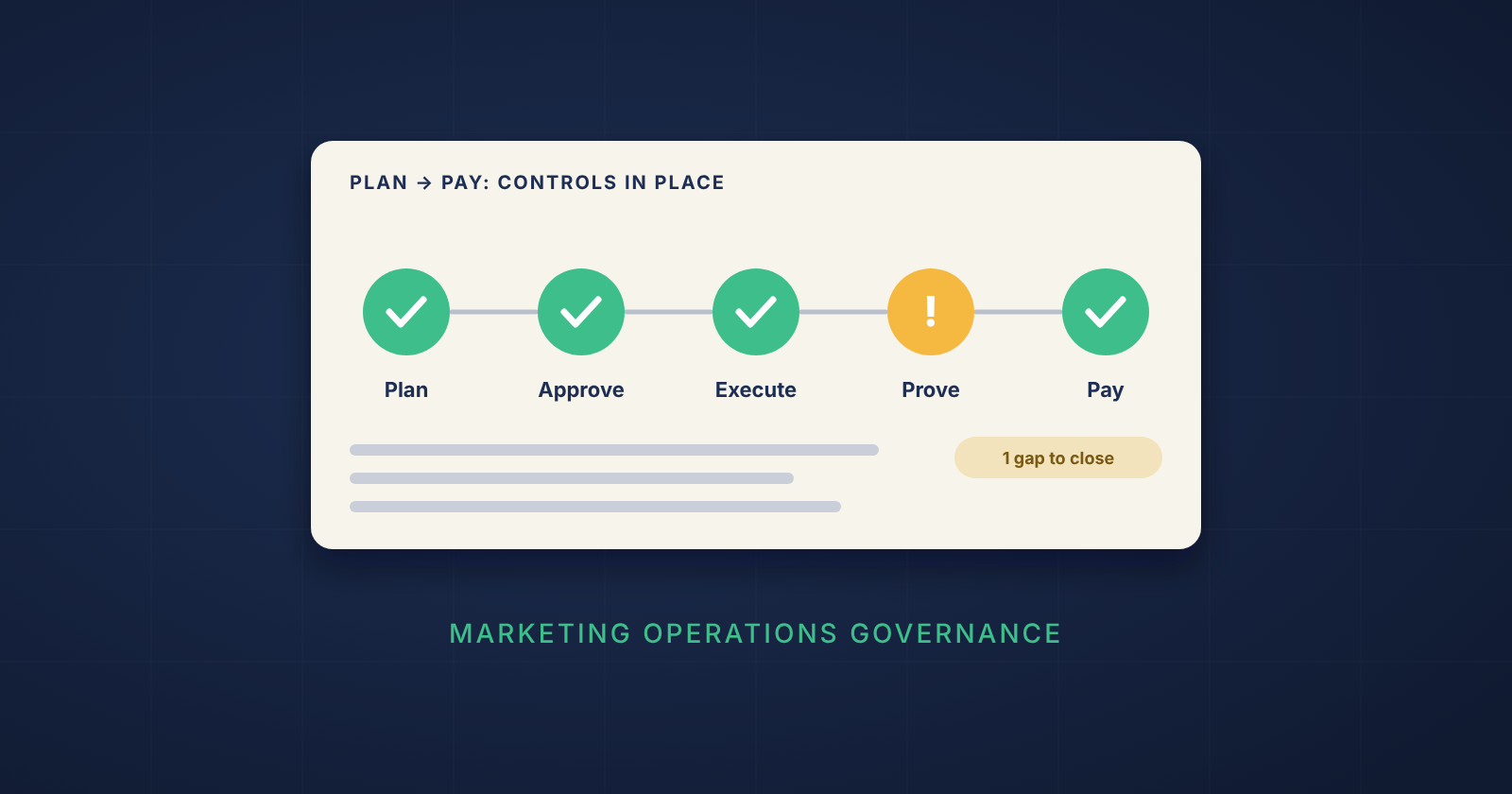
Marketing operations governance is the set of controls a company puts around how marketing money is planned, approved, spent, proven and paid. It decides who can commit spend and against which budget line, how plan changes get approved, what proof of delivery is needed before an invoice is paid, and how finance sees the position without asking marketing for a spreadsheet.
Most of what's written about marketing operations governance is about the martech stack: tools, data, naming conventions, intake forms. That matters to the team running the systems. For a CFO it misses the main point. Marketing is one of the largest discretionary costs in a large company, it's spent through dozens of agencies and hundreds of vendors, and the controls around it usually live in email approvals, agency PDFs and someone's tracker.
This guide sets out what marketing operations governance covers from finance's side, where it differs from the things it gets confused with, the controls that belong at each stage of the spend, and a scorecard to see where your company stands today.
How is marketing operations governance different from marketing operations and procurement?
Marketing operations governance is the only one of these that governs the money from plan to payment. Marketing operations governs tools and processes, brand and data governance cover content and data, and procurement governs vendors up to the contract.
What it governs | Usually owned by | What it doesn't cover | |
|---|---|---|---|
Marketing operations | Tools, data, workflows, campaign processes | Marketing ops | Whether spend was approved, delivered and correctly paid |
Brand and data governance | Brand rules, content approvals, data quality, consent | Brand, legal, IT | Money |
Marketing procurement | Vendor selection, rate negotiation, contracts | Procurement | What happens after the PO: delivery, proof, provisioning |
Marketing operations governance | Every rupee of marketing spend, from plan to payment | Shared: finance sets the rules, marketing runs them | Creative quality and campaign strategy |
The distinction matters because each of the first three can be strong while the money still leaks. A company can have good tooling, a tight brand book and sharp procurement, and still pay an invoice for a TV spot that never aired.
What are the five stages of marketing operations governance?
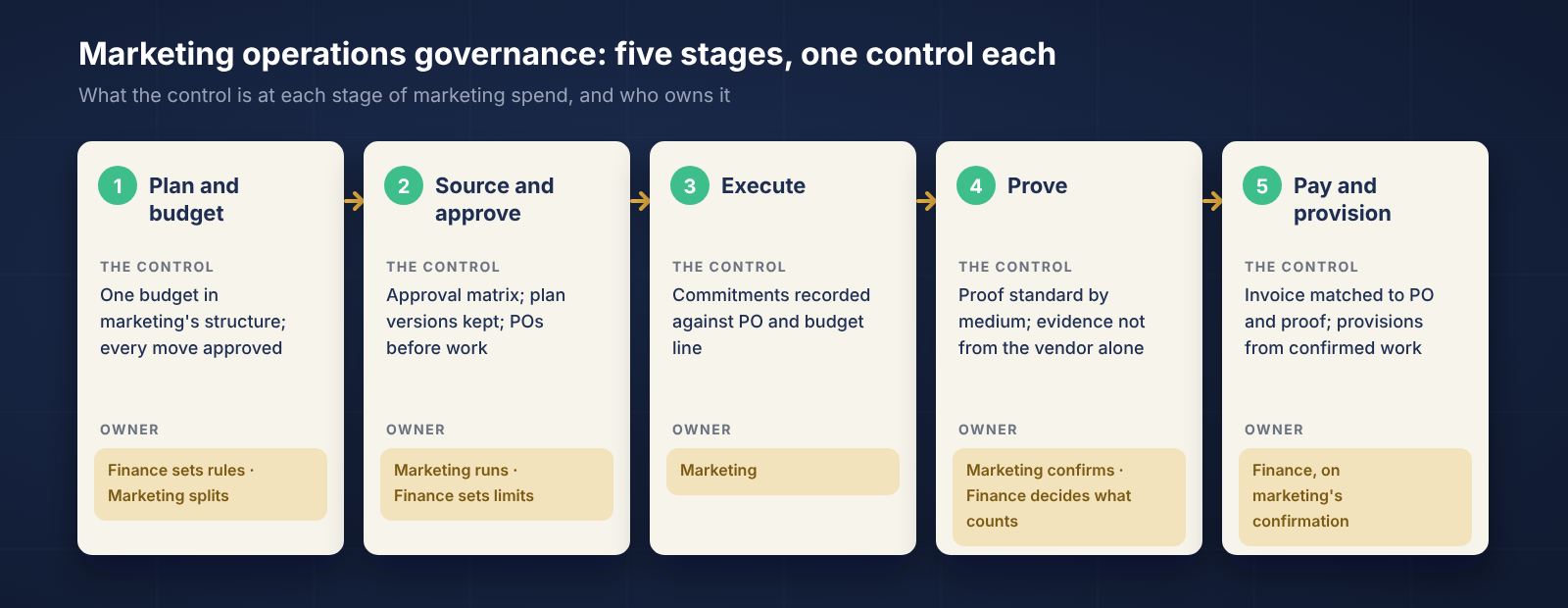
Marketing operations governance covers five stages of marketing spend: plan and budget, source and approve, execute, prove, and pay and provision. Each stage needs its own control, and a gap at any one of them shows up later as a variance nobody can explain.
How should finance control the marketing budget?
Hold one approved marketing budget in the structure marketing actually plans in, by brand, region, channel and activity, and approve and record every increase, decrease and transfer with a reason.
What goes wrong without it: the approved budget lives in finance's model, marketing plans in its own spreadsheet, and the two drift apart within weeks. Money moves between brands by email.
Owner: finance sets the total and the rules for moving money; marketing owns the split.
In Brandintellé's budget planning, every budget line shows what's approved, committed, invoiced and still available, and each move between lines carries its approval.
How should marketing spend be approved?
Approve marketing spend through a written approval matrix that ties the approver to the amount and type of spend. Check briefs against available budget before they go out, compare vendor proposals on the same terms, and keep every plan revision with its approval.
What goes wrong without it: plans get approved on version three and run on version seven. Vendors are chosen on relationships rather than comparable proposals. POs are raised after the work has started.
Owner: marketing runs it; finance and procurement set the thresholds.
Brandintellé's sourcing and plan approvals workflow keeps every version and approval on the line.
How can finance track committed marketing spend during a campaign?
Record each commitment against its PO and budget line as it's made, so finance can see committed marketing spend before the invoices arrive.
What goes wrong without it: once the campaign is live, nobody outside the brand team can see what's committed against each PO, or what has changed since approval.
Owner: marketing.
The gap between committed and invoiced is the number finance worries about most, and it's covered in committed vs actual marketing spend.
What proof of delivery should be required before paying for marketing?
Agree a proof standard for each medium before the activity starts: independent data for TV and digital, photos taken on location with time and place for on-ground work, and the proof attached to the line it supports.
What goes wrong without it: proof of delivery comes from the party being paid, such as the agency's post-campaign PDF or the vendor's photos in a chat group. It's enough to approve an invoice and rarely enough for an auditor.
Owner: marketing confirms; finance decides what counts.
Brandintellé checks TV four ways, against the estimate, the schedule, ratings data and the channel's bill, and captures on-ground proof through geo-monitoring, on location and timestamped.
How should marketing invoices be checked, paid and provisioned?
Match every marketing invoice to both the PO and the proof of delivery before payment, and calculate month-end provisions from confirmed work, not from the PO or the plan.
What goes wrong without it: invoices are matched to the PO but not to the proof. At month-end, finance emails marketing to ask what's been delivered but not billed, and gets an estimate.
Owner: finance, with marketing confirming delivery.
Brandintellé's invoice reconciliation checks each invoice against the PO and the proof before it reaches finance, and provisioning calculates the month-end provision from work completed against each PO. SAP still keeps the ledger; it receives invoices that have already been checked.
What should marketing decide and what should finance decide?
In marketing operations governance, finance sets the total budget, the approval limits and whether an invoice is paid; marketing owns the split, the vendors and confirmation of delivery; and the two decide together on large reallocations and on what counts as proof.
Decision | Marketing | Finance | Both |
|---|---|---|---|
Total marketing budget | ✓ | ||
Split by brand, region, channel | ✓ | ||
Moving money between brands or quarters | ✓ above an agreed threshold | ||
Choosing vendors and agencies | ✓ with procurement | ||
Approval limits and thresholds | ✓ | ||
Whether work was delivered | ✓ | ||
What counts as proof | ✓ | ||
Paying, holding or rejecting an invoice | ✓ | ||
Month-end provision | ✓ on marketing's confirmation |
If a row is blank in your company, or two people would both claim it, that is where the next dispute will start.
Who should own marketing operations governance: marketing or finance?
Marketing operations governance should be shared: finance writes the rules, and marketing runs them day to day.
When finance owns it alone, governance becomes a set of gates that marketing works around, and the evidence still ends up in email. When marketing owns it alone, controls bend under campaign pressure, and finance stops trusting the numbers. The arrangement that holds is the one in the table above: finance sets the totals, thresholds and proof standards; marketing owns the plan, the vendors and the confirmation of delivery; both see the same record.
That last part is the one most companies are missing. Governance breaks down less often because of bad rules than because marketing and finance are each looking at a different version of the truth. A system of record for marketing spend, sitting alongside the ERP, is what lets both sides work from one. Our guide to how a system of record for marketing spend works alongside SAP covers that in detail.
How do you assess your marketing operations governance? A 10-question scorecard
Use this: the marketing operations governance scorecard. Answer each question for your company as it works today, not as the policy says it should. Score 2 for yes, 1 for partly, 0 for no.
# | Stage | Question | Score (0–2) |
|---|---|---|---|
1 | Plan and budget | Is the approved budget held in the same structure marketing plans in, by brand, region, channel and activity? | |
2 | Plan and budget | Is every move between budget lines approved and recorded with a reason? | |
3 | Source and approve | Does a written approval matrix tie approvers to amounts and spend types? | |
4 | Source and approve | Is the approved version of every plan kept, along with each later revision? | |
5 | Execute | Can finance see committed spend against each PO before the invoices arrive? | |
6 | Prove | Is there an agreed proof standard for each medium, written into briefs and contracts? | |
7 | Prove | Does proof come from a source other than the vendor being paid? | |
8 | Pay and provision | Is each invoice matched to both the PO and the proof before it's paid? | |
9 | Pay and provision | Is the month-end provision calculated from confirmed delivery, not from POs or estimates? | |
10 | Across all stages | Do marketing and finance look at the same record of spend, without reconciling two spreadsheets? |
How to read your score:
0–7, fragmented. Controls depend on individuals and email. Start with questions 1, 3 and 8: one budget, one approval matrix, and no payment without proof.
8–14, controlled in parts. Usually strong on budget and approvals, weak on proof and provisions. Look at which stage has the most zeros; that's where the variances come from.
15–20, governed. The controls exist. The question now is whether they hold under pressure, at quarter-end and in festive season, and whether evidence is ready before audit asks for it.
The stage with the lowest score is your next project, whatever the total.
Marketing spend is rarely ungoverned on paper. It's ungoverned in the gaps between the budget sheet, the inbox and the ERP. Close those gaps, and governance stops being a set of gates and becomes a record everyone trusts.
See how Brandintellé governs marketing spend from plan to payment