

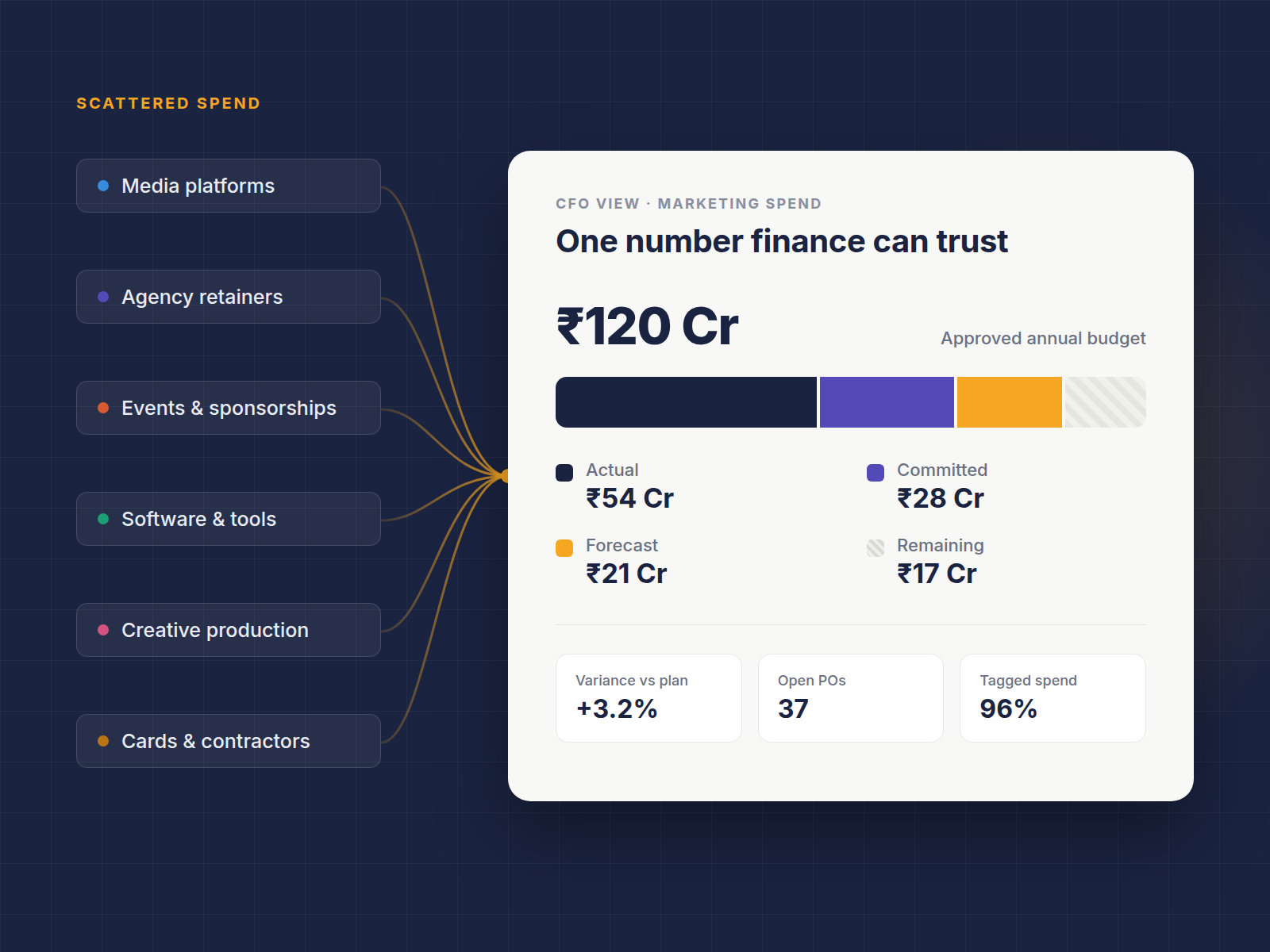
Marketing spend visibility means finance can see, at any given point throughout the year, what marketing has planned to spend, what it has already committed, what has been billed and what is still free to move. In most large enterprises, that view doesn't exist in one place. The budget sits in Excel, approvals sit in an email, the agency's estimate arrives as a PDF, and the invoice reaches SAP weeks later against a cost centre and a GL code.
This guide is for CFOs, finance controllers and marketing finance leads who want that view before the month-ends, not after it. It covers the five numbers to track, how to capture committed spend, how to provision for work that is done but not billed for, and how to check that what was billed actually ran.
Key takeaways
Finance needs five numbers for marketing, not one: planned, committed, actual, forecast and remaining. Planned is the approved budget, and the other four always add up to it.
Most marketing spends are decided weeks before an invoice exists, so visibility has to start at approval and commitment, not at payment.
In most ERP setups, marketing spend is booked against a cost centre and GL code, so the campaign, channel or region behind it is tracked somewhere else.
Month-end provisioning and billed-versus-delivered checks are where marketing numbers most often go wrong. Each needs its own process.
Performance belongs in the report as context, presented as a statistical estimate rather than a precise claim.
Why does the CFO need visibility into marketing spend?
The CFO needs visibility into marketing spend because it is committed early, billed late and spread across many vendors. One campaign can involve a media agency, a creative agency, a production house, outdoor vendors and regional activation partners, each on its own billing cycle. Without a consolidated view, your team sees the spend only when invoices land, often after the money could have been redirected.
The cost of that delay is practical. A budget that looks unused may already be tied to signed media plans. Reallocation requests take weeks because nobody can confirm what is genuinely free. At quarter-end, provisions are assembled from emails and spreadsheets instead of a system of record.
Better visibility also changes the conversation between the CFO and the CMO. Instead of arguing about whether marketing is over or under budget, both sides can see which spend is committed, which is flexible and which is tied to a defined business objective. That is the difference between containing marketing as an expense and managing it as an investment.
Can SAP show where the marketing money went?
Most ERPs, including SAP, are set up to record the financial transaction. The campaign detail behind it often sits elsewhere. A marketing plan can hold a hundred line items: channels, programmes, regions, flights and negotiated rates. By the time it reaches the ERP, those lines often collapse into a single purchase order against a cost centre, a GL code and perhaps a WBS element.
That is enough for accounting. But is it enough to answer what a CFO actually asks?
How much of next quarter's TV budget is already committed? Which region is pacing ahead? Does the digital agency's invoice match the plan it was approved against?
WBS elements and internal orders add control points, but they are usually flat. They don't hold the media detail behind each line: the channel, the programme, the time band, the rate. So the granular plan lives outside SAP, in agency files and spreadsheets, and someone reconciles the two by hand every month.
The answer isn't to replace SAP. SAP should stay the ledger. What's missing is a layer before and after it that holds the marketing detail and passes clean commitments, provisions and invoices into the ERP.
What are the five numbers a CFO should see?
A CFO-ready view of marketing spend tracks five separate numbers. Planned is the approved budget, and the other four always reconcile to it: Committed + Actual + Forecast + Remaining = Planned. Collapsing them into one "spent vs budget" figure is the most common reason why marketing numbers are misleading.
Number | What it means | Where it usually comes from | Why it matters to finance |
|---|---|---|---|
Planned | The approved budget for the period, by brand, channel and region | Annual operating plan, budget system | The baseline every variance is measured against |
Committed | Spend locked in through approved plans, POs, insertion orders or contracts, but not yet invoiced | Approval workflow, POs, media plans | Shows how much "unused" budget is already spoken for |
Actual | Spend invoiced and booked in the ledger | ERP or accounting system | The authoritative financial record |
Forecast | Activity expected to be committed before period-end but not yet approved | Budget owners' monthly updates | Shows where the period will land, not just where it is today |
Remaining | Planned minus committed, actual and forecast | Calculated | The only money that can genuinely be reallocated |
Keep performance metrics next to these numbers, but label them separately. Cost control and return on investment are different questions, and mixing them in one column muddies both.
What should finance ask marketing for?
Before building CFO-level reporting, finance and marketing need to agree on definitions, ownership and data access. Many visibility projects start with dashboards and discover later that "committed" meant something different to each team.
Ask your marketing and marketing finance teams to confirm these are in place:
A current budget broken down by brand, region, channel and campaign, at the depth where approvals actually happen.
A named owner for every budget line, vendor and approval route.
Access to POs, invoices, agency estimates, media plans, retainers and card spend.
A standard way to tag spend by campaign, channel, region and objective.
Agreement on what the CFO sees monthly, quarterly and at each forecast update.
A process for correcting missing, duplicated or miscoded entries.
You don't need perfect data on day one. You need both teams looking at the same numbers, and a routine for improving them.
How do you build a CFO-ready marketing spend visibility?
A CFO-ready system answers three questions quickly: what did we plan to spend, what have we committed and spent, and what business purpose did that spend serve? These seven steps move you from scattered costs to a view finance can trust.
As a CFO, you own steps 1 and 7 and set the rules in steps 3 and 5. Your marketing finance lead or controller runs the rest.
1. Start with the decisions, not the dashboard
Agree on what the CFO needs to decide: whether to release budget, where to reallocate, what to provision and which variances to escalate. Every report should support one of those decisions. Reports built around available data rather than decisions tend to look thorough and get ignored.
2. Map every place marketing spend appears
List every source: media agencies, creative and production vendors, outdoor and activation partners, events, sponsorships, software, contractors, dealer or distributor co-op claims and corporate cards. Note where each is approved, where it is billed and where it is booked. The gaps between those three points are where visibility breaks.
3. Make spend tags mandatory
Define a small set of required tags: brand, channel, campaign, region, vendor, budget owner and objective. Make them mandatory when spend is requested, not when the invoice arrives. Limit who can create new categories or vendor names, and review untagged spend every month.
4. Connect budgets to approvals and commitments
Track every stage of each spend: requested, approved, committed, delivered, invoiced and paid. Most of the visibility gain comes from this step, so it has its own section below.
5. Decide the source of truth for actuals
Actual spend should come from the ERP or accounting system. Platform dashboards and agency reports are useful, but they rarely match invoices exactly because of billing timing, agency commission, GST, credits and currency. Decide which source is authoritative, and ask vendors to put PO numbers and campaign codes on every invoice.
6. Add performance context without overclaiming
Link spend to the outcome each activity was meant to influence: enquiries, sell-through, reach or brand health. A brand campaign, a dealer activation and a market research study create value differently, so don't judge them by one metric. Where you show return, present it as a statistical estimate over a period and region, not proof that one ad produced one sale.
7. Set a monthly review rhythm with clear owners
Chair a monthly review with marketing operations, finance and budget owners. Cover pacing, commitments, provisions, forecast changes and open data issues. Marketing owns campaign intent and business context. Finance owns accounting accuracy and controls.
How do you track committed marketing spend before invoices arrive?
You track committed marketing spend by recording it the moment it is made: when a media plan is approved, a PO or insertion order is raised, or a contract is signed. Committed spend should reduce the available budget immediately, not when the invoice is booked.
In marketing, the gap between commitment and invoice is wide. A TV plan approved in April may air in May and be billed in July. An annual agency retainer commits twelve months of spend on day one. Outdoor sites are booked weeks before they go up. If finance counts only invoices, budget looks available long after it has been spoken for, and reallocation decisions are made on the wrong number.
Practical steps:
Require an approved plan or PO before any vendor starts work: no PO, no work.
Record the committed amount against the budget line, with campaign and vendor tags.
Treat retainers and annual contracts as commitments for their full term, released month by month.
Show committed-but-not-invoiced spend as its own figure in every CFO report.
Flag any commitment that exceeds the remaining budget before it is approved, not after.
How should marketing spend be provisioned at the month-end?
Marketing spend should be provisioned at month-end for all work that has been delivered but not yet invoiced, based on evidence that the work happened. Provisioning from the approved plan alone overstates cost when activity slips. Ignoring unbilled work understates it.
This is one of the most manual processes in marketing finance. Controllers chase brand teams for what went live, brand teams chase agencies, and the provision is assembled from emails and spreadsheets in the last days of the close. The result is accrual corrections the following month and difficult questions at audit.
A cleaner process:
Capture work completion as it happens: campaign live, event delivered, sites installed, each with supporting evidence.
Provision completed work at the committed rate.
Reverse each provision when the matching invoice is booked.
Review aged provisions monthly. Anything older than two or three months usually points to a disputed or forgotten invoice.
How do you check that what was billed actually ran?
You check that what was billed actually ran by matching three things: the approved plan or PO, evidence of delivery and the invoice. This is a three-way match. In marketing, the middle piece, proof of delivery, is the one most often missing.
For media, evidence of delivery means comparing the agency's post-campaign report against the approved plan: which spots aired, in which programmes, at what rate. For TV in India, that usually means reconciling the plan, the agency's reported implementation and BARC spot-level data (India's TV audience measurement). For outdoor, retail branding and on-ground activations, it means geo-fenced, timestamped photographs taken at the site at the time of the work.
Not every deviation is a problem. In marketing, what you plan is rarely exactly what you get: spots move, sites change, rates get renegotiated. The goal is to flag only the deviations that matter, those above a set threshold or without an approved change, so finance reviews those and lets the rest through.
What tools can CFOs use to track marketing spend?
No single tool gives a CFO full marketing spend visibility. Each category answers part of the question, and the gaps between them are where visibility is lost.
Type of tool | Built for | What else you'd need for marketing visibility |
|---|---|---|
ERP | The financial ledger, POs, payments, cost centres | A place where the campaign and media detail is held |
BI and reporting tools | Reporting on data you already have | Clean, tagged spend data feeding it |
Source-to-pay | Sourcing and purchasing across indirect spend | Media plans, campaign structure and proof of delivery |
Expense management | Employee and card expenses | A way to capture agency- and vendor-billed spend |
Spreadsheets and email | Getting started quickly | An audit trail and one version of the numbers |
Marketing spend governance platform | Budget, commitments, proof, provisions and invoice matching in one flow, integrated with the ERP | A clean integration with your ERP |
When you evaluate tools, check for a multi-level budget hierarchy with reallocation, approval workflows with an audit trail, commitment tracking, proof-of-delivery capture, provisioning, three-way invoice matching and ERP integration. A small team can start with a disciplined spreadsheet model. With several brands, regions and agencies, the reconciliation effort usually outgrows spreadsheets quickly.
Why do marketing spend numbers go wrong?
Marketing spend numbers usually go wrong for one of four reasons: timing, coding, ownership or definitions. A campaign approved in one quarter runs in the next and is invoiced in the third month. An agency bills several campaigns on one invoice. A cost lands in the wrong cost centre because the invoice carried no campaign code.
Common fixes:
Require a campaign or PO code on every purchase request and invoice.
Run a monthly provisioning process for delivered-but-unbilled work.
Clear untagged or miscoded spend before month-end reporting.
Document how shared costs, retainers and multi-region campaigns are allocated.
Separate one-time costs from recurring commitments.
Keep a simple issue log. If the same problem appears two months running, fix the process that creates it rather than correcting the entry again.
What should a monthly marketing spend report to the CFO include?
Your monthly marketing spend report should include what the numbers mean for decisions: what is on track, what has changed, what is locked in and what can still move. The dashboard shows the position. The note tells you what to do about it.
Ask for a monthly note that covers:
Budget position: where marketing stands against plan, by brand and channel.
Pacing: whether spend is ahead, behind or on track, and why.
Commitments: future spend that is already locked in.
Provisions: what has been accrued for unbilled work, with aged items flagged.
Flexible budget: what can still be reallocated.
Deviations: material differences between what was billed and what was delivered.
Decisions needed: approvals, reallocations or escalations for leadership.
Is your marketing spend audit-ready?
Marketing spend is audit-ready when every rupee can be traced from approved budget to commitment, to evidence of delivery, to invoice and payment, without rebuilding the trail from inboxes. In many Indian enterprises, questions on marketing spend surface around the half-year and year-end closes, so the weeks before each close are the right time to test the process.
Before the report goes to your auditors, check that it:
Separates planned, committed, actual, forecast and remaining spend.
Shows the owner, vendor, campaign, channel and purpose for every material line.
Links each invoice to an approved plan or PO and to evidence of delivery.
Explains material variances and deviations.
Shows provisions for unbilled work, with aged items flagged.
Uses the same categories in finance and in marketing.
Presents performance as context, without overstating certainty.
Ends with a clear set of decisions, risks or next actions.
Where a marketing spend governance layer fits
Everything above can be run with discipline, spreadsheets and a lot of manual reconciliation. At enterprise scale, that reconciliation effort is the problem: the marketing detail lives outside the ERP, and finance rebuilds it at every close.
To see if your own process has gaps, run the MOG Calculator. The finance and marketing workflows take about 15 minutes each. The result is a marketing operations governance report and a business case you can share with your CMO and leadership.
Frequently Asked Questions
What is marketing spend visibility?
It is finance's ability to see, at any point, what marketing has planned, committed, spent and has left. The view is broken down by brand, channel, region and campaign, and linked to the purpose of each spend.
What's the difference between committed and actual marketing spend?
Committed spend is locked in through an approved plan, PO or contract but not yet invoiced. Actual spend is invoiced and booked in the ledger. In marketing, the gap between the two can run to several months.
Can I track marketing spend by campaign in SAP?
SAP holds the financial record of marketing spend: POs, invoices, cost centres and GL codes. Whether you can see that spend by campaign, channel or region depends on how detailed your POs and coding are. In many companies, that detail sits in media plans and agency files, so finance reconciles it outside the ERP.
How should marketing spend be provisioned at the month-end?
Provision work that has been delivered but not invoiced, supported by evidence of completion, at the committed rate. Reverse the provision when the matching invoice is booked.
Who should own marketing spend visibility, marketing or finance?
Both. Marketing owns campaign intent and business context. Finance owns accounting accuracy and controls. It works best as a finance-led initiative that streamlines budgeting, provisioning and billing, with marketing as a partner in setting it up.