

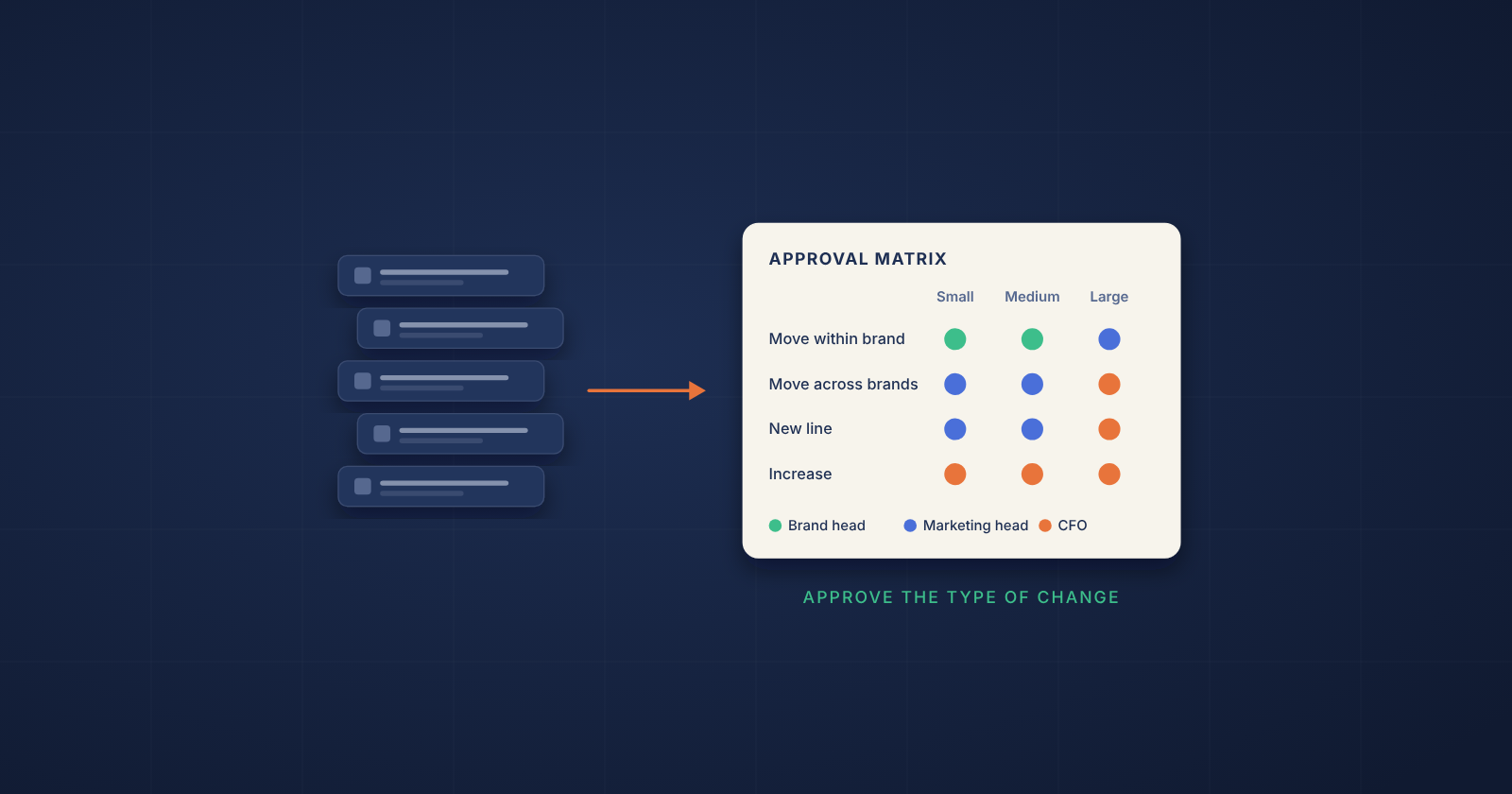
For a marketing budget, who approves a change should depend first on the type of change and only then on its size. Moves inside one brand or region stay with the person who owns that budget, moves across brands go to the marketing head, and any increase goes to finance, whatever the amount.
If you're the finance controller or head of marketing finance who owns the approval matrix, the festive season is when you find out whether it works. Regional teams want money moved towards whatever is selling, brand teams want to pause what isn't, and every request lands on someone's desk. This season there are more of those requests than usual. Brands are pacing their campaigns and being selective about extra spending rather than cutting outright, as Exchange4media reported this week, and every one of those decisions turns into a request to move money.
Most approval matrices were designed for purchases, where a bigger amount simply needs a more senior signature. That works when the amount is the risk, and for a marketing budget it often isn't. So instead of starting with amounts, this piece walks through the eight requests that actually reach finance, who should approve each one, and what the request should carry so it can be decided quickly. The matrix that sums them up is at the end.
Why amount-only approval limits don't work for marketing budgets
An amount-only matrix sends small, harmless moves to the top and lets large changes through in pieces. Moving ₹40 lakh from digital to dealer activations inside the same brand doesn't change what the company spends, while increasing a region's budget by the same ₹40 lakh does, yet both reach the same approver. Senior people end up approving routine moves, approvals slow down in the middle of the season, and a determined team can still split a big change into several small ones. This isn't unique to marketing: in a recent piece on control failures, PKC India lists weak approval matrices among the six that enterprises should fix, including limits that are routinely exceeded, delegated limits that are never updated, and large purchases split so that no single approval crosses the board's threshold.
1. Who should approve moving marketing budget within the same brand?
The brand or regional head who owns that budget, because the total they are accountable for doesn't change.
A brand manager wants to shift ₹30 lakh from a digital burst to in-store sampling for the same brand, in the same quarter. Nothing about the company's spending changes, only the mix. Sending this to the CFO adds days and no control. The one thing worth checking is that the money being moved isn't already committed to a live campaign or an open purchase order.
The request should carry: both lines, the amount, a one-line reason and confirmation that the source money is uncommitted.
2. Who should approve moving marketing budget between brands or regions?
The marketing head, with the CFO above an agreed amount, because the move changes priorities even though the total stays the same.
A brand that is outperforming in the West wants money from a slower brand in the South. The company's total spend is unchanged, but its priorities are not, and the brand losing money has a say. The marketing head is the right person to weigh the two brands against each other; the CFO comes in only when the amount is large enough to change the shape of the year. Our piece on reallocating marketing budget mid-quarter covers how marketing should write this request so it gets approved fast.
The request should carry: the lines on both sides, the reason, the effect on each brand's quarter and whether it will be reversed later.
3. Who should approve an increase to the marketing budget?
Finance, always, because an increase is the only change that raises what the company has agreed to spend.
A region wants ₹60 lakh more for an extended festive campaign, with no line to take it from. However small the amount, this is a different kind of decision from a move: it changes the company's spend. It should go to the CFO, and to the management committee above an agreed amount, and it should state where the money comes from, such as a held-back reserve, a reforecast or a better-than-planned quarter.
The request should carry: the amount, the source of funding, the expected result and what happens if it is refused.
4. Who should approve a cut to a marketing budget line?
The owner of the line for small cuts, and the marketing head for larger ones, with finance told in both cases.
Mid-quarter, a business decides to take ₹75 lakh out of its quarterly marketing release while leaving the annual approval untouched, the kind of move companies make when volumes soften. A cut lowers spending, so the risk isn't overspending; it's cutting money that is already promised to a vendor. That is why finance should be told rather than asked: finance needs to know what is now uncommitted, but doesn't need to slow the cut down.
The request should carry: the line, the amount, and confirmation that nothing contracted or already live is being cut.
5. Who should approve a new marketing budget line in the middle of the year?
The marketing head together with finance, and the CFO above an agreed amount, because a new line creates a new place to spend that wasn't in the plan.
A team wants to try a channel it hasn't used before, such as retail media on a quick-commerce app, partway through the year. The money may come from an existing line, but a new line still needs a second look: it needs an owner, it needs to map to the right expense head in the ledger, and someone should agree what it is meant to achieve. Our guide to structuring a marketing budget covers how lines map to the ledger.
The request should carry: the owner, the expense head it maps to, the funding source and what success looks like.
6. Who approves the quarterly release of the marketing budget?
Finance, against the phasing agreed before the year started, with the CFO involved only when a release departs from that phasing.
In most large Indian companies the annual budget is approved once and released quarter by quarter. If the phasing was agreed in advance, each release is a check rather than a negotiation: finance confirms what is already committed for the quarter and releases accordingly. Our quarterly marketing budget playbook sets out the release rules worth agreeing up front.
The request should carry: what is already committed for the quarter, planned activity and any change from the agreed phasing.
7. Who approves budget requests that have been split to stay under a limit?
The approver whose limit the requests reach when added together, because limits should count per line, per quarter, not per request.
A region raises four requests of ₹22.5 lakh each over three weeks, each one inside a regional head's limit of ₹25 lakh. Together they add ₹90 lakh to one line. Counting limits per line, per quarter means the request that crosses the limit goes up a level automatically, and the approver sees the full picture instead of the fourth instalment. This is rarely bad intent; usually it's just the quickest route through a slow process, which is one more reason to keep small, low-risk approvals close to the people asking.
The request should carry: the running total for the line this quarter, shown automatically rather than typed in.
8. Who approves paying a vendor when proof of the work is missing?
A named finance approver, as a recorded exception with a reason, never by default.
An on-ground activation was completed, but some site photos are missing and the invoice is due. Paying without proof by default is how unverified spend builds up; refusing every exception is how vendor relationships break. The middle path is an exception route: the payment can go through, but only with a named approver, a written reason and a record that auditors can find later. Approvals like these work best in a system rather than over email. In Brandintellé, for example, approval limits can be set by budget line and amount, every request shows its status, from requested to approved, rejected with a reason or on hold, and approvers can act from their phone.
The request should carry: what proof exists, what is missing and why, and who is accepting the exception.
What a marketing budget approval matrix looks like
Put the eight requests together and you get a matrix organised by type of change first and amount second. The amounts below are illustrative; set yours from the size of your budget and the number of requests you see in a typical month.
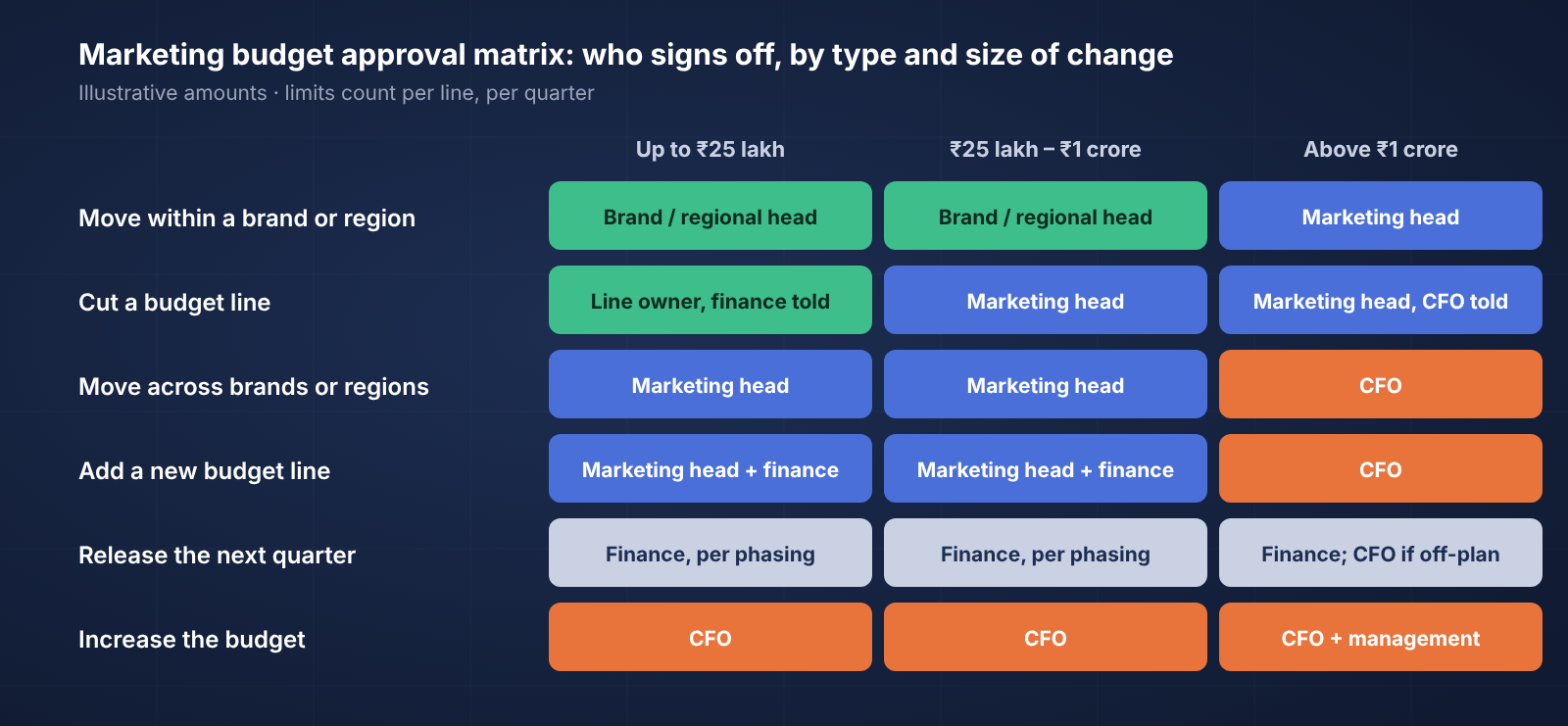
Three rules sit underneath the grid, and they matter as much as the grid itself:
Limits count per line, per quarter. Several small requests on the same line add up, and the one that crosses a limit goes to the next approver.
Increases always go to finance. They are the only change that raises what the company has agreed to spend.
Every approval is recorded with its reason. When auditors pick a budget change to test, the answer should be one screen, not a forwarded email thread.
Redraw the matrix with next year's budget, so it is ready when the year opens, and look at it again after the half-year to see which limits were hit most often. Where approvals were routine, raise the limit; where surprises got through, lower it.
Frequently asked questions
What is a delegation of authority matrix?
A delegation of authority (DoA) matrix is the table that sets who can approve which decisions, and up to what amount. For a marketing budget it covers moves between lines, cuts, new lines, quarterly releases and increases. It works best when organised by the type of change first and the amount second, because the type of change says more about the risk than the size does.
What should a marketing budget approval matrix include?
It should list each type of change (a move within a brand or region, a move across brands or regions, a cut, a new line, a quarterly release and an increase), the approver at each size of change, how limits add up within a quarter, and what every request must carry: the lines involved, the reason, the effect on the quarter and what is already committed.
How do you stop approval limits being bypassed by splitting requests?
Count limits per budget line, per quarter, instead of per request. When several requests on the same line add up to more than an approver's limit within the quarter, the request that crosses it goes to the next level automatically. Keeping every request in one system, rather than in email, makes those running totals visible to the approver.
How often should the marketing budget approval matrix be reviewed?
Once a year with the new budget, and again after the half-year. The annual review sets limits that fit the new structure and amounts. The half-year review looks at which limits were hit most often and where surprises got through, so limits can be raised where approvals were routine and tightened where they weren't. Update names whenever people change roles.
A good approval matrix spends senior time on the decisions that change what the company spends, and nowhere else.