
A large company's marketing spend needs two systems of record, each for different things. The ERP stays the system of record for the financial ledger: WBS elements, internal orders, cost centres, purchase orders, invoice postings, accruals, actuals and payments. The marketing spend platform is the system of record for everything the ledger was never built to hold: the line-item plan, approvals, estimates, proof of delivery, deviations and work completion. It passes finance only what the ledger needs, in the ledger's own terms.
This question comes up in almost every evaluation, usually from finance or IT, and usually early. The worry is reasonable. Nobody wants a second ledger, two versions of the budget, or a reconciliation project between the new platform and the ERP every month-end.
The answer is a clear split of ownership, agreed before implementation. This guide sets out what that split should look like, what should flow between the two systems, and how to test whether a vendor really works that way.
Should a marketing spend platform replace the ERP for marketing?
No. A marketing spend platform should sit beside the ERP, not replace any part of it. The ERP records the transaction; the platform runs everything before and after it.
The ERP holds the cost objects, purchase orders, posted invoices and actuals that the accounts are built from, and auditors rely on it. A platform that asks to become the system of record for any of that creates exactly the parallel ledger finance is afraid of.
What the ERP doesn't do well is the marketing work around the transaction: planning in detail, approving campaigns, collecting estimates and schedules from agencies, checking what was delivered, and settling deviations. That's the gap a marketing spend platform should fill.
What should stay in the ERP?
Every record that the financial statements, tax filings or audit depend on.
Cost objects: WBS elements, internal orders, cost centres and GL accounts.
Vendor master: the legal vendor record, bank details and tax registrations.
Purchase requisitions and purchase orders: the commitment, as finance recognises it.
Invoice posting and actuals: what was billed, booked and paid.
Accruals: the period-end provision, posted as a journal.
Payments: what left the bank, and when.
What should the marketing spend platform be the system of record for?
Everything about the marketing spend underneath each ERP record: what was planned, approved, delivered and proven.
The detailed plan: line items by brand, region, channel, medium and activity, often several levels deeper than the ERP's cost object.
Campaign approvals: who approved which plan, budget move or deviation, at which limit, and why.
Estimates and schedules: what the agency or vendor proposed and what was booked, medium by medium.
Proof of delivery: aired spots, platform delivery data, photos of outdoor and on-ground work.
Deviations and credit notes: the difference between what was planned and what was delivered, and how it was settled.
Work completion: confirmation that the work was done, which is what an accrual should be based on.
Why can't the ERP hold the marketing detail itself?
Because one ERP line usually stands for dozens of marketing lines, and the questions marketing and finance ask live in those lines.
Take a single WBS element for one brand's media in one quarter. In the ERP it's one cost object with a budget, a few purchase orders and the invoices posted against them. Inside it sits the actual plan: TV by channel, programme and time band; digital by platform and campaign; outdoor by site; print by edition and language. When someone asks "did the regional TV burst deliver?" or "how much of the outdoor budget is committed but not yet billed?", the ERP can't answer, because the detail was never in it.
Adding more cost objects or custom fields to the ERP rarely fixes it; the real plan just moves back into spreadsheets. The cleaner answer is to keep the ERP at the level finance needs, and let the platform hold the detail and roll it up.
What should flow between the ERP and the platform?
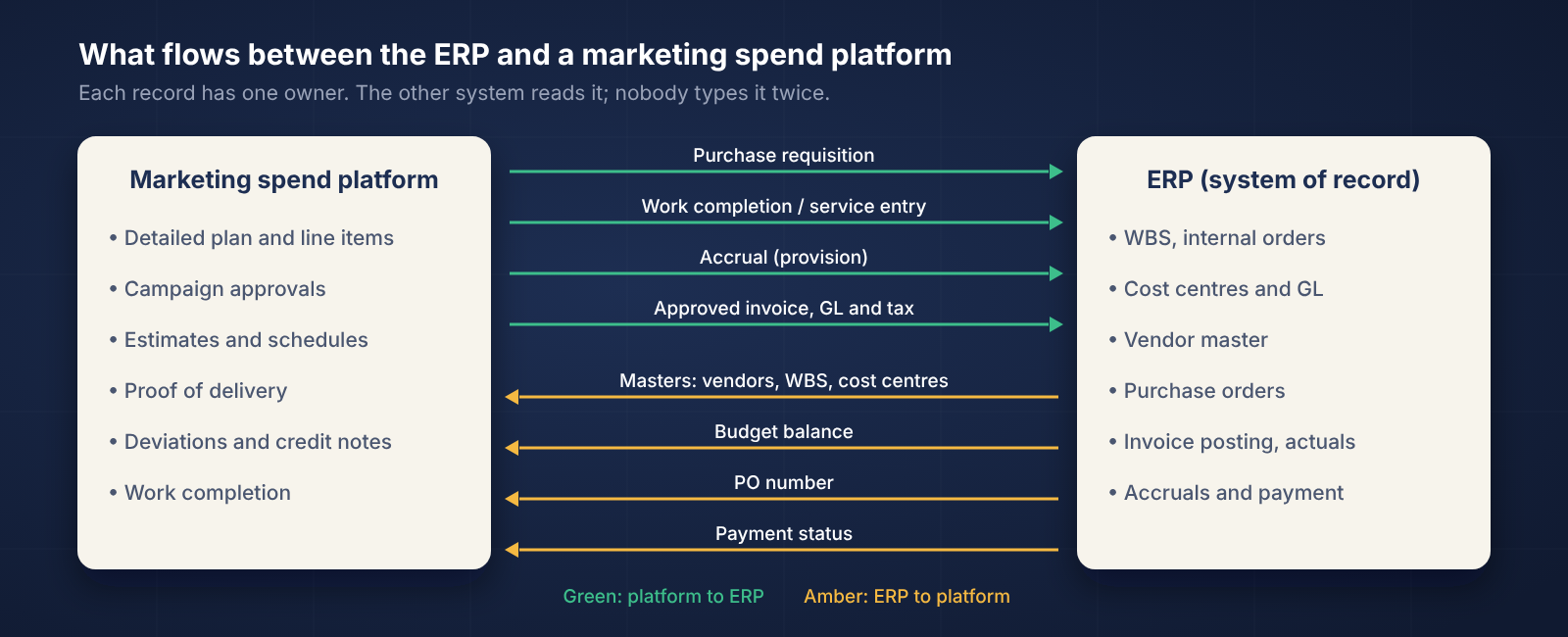
Each record has one owner. The other system reads it. Nothing is typed twice.
Record | Owner | What the marketing spend platform does with it |
|---|---|---|
WBS, internal orders, cost centres, GL | ERP | Reads them as masters and maps each budget line to one |
Vendor master | ERP | Reads it, so every plan, PO and invoice uses the same vendor |
Detailed plan and approvals | Platform | Holds them; sends the purchase requisition to the ERP |
Purchase order | ERP | Receives the PO number back and links it to the plan line |
Proof and work completion | Platform | Holds them; sends the service entry or work completion to the ERP |
Accrual | ERP | Calculates it from work completion and posts it |
Invoice | ERP (posting) | Checks it against PO and proof first; sends it approved, with GL and tax confirmed |
Budget balance and payment status | ERP | Reads them back, so marketing sees the same numbers finance does |
Three rules keep this clean. First, the ERP's numbers are the keys: the WBS element, the PO number and the vendor code travel with every record. Second, data flows one way per field, so there's never a question of which version is right. Third, the platform rolls its detail up to exactly the ERP object it maps to, so the two systems always reconcile.
What should you ask a vendor about the ERP?
Use these in the RFP and then ask to see each one working in the demo:
Which ERP records do you treat as the system of record, and do you ever hold your own copy of any of them?
Which documents do you send to the ERP, and which do you read back? Show us both directions.
How does each budget line map to a WBS element, internal order or cost centre?
How are accruals calculated, and are they posted to the ERP automatically?
What happens when the ERP and your platform disagree, and which one wins?
Who builds the integration, who maintains it, and what happens when the ERP is upgraded?
Red flags: a vendor that wants to hold its own vendor master or its own actuals; an integration that is really a CSV export; or an answer to question 5 that isn't "the ERP".
How do you map which system owns each marketing spend record?
Use this: copy the table into a spreadsheet and fill in the two middle columns for your company. Every row where "today" and "should" differ is a gap to close in implementation.
Record | Where it lives today | Where it should live | Which way it syncs | Gap to close |
|---|---|---|---|---|
WBS / internal orders / cost centres | ERP | ERP → platform | ||
Vendor master | ERP | ERP → platform | ||
Detailed plan and budget lines | Marketing spend platform | Rolls up to the ERP cost object | ||
Approvals and budget moves | Marketing spend platform | Stays in the platform | ||
Purchase requisition and PO | Raised from the platform, recorded in the ERP | Platform → ERP, PO number back | ||
Proof of delivery and work completion | Marketing spend platform | Service entry → ERP | ||
Accruals | Calculated in the platform, posted in the ERP | Platform → ERP | ||
Invoices and payments | Checked in the platform, posted and paid in the ERP | Platform → ERP, status back |
Five decisions to agree with finance and IT before implementation
Which ERP object carries the marketing budget: WBS element, internal order or cost centre.
Which IDs travel with every record (budget line, PO number, vendor code) so the two systems always match.
How often masters, budget balances and payment status sync back.
Who resolves a mismatch between the two systems, and within how many days.
Who owns the integration after go-live, including at ERP upgrades.
How does a Marketing Spend Platform like Brandintellé work with your ERP?
SAP stays your ledger. Brandintellé is the system of record for everything before and after it.
Two-way SAP integration. Purchase requisitions, purchase orders, service entries and invoices move between the two systems. Masters such as vendors, WBS elements and cost centres are synced from SAP.
Budgets mapped to your cost objects. The detailed budget structure in Brandintellé maps to WBS elements and internal orders in SAP, so the detail sits above the ERP without replacing it.
Accruals from work completion. Agencies or brand teams submit work completion against the PO, Brandintellé calculates the provision, and posts it to SAP.
Invoices checked before posting. Each invoice is matched against the PO and the proof of delivery, validated automatically, then sent to SAP with the GL and tax details confirmed. The spend flows back to its budget line, so the budget view stays current.
Balances read back. Budget balances and payment status come from SAP, so marketing and finance look at the same numbers.
We own the integration. Brandintellé builds the integration with certified SAP partners who already know its interfaces, and other finance systems connect through Brandintellé's APIs.
For multi-country rollouts, each market's cost objects, currency and tax rules are configured during implementation, against the same ERP-first design.
The ERP should know what was spent. The marketing spend platform should know what it was spent on, and whether it was delivered.