

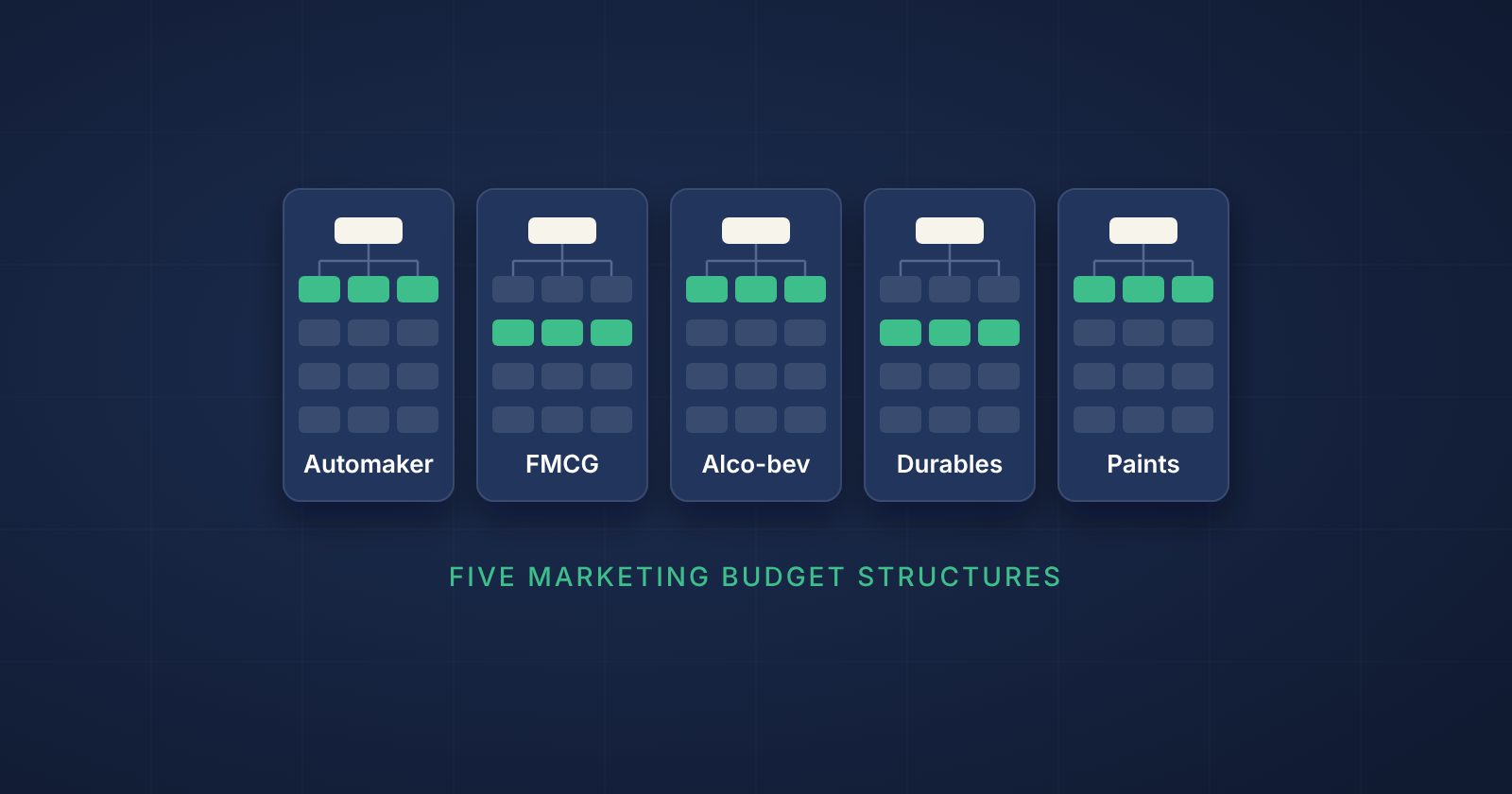
Most Indian enterprises structure the marketing budget in one of five patterns, by dealer zone, brand, state, region with a sales-office tag, or zone and programme. Hold money at the level where someone is accountable, track everything below it, and map every line to one ledger account. That's the short answer. The rest of this piece shows the five patterns and the decisions behind each one.
If you're the person in finance who builds the marketing budget template, this is the month it gets rebuilt. Most templates are rebuilt the same way: last year's sheet is copied, a few rows are added for new brands, and the structure quietly stays whatever it was three years ago. Then, around the festive season, someone asks how much went on in-store activations in one state, and the answer needs three days and a side spreadsheet.
There's a faster way to get this right. Most large companies in India end up with one of a handful of shapes, and the shape depends less on company size than on how the business sells: through dealers, through distributors and stores, state by state, through two parallel organisations, or through contractors on site. Start from the pattern closest to yours, then make five decisions to fit it to your business.
How to read these marketing budget structures
Each pattern below is drawn the same way. The row with a green outline holds money: it has an approved amount, someone owns it, and moving money in or out of it needs an approval. Dashed rows are tracked: spend is recorded there, but without its own approved amount. An amber dashed row is a tag: a second way of grouping the same lines, carried on each line rather than built as an extra level. The examples are illustrative and generalised from the companies we work with.
How automakers structure the marketing budget across zones and dealers
Most automakers hold the marketing budget by dealer zone and let dealers draw on it through approved activity requests, tracking spend down to each dealer and activity.
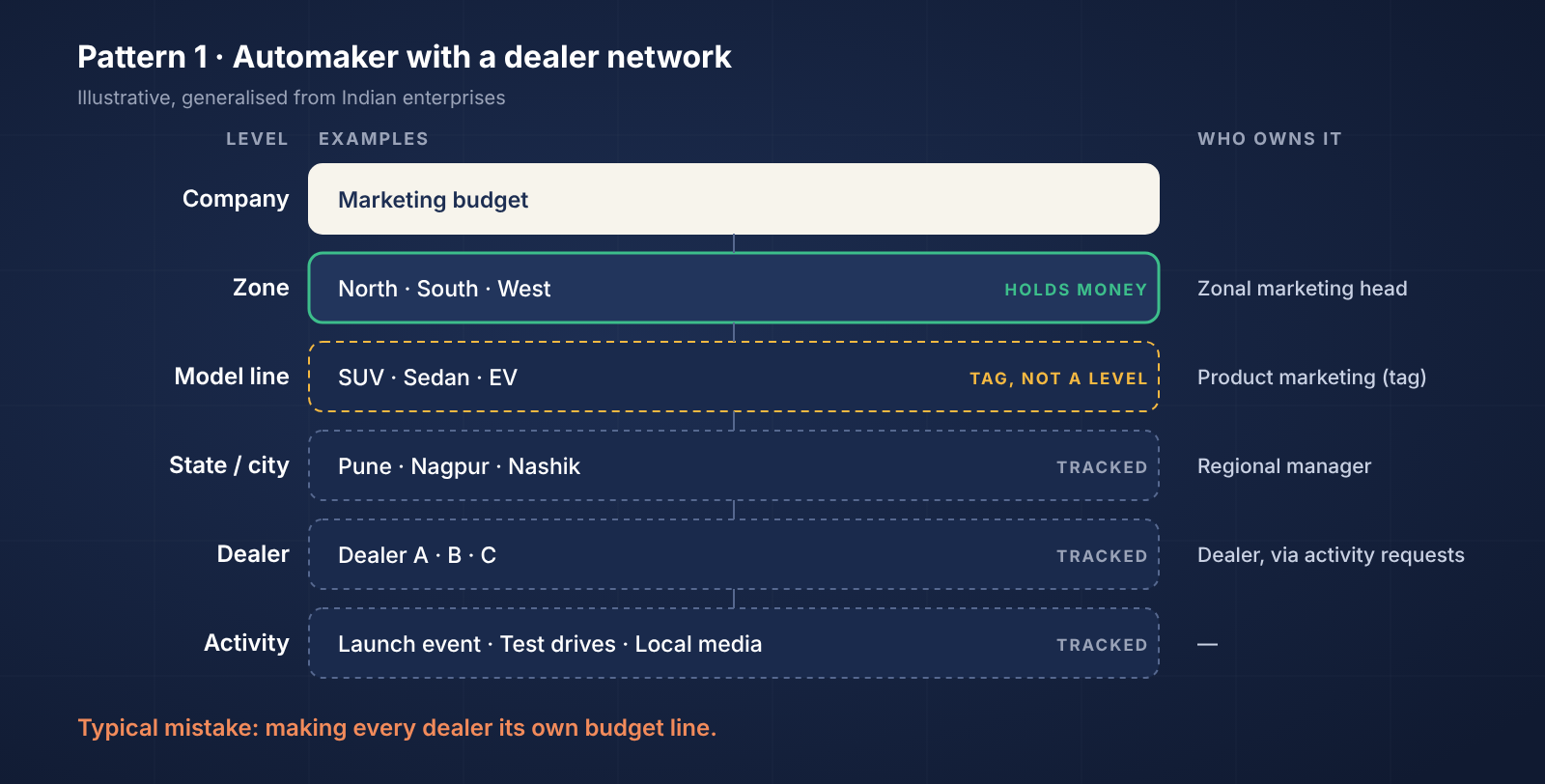
Automakers sell through dealers, so most marketing money is eventually spent in a dealer's town. That's why the instinct is to give every dealer a budget line. Resist it. With a few hundred dealers and a dozen activity types, you end up with thousands of small lines, and every launch or test-drive weekend turns into a transfer request.
The pattern that works holds money by zone, owned by the zonal marketing head, and lets dealers draw on it through activity requests that are tracked down to the dealer and the activity. The model line, whether SUV, sedan or EV, sits on each line as a tag, so product marketing can still see what each model received without the structure doubling in size. Automakers also tend to lock the annual budget at a detailed level and let the quarterly outlook move underneath it, which this shape handles well, because the locked number sits on a small number of zone lines.
How FMCG companies structure the marketing budget by brand
Most FMCG companies hold the marketing budget at brand level, owned by the brand manager, and track variant, channel and activity underneath.
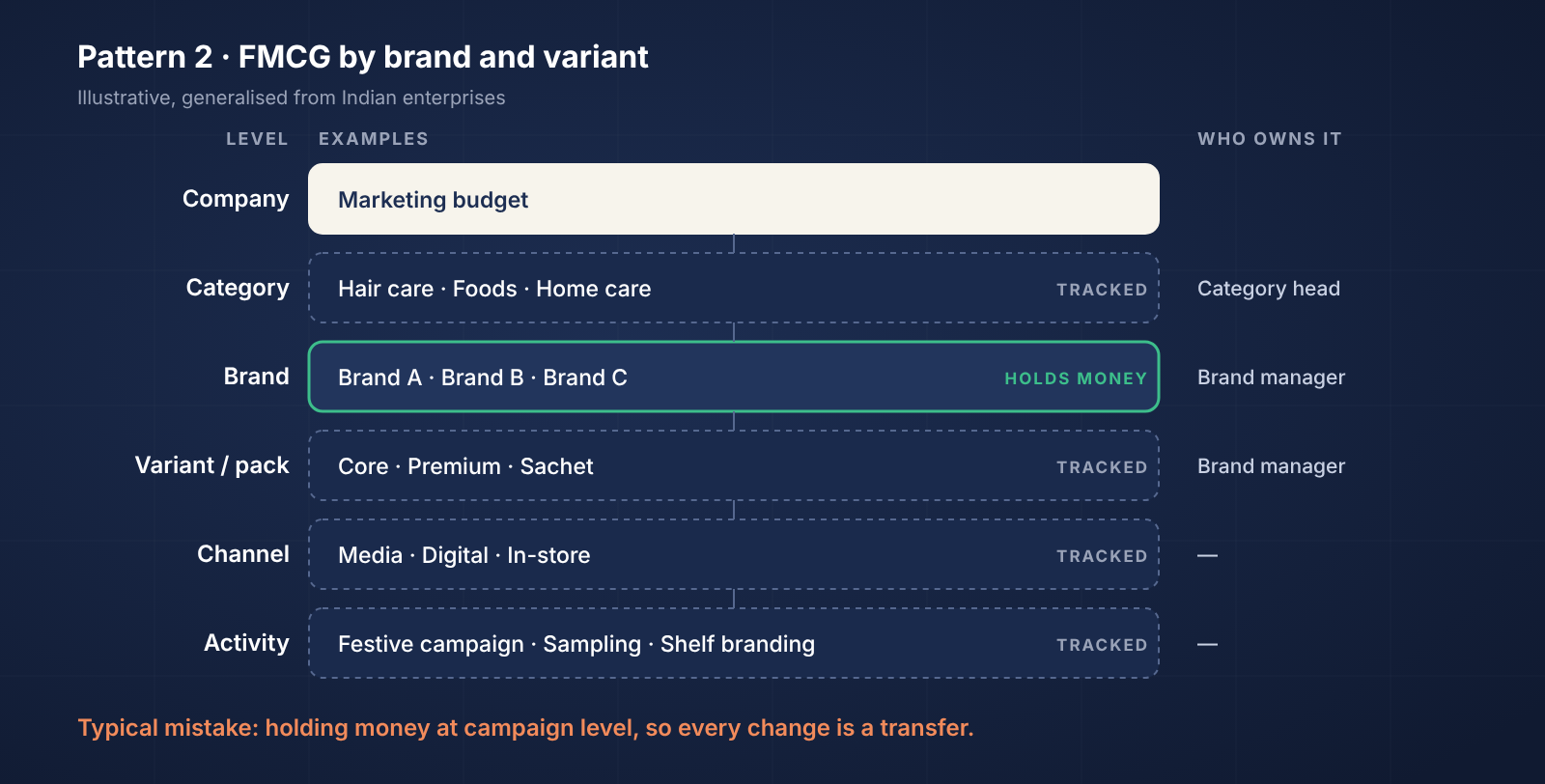
In FMCG the person accountable for marketing money is almost always the brand manager, so the budget is held at brand level. Category sits above it for roll-up, and variant or pack, channel and activity are tracked below it. This lets a brand manager move money between a festive TV burst and in-store sampling without asking anyone, while finance still sees exactly where it went.
The mistake here is holding money at campaign level. Campaigns are short and constantly re-planned, so a structure that holds money per campaign generates a transfer every time the plan changes. Campaigns belong in the tracked rows, where they can come and go freely. It's also worth deciding early whether trade promotions, such as distributor schemes and retailer margins, sit inside this structure or in a separate trade budget, because mixing them halfway makes the brand totals hard to compare year to year.
How alco-bev companies structure the marketing budget by state
Most alco-bev companies hold the marketing budget by state, because state rules shape what can be spent, and carry each brand as a tag on the state's budget lines.
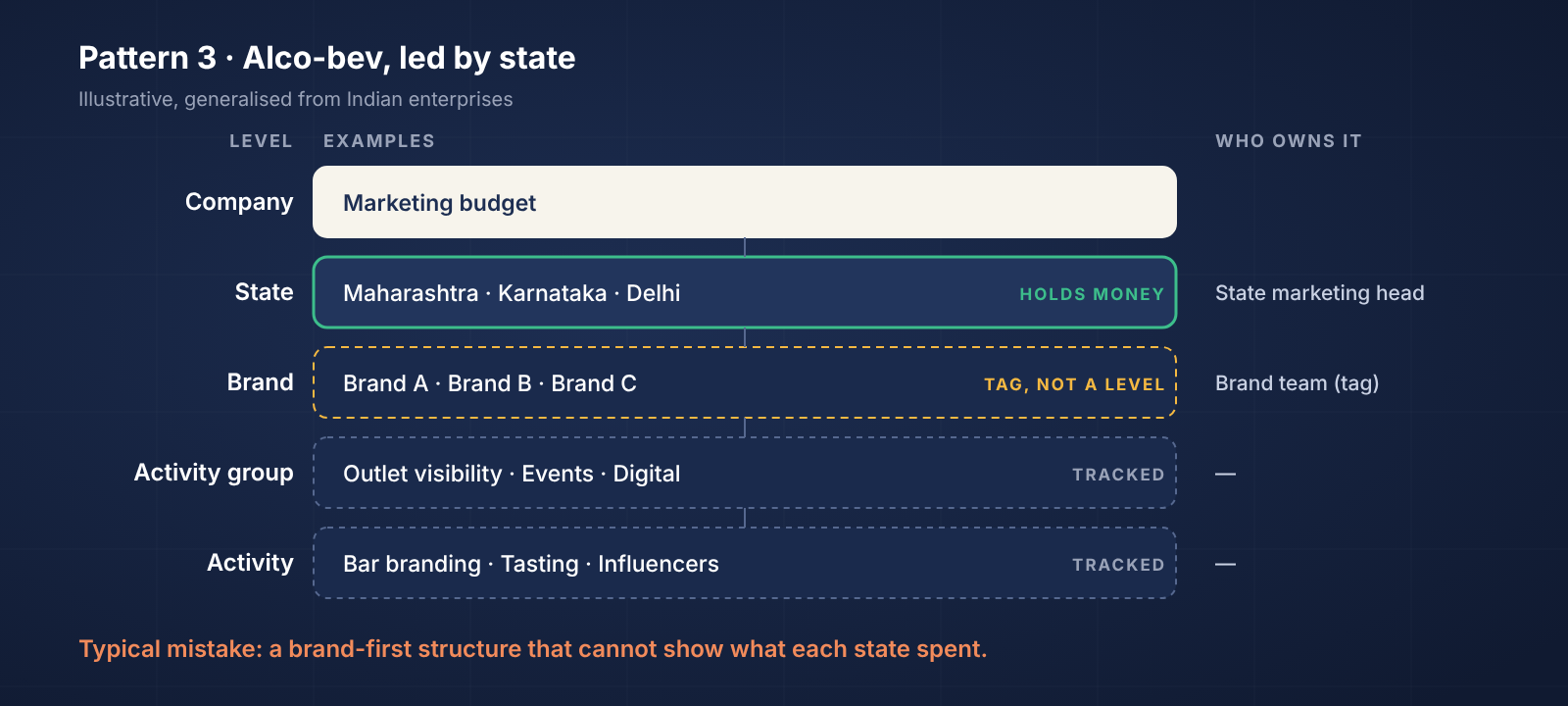
In alco-bev, the state shapes almost everything: what can be promoted, through which outlets, at what price, and when policy changes force a rethink. So the budget is held by state, owned by the state marketing head, and each brand is carried as a tag on the state's lines. Activities usually sit in parent and child groups, such as outlet visibility, events and digital, each with its own activity types underneath, which is why alco-bev structures often run much deeper than other industries.
The typical mistake is building the structure brand-first because that's how the global or head-office team thinks. It then can't answer the question that matters most mid-year: what did we spend in this state, and what can we move out of it now that the rules have changed?
How consumer durables companies structure the marketing budget across products and sales offices
Most consumer durables companies hold the marketing budget by category and region, and carry the sales-office hierarchy as a tag on each line rather than as a separate level.
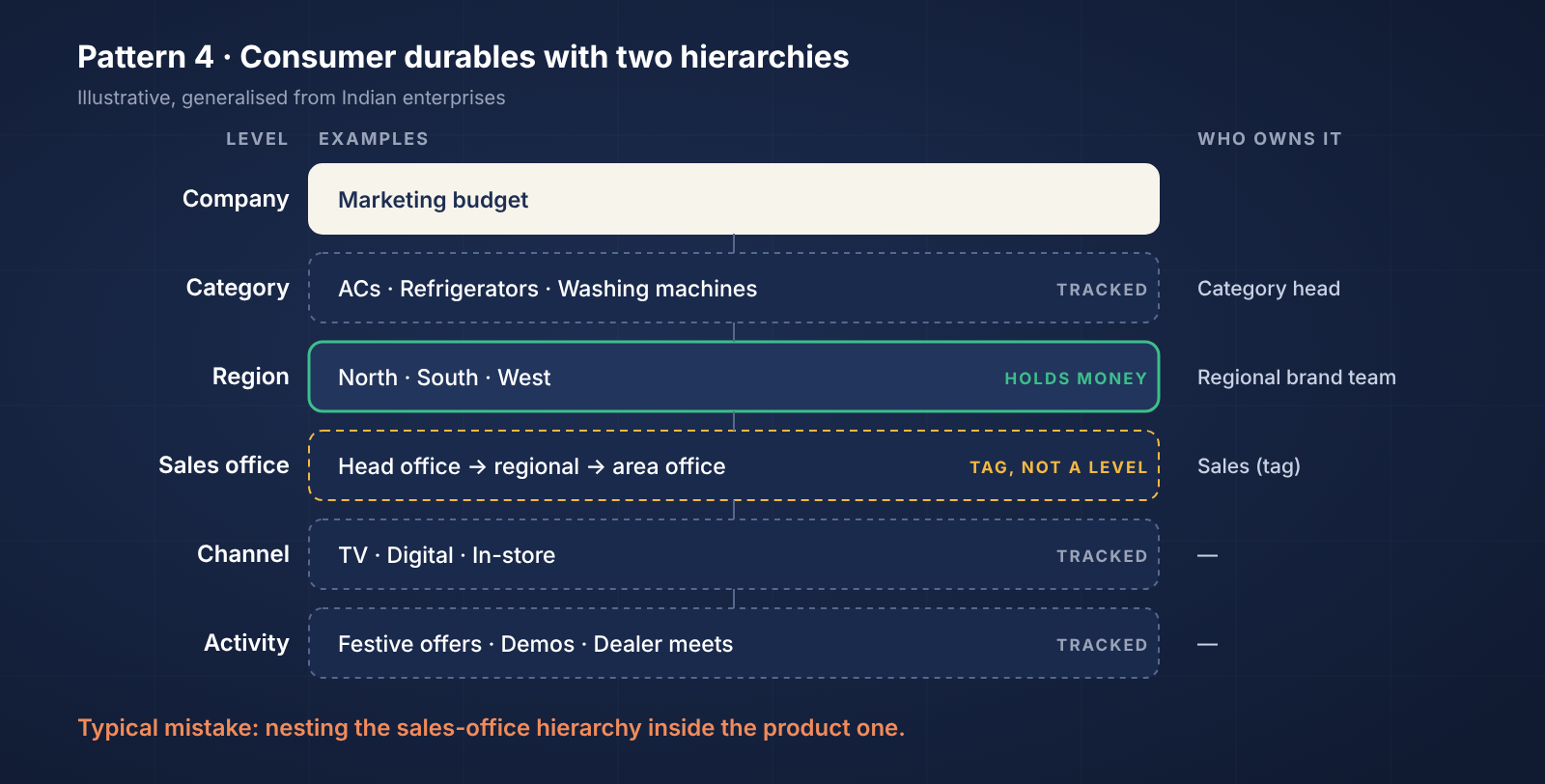
Durables companies usually run two organisations at once. The product side goes from category to sub-category to variant. The sales side goes from head office to regional office to area office to dealer. Both are real, and both want to see their spend.
The pattern that works holds money by category and region, owned by the regional brand team, and carries the sales-office hierarchy as a tag on every line. That way the brand team can add up spend by product, and the sales team can add it up by office, from the same lines. The mistake is nesting one hierarchy inside the other, so that every category is split again by every office. It multiplies the lines, forces an argument about which hierarchy comes first, and nobody ever wins it.
How paint and building materials companies structure the marketing budget for dealers and contractors
Paint and building materials companies usually hold the marketing budget by zone and by programme, so contractor and painter schemes sit inside the marketing budget rather than outside it.
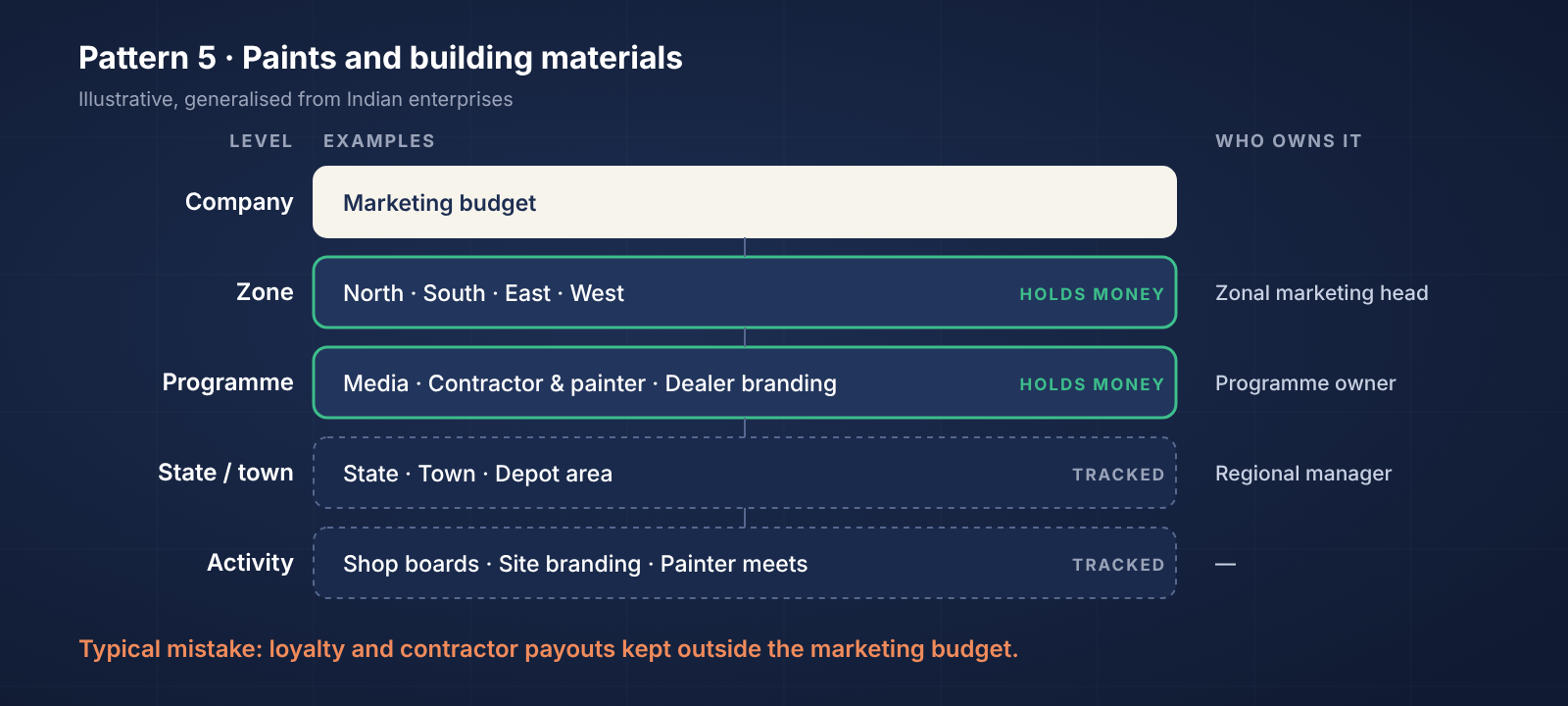
Paints and building materials companies spend a large share of their marketing money on people who influence the purchase: contractors, painters and dealers, through loyalty points, meets and shop branding, alongside regular media. Here the budget is usually held at two points: by zone, owned by the zonal marketing head, and by programme, owned by whoever runs media, the contractor and painter scheme, or dealer branding. State, town and activity are tracked below.
The typical mistake is leaving loyalty and contractor payouts outside the marketing budget, often inside sales incentives, because they are paid differently. The marketing budget then looks smaller than the real cost of reaching the customer, and nobody can compare a painter scheme with a media burst on equal terms.
How to design your own marketing budget structure: five decisions
Five decisions turn any of these patterns into your own structure: the questions it must answer, the level that holds money, how to treat a second hierarchy, how each line maps to the ledger, and who owns each level.
Whichever pattern is closest to yours, these are the five decisions that turn it into your structure. They are best made before a single number goes into next year's template.
1. Which questions must the budget answer next year? Write down five or six questions the CFO, the CMO and the business heads asked this year, such as how much went to one brand, in one region, on one kind of activity. Every level in your structure should exist because one of those questions needs it. A level that answers nobody's question is just extra work.
2. At which level is money held? Pick the level where one person is accountable for the number: zone, brand, state, region or programme. Everything above it is roll-up, and everything below it is tracked. If you're unsure, go one level higher rather than lower; it's far easier to track more detail than to manage hundreds of tiny approved amounts.
3. Is there a second hierarchy, and is it a tag? If a second group of people needs to see spend their way, such as a sales organisation, model lines or brands inside a state, carry it as a tag on each line instead of adding a level. One line, two ways of adding it up.
4. How does each line map to the ledger? Every budget line should map to exactly one expense head and one cost centre in SAP or whichever ERP you use. Many lines can share the same expense head, and that's normal. One line spread across several expense heads, depending on who books the invoice, is what makes the budget and the ledger disagree at every month-end. Agree the mapping once, write it down, and change it only at the start of a year. If you'd rather not maintain all of this in a spreadsheet, Brandintellé lets you set up the budget in your own hierarchy, at whatever depth you need, by uploading the template you already use, while SAP stays the ledger.
5. Who owns each level? Put a name or a role against every level that holds money, and decide what that owner can see and change. Ownership is what makes the structure work in practice: it decides who gets asked when a line runs short, and who can move money inside their own area without a formal request.
The structure is agreed during budget season, alongside the numbers, and our CMO's guide to budget season shows where it fits in that calendar. Once the structure is set, the next question is how to split the money across it, which our guide to marketing budget allocation covers.
Frequently asked questions
How do large companies structure marketing budgets across brands, regions and channels?
They hold the budget at the one level where someone is accountable, and track the rest underneath. FMCG companies usually hold it by brand, automakers by dealer zone, alco-bev companies by state, durables companies by category and region, and paints companies by zone and programme. Channels and activities are tracked below that level, and a second hierarchy, such as sales offices or model lines, is carried as a tag on each line.
What are the main categories in a marketing budget?
Most enterprise marketing budgets group spend into media (TV, print, outdoor, digital), on-ground and in-store activity, trade and channel programmes, production and content, research, and fees for the people who run the work. These categories usually sit below the brand or region level as tracked rows, and each one maps to an expense head in the ERP so the budget and the ledger stay comparable.
Should a marketing budget be organised by cost centre or by campaign?
Neither on its own. Cost centres and expense heads are how the ledger records spend, so every budget line should map to exactly one of each. Campaigns change too often to hold money, so they work best as tracked rows. The budget's own structure, by brand, region, state or zone, sits between the two and is where money is actually held and owned.
Can SAP hold a marketing budget hierarchy?
SAP records spend against cost centres, internal orders and expense accounts, and purchase orders can carry commitments against them, which is why it should stay the ledger. Many companies keep the marketing hierarchy itself, by brand, region and activity, in a planning layer above SAP and map each budget line to one SAP account and cost centre, so both views stay consistent.
Your budget structure decides which questions you'll be able to answer next year. Pick the pattern, then make the five decisions before the numbers go in.
See how Brandintellé sets up the marketing budget in your own hierarchy.