
Your ledger tells you what marketing has been invoiced. It doesn't tell you what marketing has already decided to spend. Here is how to track that gap, stage by stage, and give the CFO a remaining budget that holds.
If you're the person in finance who tells the CFO how much marketing budget is really left, you know this moment. The ledger says most of the festive budget is still available. The brand team says it is nearly gone. Both are right. They are counting the same rupee at different points in its life.
Marketing money is decided long before it is invoiced. A plan is approved. The campaign goes live against that budget. A purchase order follows. The invoice comes last, sometimes two months after the work. The ledger records that last step faithfully. The steps before it sit in approvals, email threads and media plans.
Key takeaways
Committed spend is money marketing has already decided to spend but has not been invoiced for. Actual spend is what has been invoiced and booked.
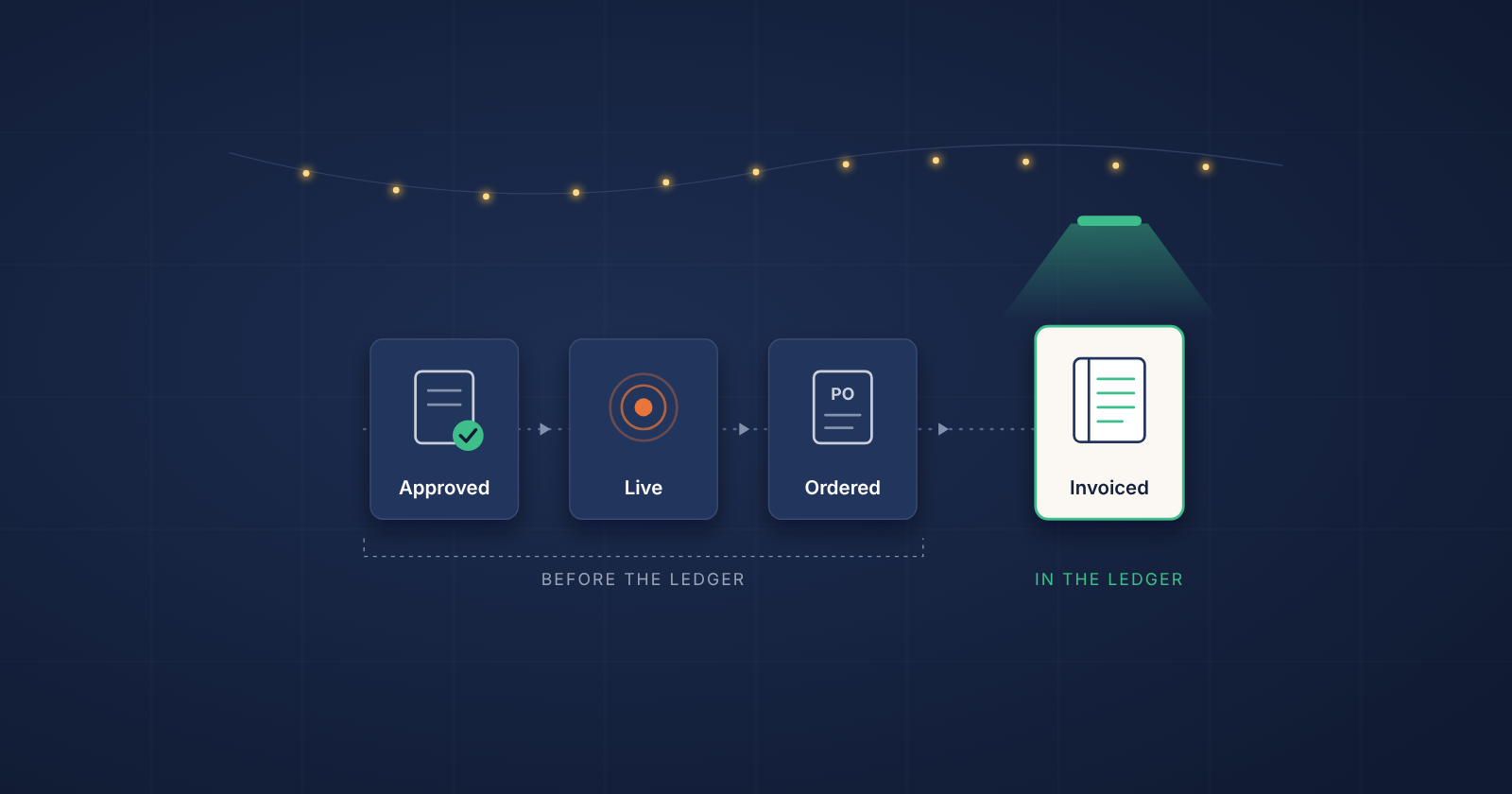
Marketing money passes through four stages: approved, live, purchase order raised and invoiced. Three of them happen before the ledger sees an invoice.
The purchase order is not a clean measure of commitment. Retainers and buffered POs overstate it, and work that starts before a PO understates it.
A monthly view that tracks each budget line by stage, and ties back to the ledger and the month-end provision, gives the CFO a remaining budget and a cash forecast that hold.
Your ledger is right. It answers a different question.
The ledger answers one question well: what have we been billed for, and what do we owe? It is built to be right about that, and it usually is.
Once a purchase order exists, finance can often see that too. ERPs can hold open PO amounts against a cost centre as commitments, as SAP's documentation on commitments management describes.
Two things still sit outside that view. The first is money committed before any PO is raised. The second is the campaign itself. A cost centre and a GL code tell you which budget paid, not which campaign, brand or region the money went to.
This matters because the remaining budget is the number decisions are made on. It decides whether the next plan gets approved and whether next quarter's tranche is released. And the line is large: Gartner's 2025 CMO Spend Survey puts marketing at 7.7% of company revenue among large companies in North America and Europe.
We've written a separate guide on the five numbers a CFO should see for marketing spend. This article goes deeper into one of them: committed spend, and how to count it honestly.
Marketing money passes through four stages before it is spent
Every rupee of marketing spend moves through the same four stages. Each stage is recorded in a different place, and only the last one reaches the ledger as actual spend.
Approved. A plan or brief is signed off against a budget line. The record is an approval email or a note for approval.
Live. The activity has started against that budget, often before a PO exists. Regional retail branding begins on an approval email. A running media plan is extended by a week. The record is usually a message, not a document.
Ordered. A purchase order is raised. The record is in the ERP, and it can show as an open commitment.
Invoiced. The vendor bills and the invoice is booked. This is actual spend.
Between ordered and invoiced sits one more state: work delivered but not yet billed. That is the month-end provision, and we cover it in our guide to month-end marketing provisions.
Take the festive campaign from that guide. Assume its budget line is ₹6 crore for the quarter. At the end of the first month, plans worth ₹5.2 crore have been approved. Purchase orders cover ₹4 crore of that. Of the ₹1.2 crore approved without a PO, ₹40 lakh is already live. One invoice of ₹30 lakh has been booked.
Ask how much is left, and you get three answers:
From the ledger: ₹6 crore minus ₹30 lakh invoiced leaves ₹5.7 crore.
From open POs: ₹6 crore minus ₹4 crore ordered leaves ₹2 crore.
From the stages: ₹6 crore minus ₹5.2 crore approved leaves ₹80 lakh.
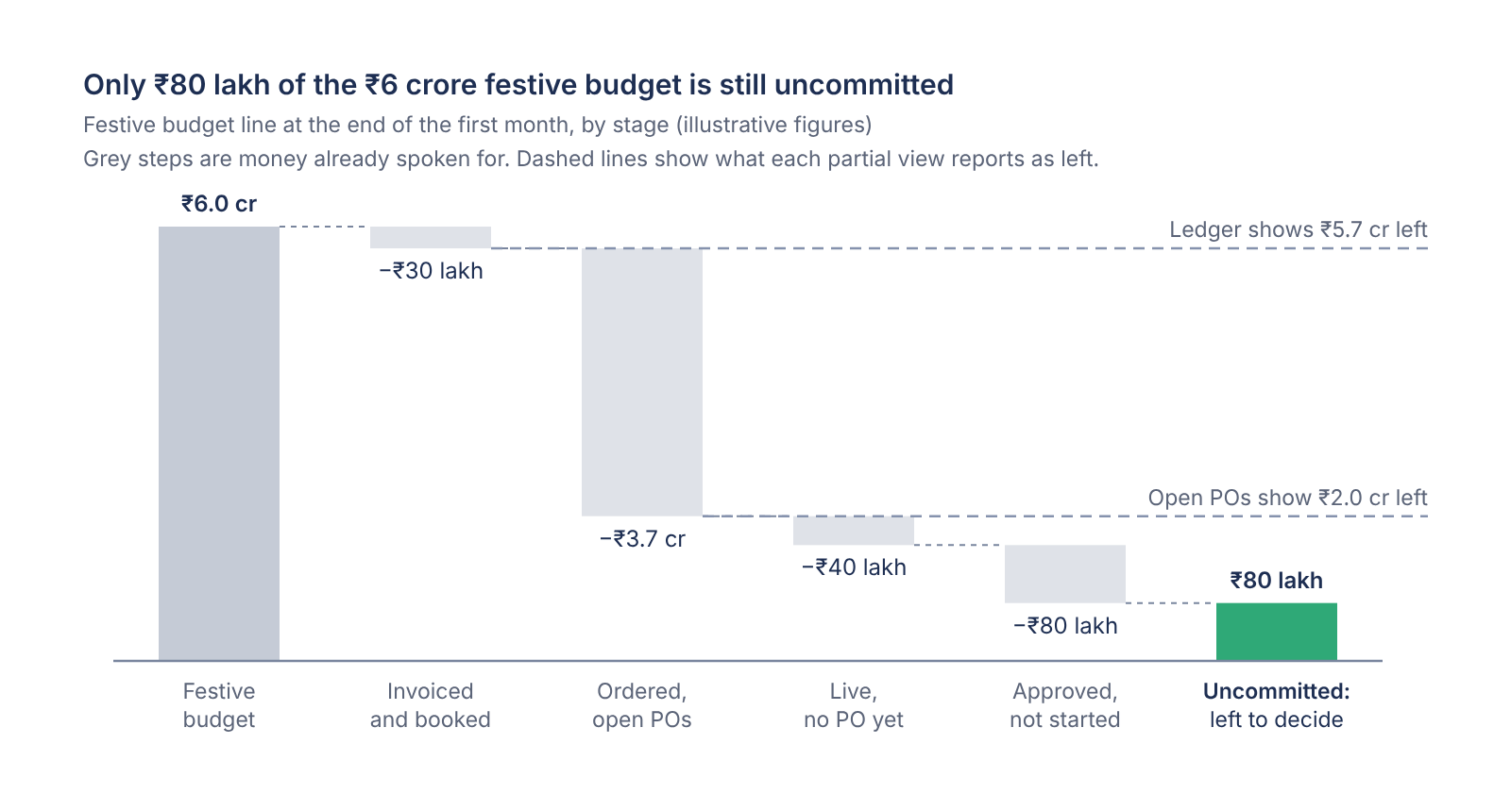
Illustrative festive campaign figures, end of the first month
Only the last number tells the CFO what can still be decided. The other two describe money that marketing has already spoken for.
Why the purchase order isn't the commitment
It is tempting to treat the open PO balance as the commitment. It is the most visible stage, and it already sits in the ERP. But the PO measures commitment badly in both directions.
Some POs say more is committed than really is:
Retainers. An annual retainer is often raised as one PO for the year. It is a full-term commitment against the annual budget, but it is consumed month by month.
Buffered POs. Getting a PO revised upward takes longer than asking for more at the start. So POs are often raised with a margin, and the margin looks like committed money.
Stale balances. When work ends short of the PO value, the unused balance stays open until someone closes it.
Other spend is committed before any PO exists:
Work that starts on approval. Regional activity and quick extensions often begin before the paperwork catches up.
Verbal commitments. In-season regional spend is sometimes agreed on a call and raised later.
So the open PO balance mixes money that will never be spent with missing money that will. The fix is not to distrust POs. It is to treat the PO as one stage among four, and to start counting commitment at approval.
How to build the monthly committed-vs-actual view
The view is one row per budget line, with a column for each stage. Marketing confirms the stages, because marketing owns and defends its spend. Finance builds the number and ties it to the books.
Column | What it counts | Where the figure comes from | Who confirms it |
|---|---|---|---|
Budget | The approved amount for the line this period | The annual plan and any approved changes | Finance |
Approved, no PO yet | Signed-off plans with no PO raised | Approval emails or notes for approval | The budget owner in marketing |
Of which live | Approved activity that has already started | The budget owner | The budget owner in marketing |
Ordered | Open PO balance, net of what has been invoiced | The ERP | Finance |
Invoiced | Invoices booked against the line | The ERP | Finance |
Uncommitted | Budget minus approved, ordered and invoiced | Calculated | Finance |
Once a month, tie it back to the books in four steps:
Match the ordered and invoiced columns to the ERP. For each cost centre, the totals should agree. A gap usually means a PO raised against the wrong line, or a coding difference.
Keep the provision inside the ordered column. Work delivered but not billed is part of the open PO balance. In the festive example, ₹1.37 crore of the ₹3.7 crore still on order has been delivered and provisioned. Count it once.
Chase approvals that never became POs. Anything approved more than a month ago with no PO needs an answer from marketing: live, delayed or dropped.
Close stale PO balances. When work ends short, reduce or close the PO so the unused balance goes back to uncommitted.
Give the CFO the next three months, not last month
The same view answers the question CFOs ask most about marketing cash: how much goes out over the next three to four months?
Every commitment in the view will become an invoice, and each kind bills on its own rhythm. TV bills after it airs. Digital usually bills a month in arrears. Field activity bills after proof of work is accepted. Retainers bill evenly through the term.
So phase each commitment by the month you expect its invoice. Approved plans and live work go into the months they will bill, not the month they were approved. Retainers go in month by month, not as one lump. Add the rows up and you have a marketing cash forecast built from decisions already taken.
Many companies release the marketing budget in quarterly instalments. This view makes that decision easier. If a line has little uncommitted budget left, finance can see that marketing has genuinely used what it was given, even when the ledger still shows plenty available. Both sides then start the conversation from the same numbers.
Frequently asked questions
How can a CFO see committed vs actual marketing spend beyond what SAP shows?
Track each marketing budget line through four stages: approved, live, ordered and invoiced. SAP shows booked invoices and, in many setups, open PO commitments. The stages before the PO, approved plans and work already running, sit in approvals and email. Add them to a monthly view per budget line, tie the ordered and invoiced figures to SAP, and report what is still uncommitted.
Why doesn't SAP show marketing spend by campaign?
The ledger records each transaction against a cost centre and a GL code, which is what accounting needs. Campaign, brand, channel and region detail lives in the media plan, the brief and the PO text. Some companies carry campaigns as internal orders or WBS elements, which helps once a PO exists. The lasting fix is to tag each commitment by campaign when the plan is approved.
Our CFO wants visibility into all vendor spend commitments. How do we achieve this?
Start from approval, not from the purchase order. List every approved plan by vendor and budget line. Mark which are live, which have a PO and which are invoiced, and have marketing confirm each line monthly. Close PO balances when work ends and phase retainers by month. Tie the ordered and invoiced totals to the ERP, so each vendor has one agreed number.
What is the difference between committed spend and actual spend in marketing?
Actual spend is what has been invoiced and booked in the ledger. Committed spend is money marketing has already decided to spend but has not been invoiced for: approved plans, work already live and open purchase orders.
How does a marketing spend governance tool like Brandintellé track committed spend?
It records commitment on the budget line at every stage. In Brandintellé, each line shows what is approved, what is live, what is on a PO and what is invoiced, next to the budget and the available balance for each month. Plans can't move without available budget, POs are raised against the accepted estimate, and month-end provisions post to SAP, which stays the ledger.
The ledger tells you what marketing has spent. Commitment tells you what is left to decide.
See how Brandintellé shows approved, ordered and invoiced spend on one budget line.