
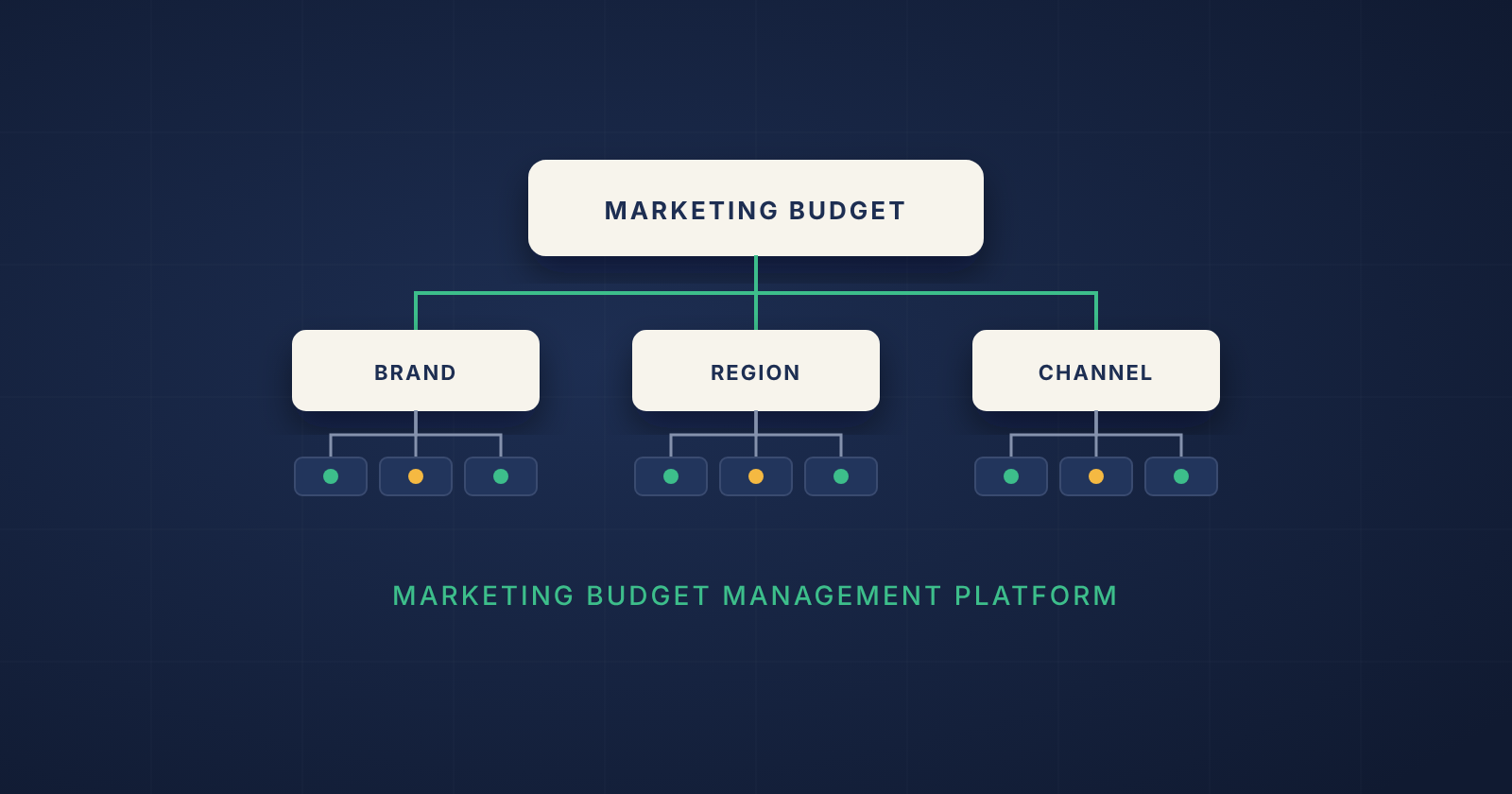
A marketing budget management platform is a software that holds the marketing budget in the structure the business plans in (brand, region, channel, activity) and controls it as it is spent: approvals, moves between lines, commitments to vendors, proof of work and invoices. Excel records the budget. A platform governs it, and it hands clean numbers to the ERP rather than replacing it.
If you run marketing finance in a large company, you have probably been asked some version of this question: "Do we need a tool for the marketing budget, or is Excel fine?" The honest answer is that Excel is fine for writing the budget down. Where it breaks is everything that happens after April: the requests to move money, the approvals in email, the purchase orders raised against lines nobody is tracking, the invoices that arrive months later and can't be matched to what was planned.
That gap is what a marketing budget management platform exists to close. This guide explains what one should do, how it differs from the tools you already have, and when it's worth buying one.
What does a marketing budget management platform do?
It does six jobs in sequence, from the approved budget to the paid invoice, and keeps every step linked to the budget line it came from.
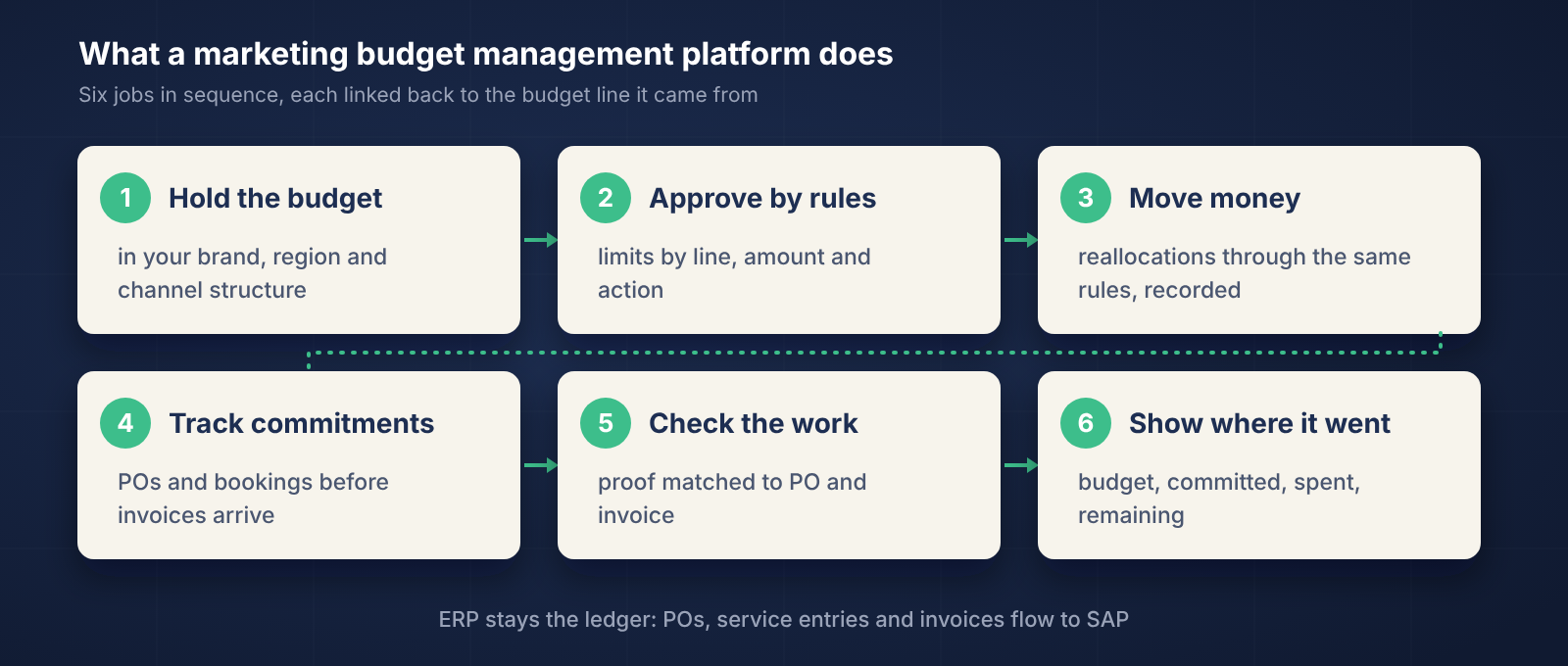
1. Hold the budget in your structure. Brand, sub-brand, region, state, channel, activity: as many levels as the business needs, with an owner for each level. This is the part most tools skip, and it decides every report you can run later. Our guide to marketing budget structure shows the patterns large Indian companies use.
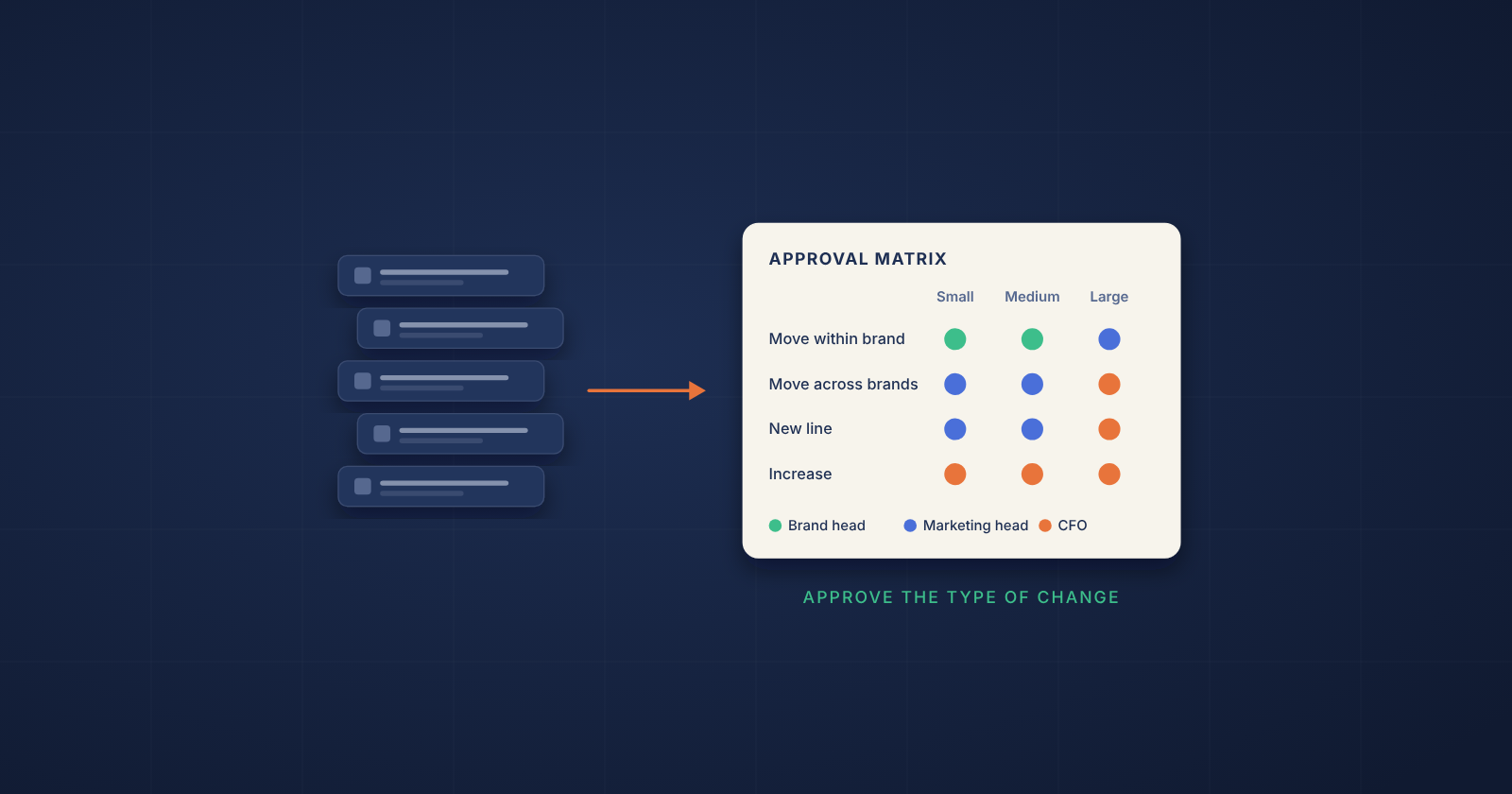
2. Approve spend by rules, not by inbox. Who can approve what, up to which amount, for which line. When the rule lives in the system, a request goes to the right person on its own and the approval is recorded. Our marketing budget approval matrix covers how to set those rules.
3. Move money without losing track of it. Budgets change mid-year. A platform lets a brand or region move money between lines through the same approval rules, and keeps a record of every move and its reason, so the budget you approved and the budget being spent can always be reconciled.
4. Track commitments, not just invoices. The moment a purchase order or a media booking is raised, that money is gone, even though no invoice has arrived. A platform shows what is committed against each line, so "available budget" means what it says. This is the difference between committed and actual spend.
5. Check the work before paying for it. Proof that the campaign ran, the hoarding went up or the platform delivered, matched against the purchase order and the invoice before payment. Without this step, the budget is controlled on the way out but not on the way back.
6. Show where the money went. Budget, committed, spent and remaining, by any level of the structure, at any time, without someone rebuilding it in a spreadsheet the night before a review.
How is it different from Excel, SAP, FP&A tools or MRM software?
Each of those tools does part of the job well. A marketing budget management platform is the one built for the whole marketing spend cycle, and it sits between them rather than replacing any of them.
Tool | What it's good at | Where it stops for marketing spend |
|---|---|---|
Excel | Building the budget; flexible, everyone knows it | No approvals, no link to POs or invoices, a new version every week |
SAP or another ERP | The financial ledger: POs, invoices, payments, cost centres | Sees a cost centre and a GL code, not a brand, campaign or activity |
FP&A planning tools | Company-wide budgets, forecasts and scenarios | Plan at account level; don't follow a campaign through approvals, vendors and proof |
MRM / marketing work management | Campaign calendars, briefs, tasks, creative workflow | Track work, not money; budgets are a field, not a controlled ledger |
Expense and spend management tools | Employee cards, reimbursements, small-ticket spend | Built for travel and SaaS bills, not media plans and vendor contracts |
Marketing budget management platform | Budget in marketing's structure, approvals, commitments, proof and invoices in one chain | Doesn't replace the ERP; it feeds it |
The row that matters most for finance is the second. In SAP, a hundred campaign line items often collapse into one cost centre. That's not a flaw in SAP; it's a ledger, and it was never meant to know which brand in which state ran which activity. The platform keeps that detail and passes SAP what it needs: purchase requisitions, purchase orders, service entries, invoices.
If you're comparing named products rather than categories, our comparison of marketing planning and spend tools sets out where each one focuses, including Uptempo, Planful, Marmind and Aprimo.
When does a company need a marketing budget management platform?
When the budget has more owners than one person can track, and when finance can no longer answer "how much is left" without asking marketing.
A few signs it's time:
The budget runs across several brands, regions or business units, each with its own owner.
Moving money between lines needs an email chain, and nobody can say later who approved what.
Finance learns about a commitment when the invoice arrives.
Month-end provisions are built from messages and spreadsheets rather than from a system.
Auditors ask for proof behind marketing invoices and it takes weeks to assemble.
The quarterly review is spent agreeing on the numbers instead of deciding what to do with them.
If only one or two of these apply, a well-run spreadsheet and a clear approval policy may be enough for now. If most of them do, the cost is already being paid in time, delayed payments and money that sits unspent in one line while another runs short.
What should a marketing budget management platform not do?
It shouldn't replace your ERP, and it shouldn't try to be your project management tool.
Two warnings from the buying side.
First, be wary of any platform that wants to become the ledger. Finance has spent years getting SAP right, and moving the books is not what this category is for. The platform should sit above the ERP and integrate with it.
Second, a tool that manages campaign tasks and calendars well is not the same as one that controls money. Many lists of "marketing budget software" mix the two, and the difference shows up the first time an auditor asks for the approval trail behind an invoice.
How does Brandintellé handle marketing budget management?
Brandintellé holds the budget in your own structure, at as many levels as you need, and runs approvals, reallocations, commitments, proof of execution and invoice checks against it. It integrates with SAP rather than replacing it, it can run in our cloud or on your own, and auditors can be given their own view-only access.
Excel tells you what the budget was. A platform tells you where it is, who moved it, and whether you got what you paid for.
See how Brandintellé manages the marketing budget from plan to payment.