
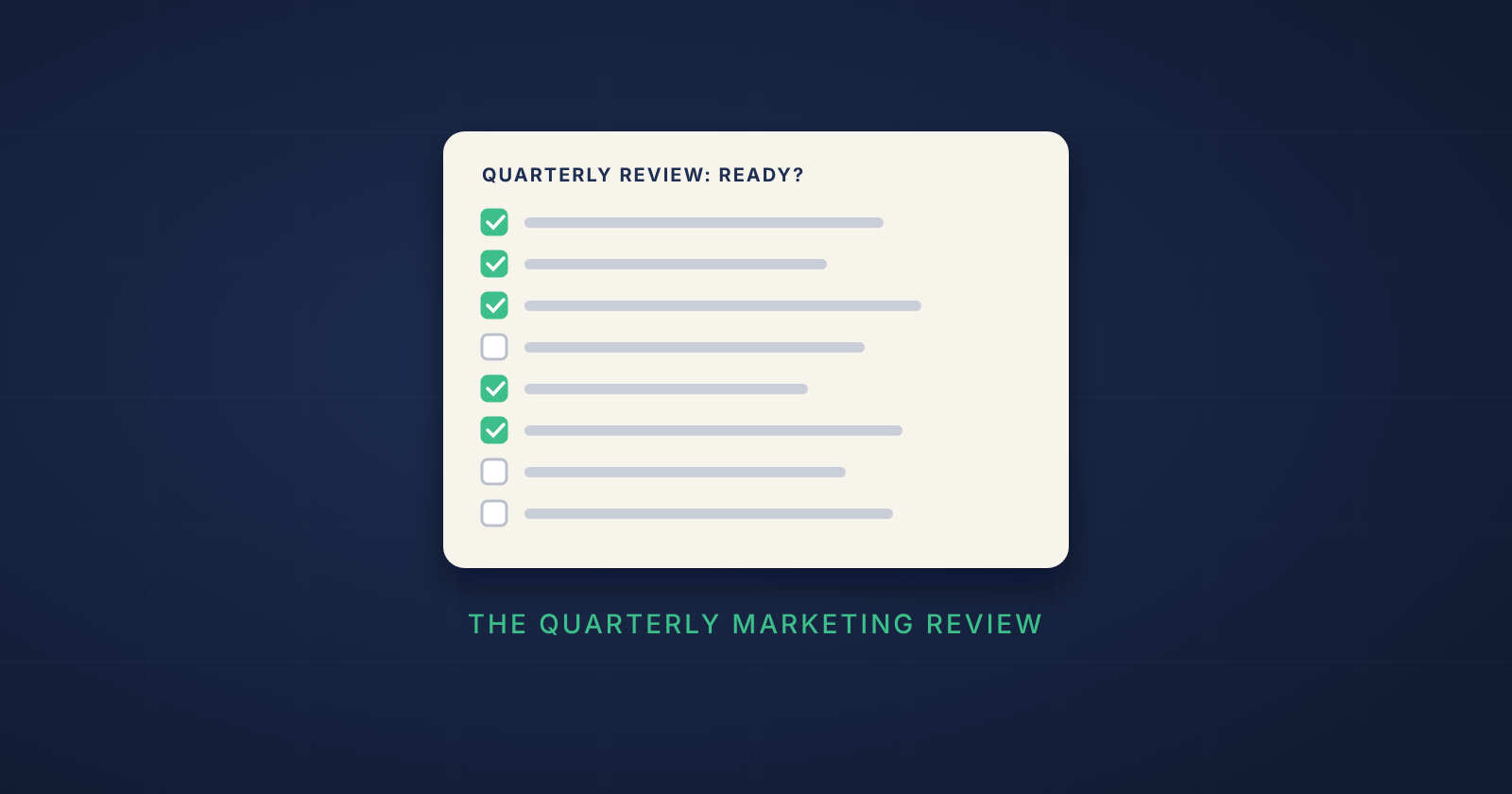
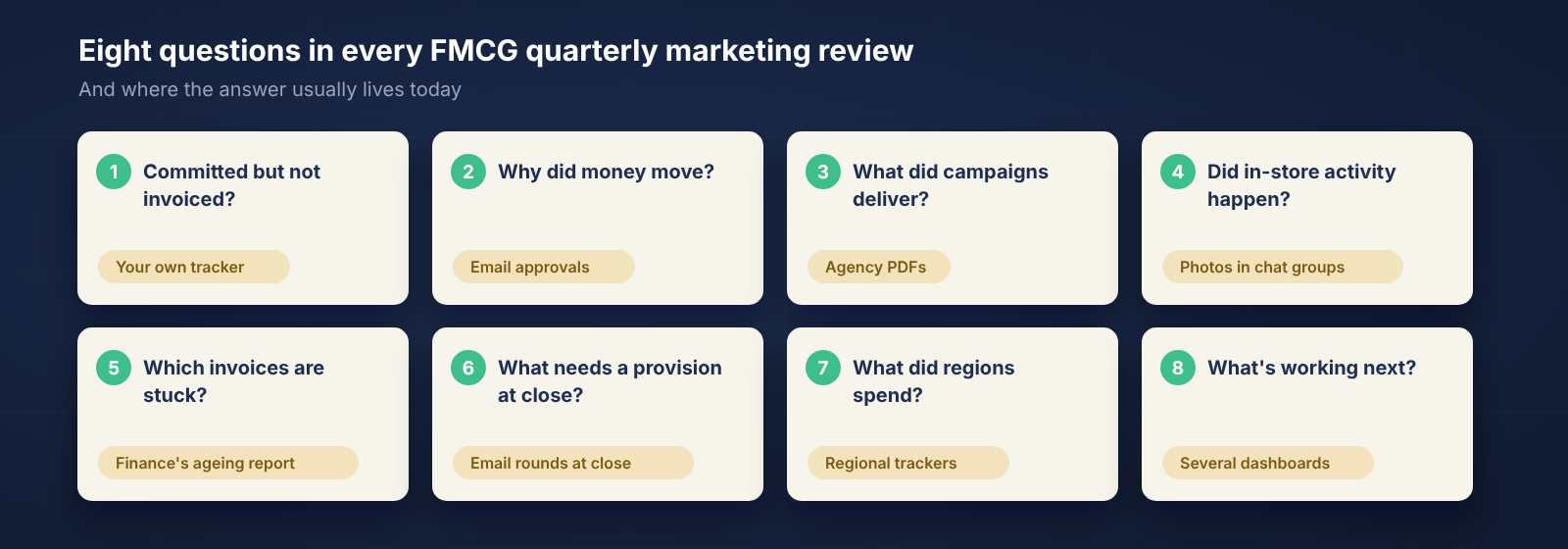
A quarterly marketing review in an FMCG company usually comes down to eight questions from the CMO and the finance business partner: what's committed, why money moved, what campaigns delivered, whether trade activity happened, which invoices are stuck, what to provision, what regional teams spent, and what's working. Category and brand heads who walk in with those eight answers ready spend the review deciding, not defending.
If you run a category, a brand portfolio, media or trade marketing, the quarterly review is where your spend gets examined from two sides at once. The CMO wants to know what the money achieved. Finance wants to know where it is, what's committed and whether the numbers match theirs. You sit in the middle, usually with a spreadsheet you rebuilt the night before.
The questions are predictable. The answers are hard only because they live in different places: the budget sheet, agency emails, post-campaign PDFs, field photos and the ERP. This article lists the eight questions, why each one gets asked, where the answer usually sits today, and what a ready answer looks like. At the end is a one-page prep sheet to fill in before your next review.
What questions come up in a quarterly marketing review?
1. How much of your budget is committed but not yet invoiced?
Why it's asked: finance sees what has been invoiced. You know what has been promised to agencies and vendors. The gap between the two is the number finance worries about most, because it hasn't reached the ledger yet.
Where the answer usually lives: your own tracker, plus a few email threads with agencies.
What a ready answer looks like: for each brand, the budget, what's approved, what's committed by PO, what's invoiced and what's still open, as of the review date.
In Brandintellé's budget planning and tracking, every budget line shows spend at each of those stages, so this number is current without rebuilding it.
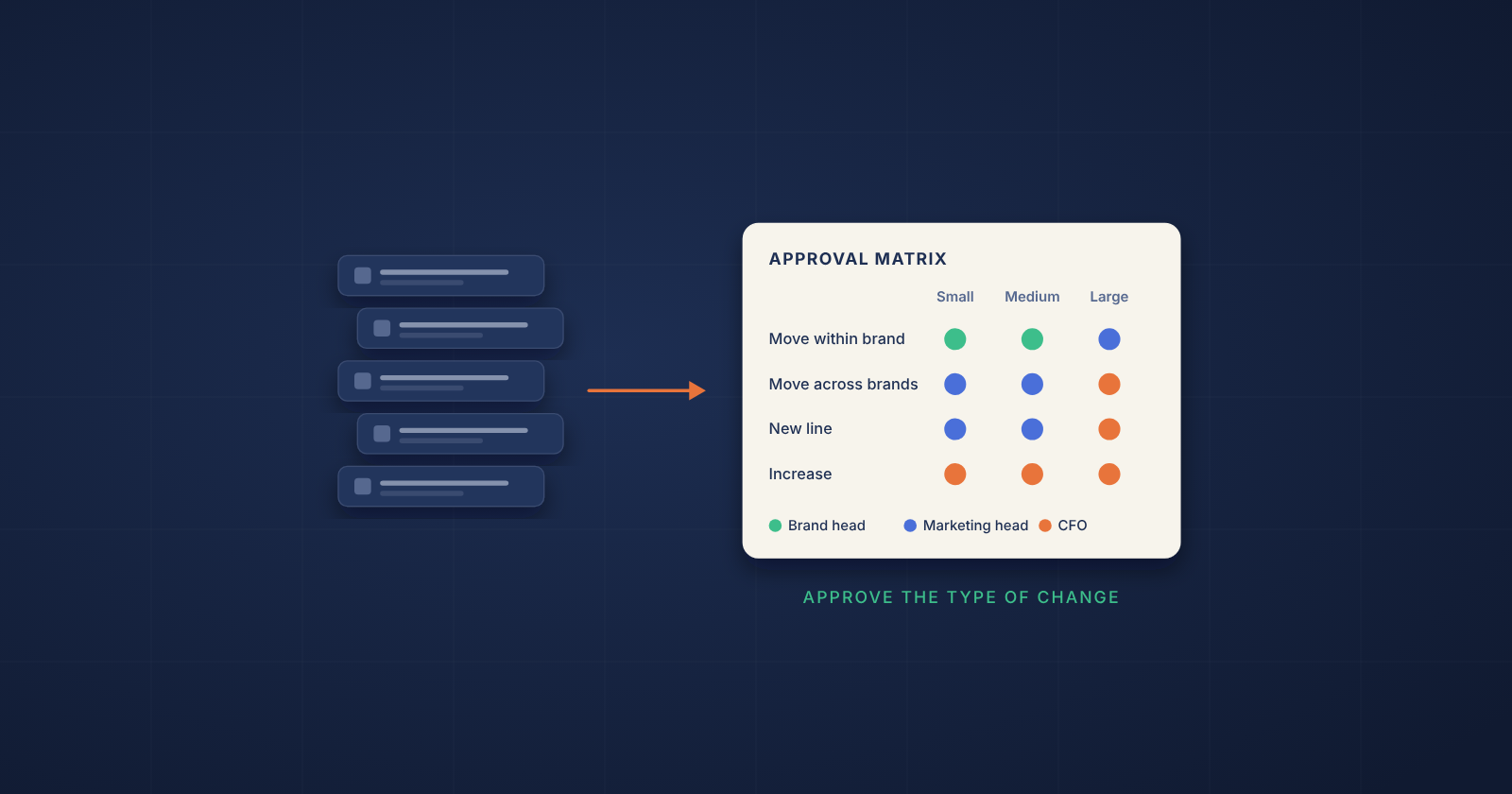
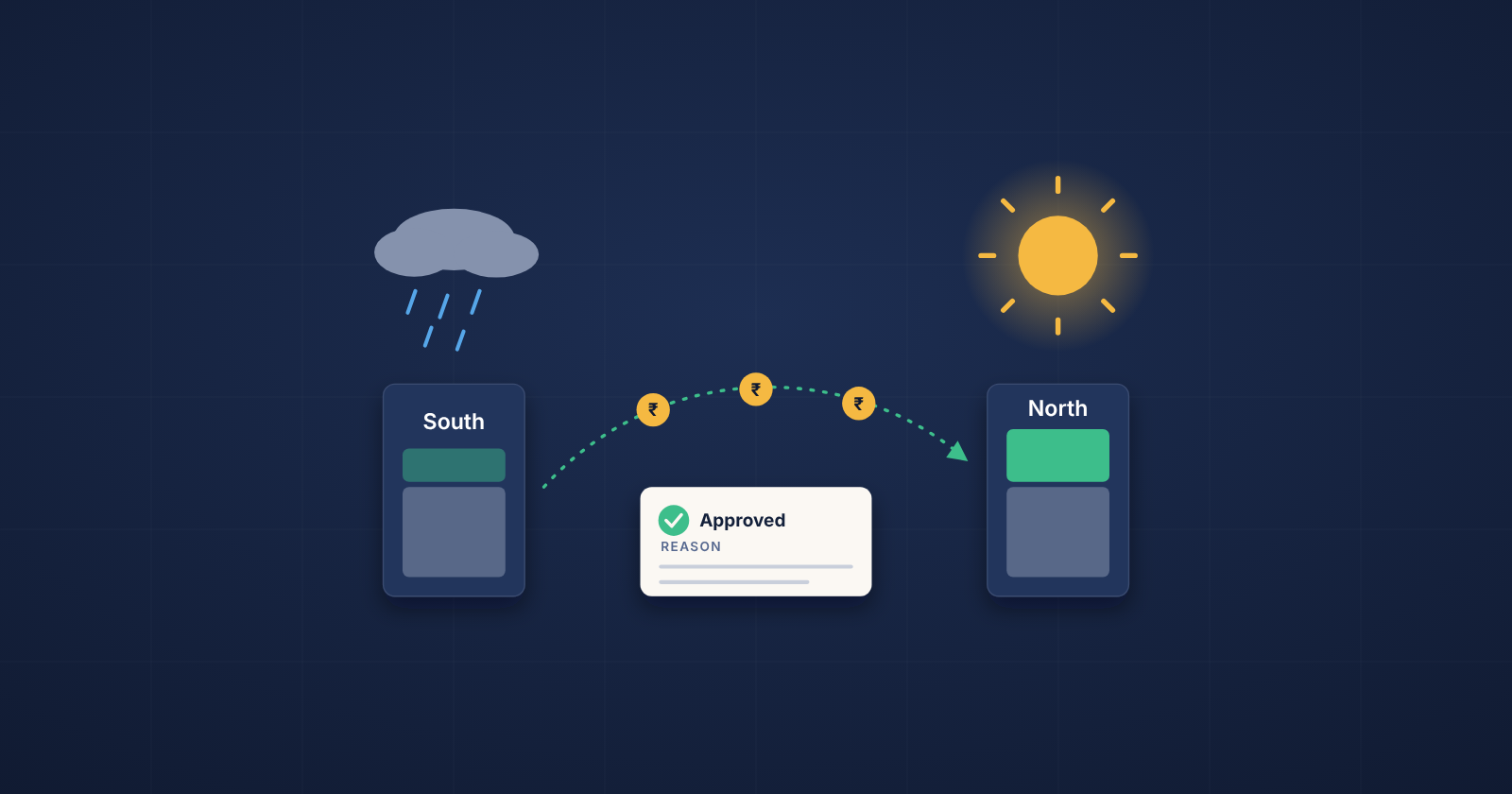
2. Why did money move between brands or lines this quarter, and who approved it?
Why it's asked: reallocations are normal in FMCG: a launch slips, a competitor moves, a festive window opens. What finance needs is the reason and the approval behind each move.
Where the answer usually lives: an email approval, if anyone can find it.
What a ready answer looks like: a list of every move this quarter: from which line, to which line, how much, why, and who approved it.
3. What did last quarter's campaigns actually deliver against the plan?
Why it's asked: the CMO wants to know the media ran as bought before anyone debates whether it worked.
Where the answer usually lives: the agency's post-campaign PDF, compared against the estimate by hand.
What a ready answer looks like: for each campaign and medium, planned versus delivered, the deviations, and what was done about them: accepted, made good or credited.
4. Did the in-store and on-ground activity actually happen?
Why it's asked: POSM, visibility and BTL are often the least evidenced spend in the budget. You can prove the material was shipped; finance wants to know it went up, in the right outlets, and stayed up.
Where the answer usually lives: photos in a chat group, and a vendor's completion report.
What a ready answer looks like: outlets or sites planned, outlets with proof of installation, outlets checked again during the campaign, and any visits that were missed.
With Brandintellé's geo-monitoring, proof is captured on location, geo-fenced and timestamped, with no gallery uploads, and attached to the line item it proves.
5. Which invoices are stuck, and why?
Why it's asked: delayed invoices damage vendor relationships and distort the quarter's numbers. Finance wants to know whether the hold-up is on marketing's side.
Where the answer usually lives: a mix of finance's ageing report and your inbox.
What a ready answer looks like: each open invoice with its PO, what it's waiting for (proof, a corrected invoice, a deviation explanation) and who owns the next step.
6. What does finance need to provision at quarter-end?
Why it's asked: work that's done but not yet billed still has to be accrued. Finance can only do that if marketing confirms what was delivered.
Where the answer usually lives: an email round asking each brand and agency what's complete.
What a ready answer looks like: for each PO, the work completed this quarter but not yet invoiced, confirmed by the agency or the brand team.
7. What did regional teams and distributors spend?
Why it's asked: regional and channel-partner activity is funded centrally but run locally, and often reported upward only as a total.
Where the answer usually lives: regional trackers and distributor claims that arrive at quarter-end.
What a ready answer looks like: regional plans approved against the central budget, the split between brand-funded and partner-funded spend, and claims backed by proof.
Brandintellé's regional marketing workflow lets regional teams and distributors submit plans and claims under the central campaign.
8. What's working, and where would you move money next quarter?
Why it's asked: this is the question the review is really for. Everything above is what earns you the time to discuss it.
Where the answer usually lives: several dashboards, none of which match the budget sheet.
What a ready answer looks like: spend by brand, medium and region next to delivery and sales, and two or three moves you'd propose, with the reason for each.
Brandintellé's impact and analytics dashboards show the same spend by media, brand and geography, and AI Insights suggests where to move budget, for your team to decide.
How can you prepare for your next quarterly marketing review?
Use this: fill in this prep sheet a week before the review. It takes about an hour the first time, and much less once the sources are known.
# | Question | My answer (one line) | Where the answer came from | Ready? (ready / partly / not yet) | What to chase, and from whom |
|---|---|---|---|---|---|
1 | Committed but not invoiced | ||||
2 | Moves between lines, and approvals | ||||
3 | Campaign delivery against plan | ||||
4 | Proof of in-store and on-ground activity | ||||
5 | Stuck invoices and why | ||||
6 | Quarter-end provisions | ||||
7 | Regional and distributor spend | ||||
8 | What's working, and next moves |
How to read it:
Every "not yet" is a question you'll be asked anyway. Chase it this week, not in the meeting.
If the "where it came from" column says "spreadsheet" or "email" for most rows, the answers will take just as long next quarter.
Share the sheet with your finance business partner before the review. Agreeing the numbers in advance means the meeting can be spent on question 8.
The quarterly review goes well when the eight answers are ready before the meeting. Then the time goes on the only question that moves the business: where the money should go next.
See how Brandintellé keeps these answers ready for every review