
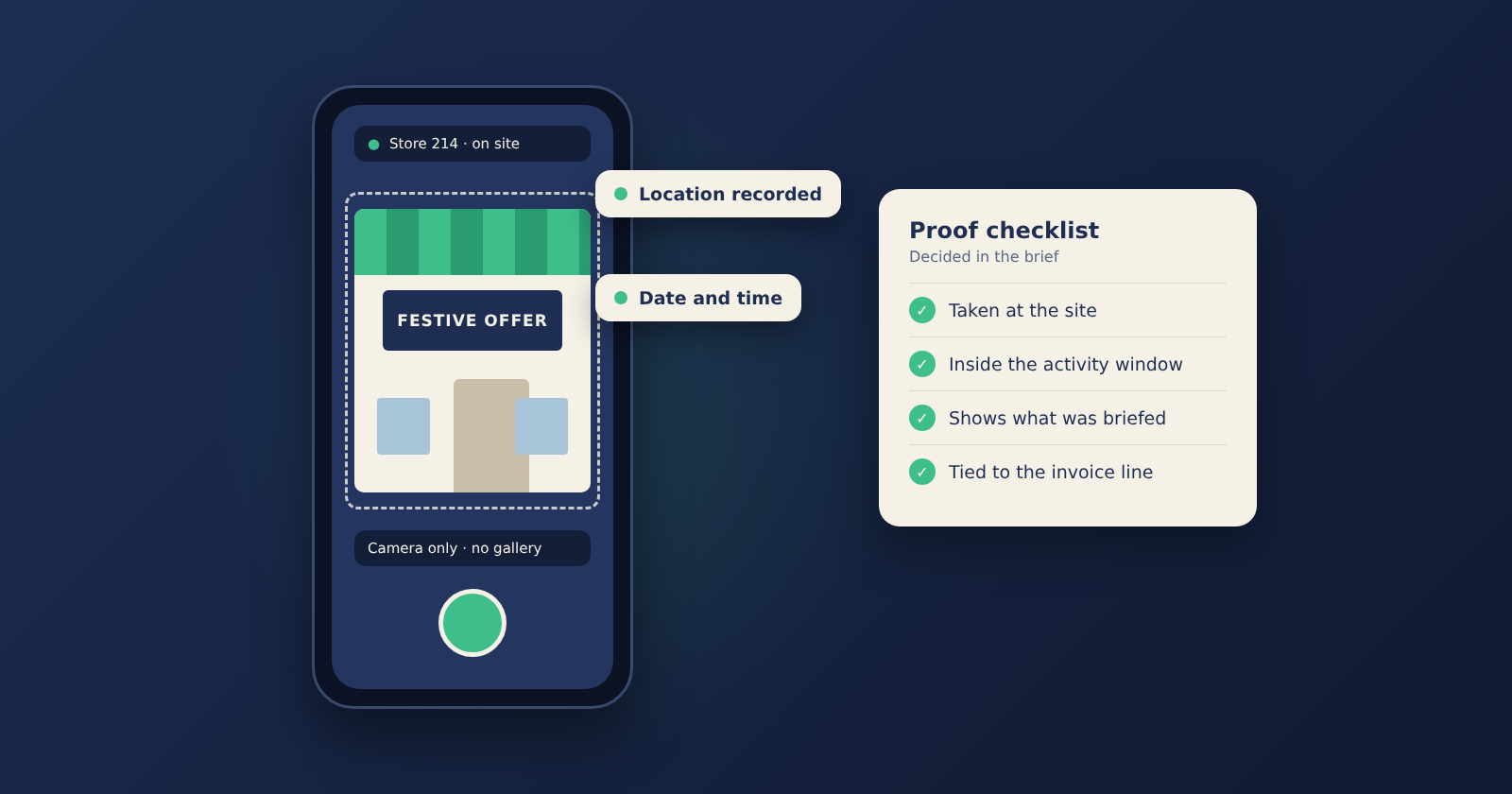
The vendor's invoice for your zone arrives on a Tuesday, along with a link to a chat-group folder holding about 2,000 photos, and finance would like your sign-off by Friday so the payment can go out. If you run marketing for a region, you have probably scrolled through that folder yourself: store fronts shot from across the road, a wall painting that looks finished in one photo and half done in another, a canopy that could be in any of three towns, and a few pictures you're fairly sure you saw last Diwali. Somewhere in there is the answer to a simple question, did the 500 store brandings on this invoice actually go up, and the way they were briefed, but the folder won't hand it to you easily.
This guide is for the person who has to answer that question. It follows one festive activation from the brief to the payment and shows what proof to ask for, when it should be captured, how to tell real proof from weak proof, and what to do about the stores where proof is missing. None of it needs special software. It needs proof to be decided before the work starts, not after the invoice arrives.
Key takeaways
Proof is decided in the brief, not at the invoice: say what to photograph, from where and when, before the work starts.
Good proof is a photo taken at the site, dated and located, of exactly what was briefed, and tied to the invoice line it pays for.
Different activities need proof at different moments: at setup, while they're running, or on a later revisit.
When proof is missing or partial, pay for what was proven, hold or part-pay the rest, and write down why.
To keep things concrete, we'll follow one illustrative zone of a consumer brand's festive campaign: store branding and in-store activations in about 500 outlets across 40 towns, plus wall paintings in the smaller towns, all run by one vendor and billed on one invoice.
What counts as proof of execution for a BTL activation?
Proof of execution is a photo taken at the site, at the right time, of the exact thing that was briefed; anything else is the vendor's word for it.
A useful photo answers three questions at once. Where was it taken, and is that the store on the approved list? When was it taken, and does that fall inside the activity window? And what does it show, the branding that was briefed, in the size and position that was agreed? A photo that answers all three is proof. A completion report, a collage of twenty stores, or a message that says "all done, sir" is a claim, and the difference matters because a claim has to be taken on trust while proof can be checked by anyone, months later, without calling the vendor. It's worth saying this to vendors plainly, because clear proof works in their favour too: when the photos settle the question, the invoice gets cleared faster and there's nothing to argue about.
How do you write proof into the activation brief?
For each activity, the brief should say what to photograph, from where, how many photos to take, and at what point in the activity.
Most disputes over proof start with a brief that only described the work. If the brief for our festive store branding says "install the festive branding at 500 listed outlets", the vendor will send whatever photos they think are enough. If it says "for each outlet, one wide photo from across the road showing the store's name board and the branding, one close photo of the branding, both taken at the outlet after installation and within the first week of the campaign", everyone knows what done looks like before a single store is touched. Do the same for each kind of activity. A wall painting needs a photo of the whole finished wall from the road, with something of known size in the frame, plus a close shot of the artwork. A sampling or canopy activation needs photos during activity hours, at the start and near the end, with the stand, the product and the people running it visible. Two more lines in the brief save a lot of trouble later: photos must be taken at the site, not uploaded from a phone's gallery, and every photo must carry the store code from the approved list. Put all of it in the work order as well, so the vendor knows from day one that payment depends on it.
When should proof be captured: at setup, while it's live, or at takedown?
It depends on what you paid for: things that stay up need a setup photo and a later revisit, things that happen once need photos while they're running, and things you paid for by size need a reference in the frame.
Store branding, shop-in-shop displays and dealer boards are meant to stay up for the whole campaign, so a photo on installation day only proves they went up. A second look two or three weeks later shows whether they're still there, still visible and not covered by someone else's display, and that second look is often where the real gaps appear. Hoardings and wall paintings work the same way, with one extra problem: a photo can't tell you whether a wall is 10 feet by 10 or 8 by 8, and on a large wall-painting programme that difference adds up quickly. The practical answer is a known reference in the frame, like a door or a shop shutter, plus a physical measurement of a small sample of walls. Events, sampling days and canopies happen once, so proof has to be captured while they're running; a photo the next morning proves only that the venue exists. And if you're paying for removal, as you often are with temporary structures, ask for a photo of the cleared site too.
How do you tell real proof from weak proof?
Real proof is taken on the spot and can be traced to one site and one moment; weak proof is anything that could have come from somewhere else.
When you go through the photos for a zone, most of them will fall into one of a handful of patterns, and it helps to decide in advance what you'll do with each one:
What you see | What to do | Why |
|---|---|---|
Taken at the listed outlet, inside the activity window, showing what was briefed | Accept | Place, time and subject all check out |
Right outlet, but the date falls outside the activity window | Query | It may be an old photo or an early trial install; ask for a fresh one |
Right date, but the location is away from the listed outlet | Query | It could be a different branch or the wrong store |
No date or location at all (forwarded image, screenshot, gallery upload) | Query, and accept only after a revisit | It can't be tied to a place or a moment |
Branding visible, but not as briefed (smaller, wrong creative, an element missing) | Query and part-pay | Some of the work was done, but not all of it |
The same photo used for two or more outlets | Reject | One photo can prove only one site |
Edited, cropped or collaged image | Reject | You can't see what was changed |
The point of a table like this isn't to catch vendors out. It's to make the decision the same for every outlet and every reviewer, so a store in one district isn't paid on a photo that would be queried in the next.
What do you do when proof is missing or partial?
Pay for what was proven, hold or part-pay the rest, and write down the reason for each decision so it still makes sense when someone asks about it later.
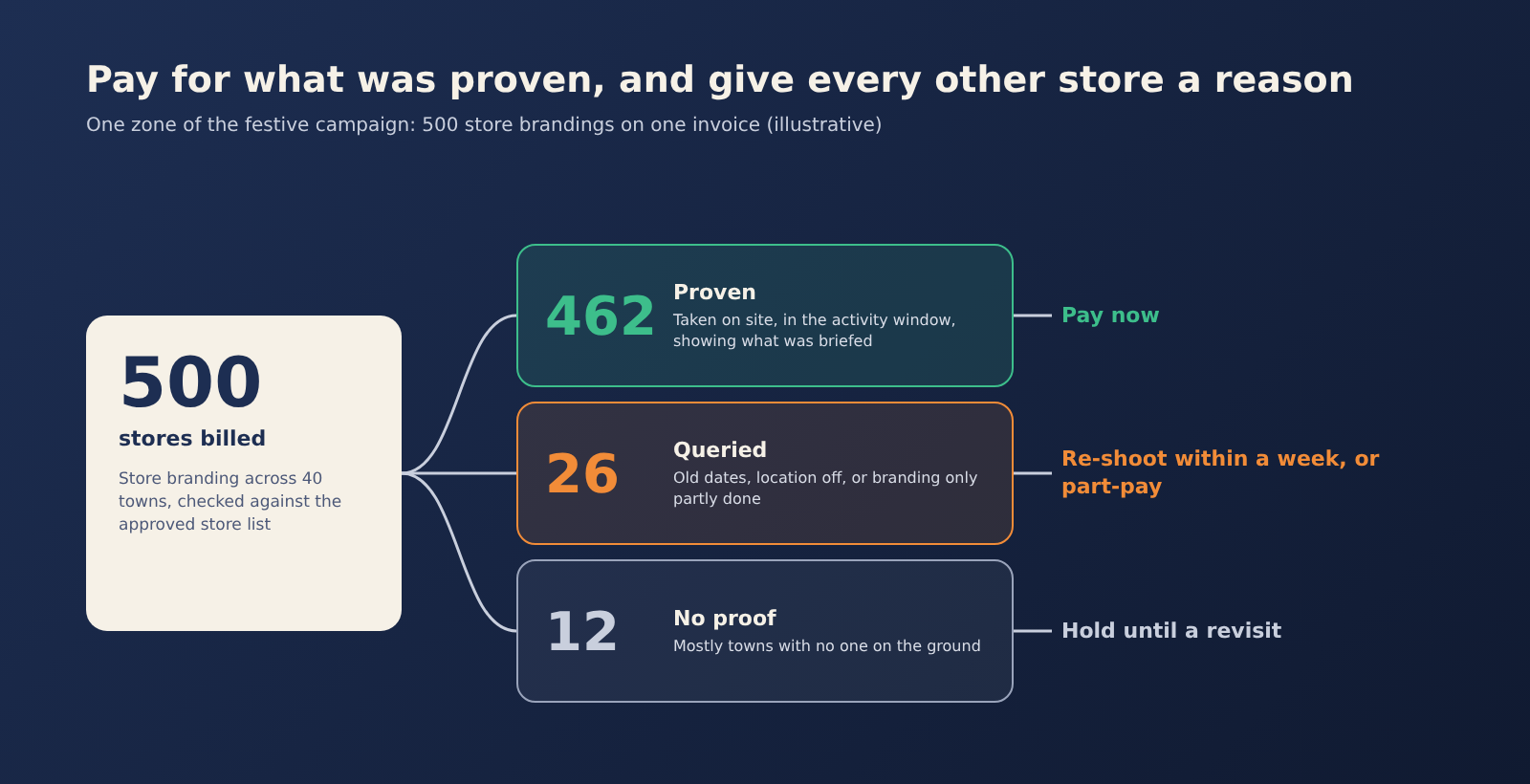
Back to our zone. Of the 500 outlets on the invoice, say 462 have photos that pass every check, 26 are queried because the dates are old, the location is off or the branding was only partly done, and 12 have no usable proof at all, mostly in small towns where nobody from the field team could get to the store. The fair answer is not to hold all 500 until the last 12 are sorted, and it isn't to pay all 500 to keep the vendor happy either. Pay for the 462. Give the vendor a week to re-shoot the 26, and agree a part-payment for any outlet where only some of the branding went up. Hold the 12 until someone can check them, which in practice is often the sales representative who visits those outlets on a regular beat, or a sample visit if the outlets are too spread out to cover.
It's worth being honest about the limits here. Photo proof works only where someone is on the ground to take the photos and there's enough network to send them. In towns where neither is true, the evidence will be thinner, and the right response is to say so and plan a revisit or a sample check, not to mark those outlets as verified because the invoice needs to move.
How do proof and payment connect at month-end?
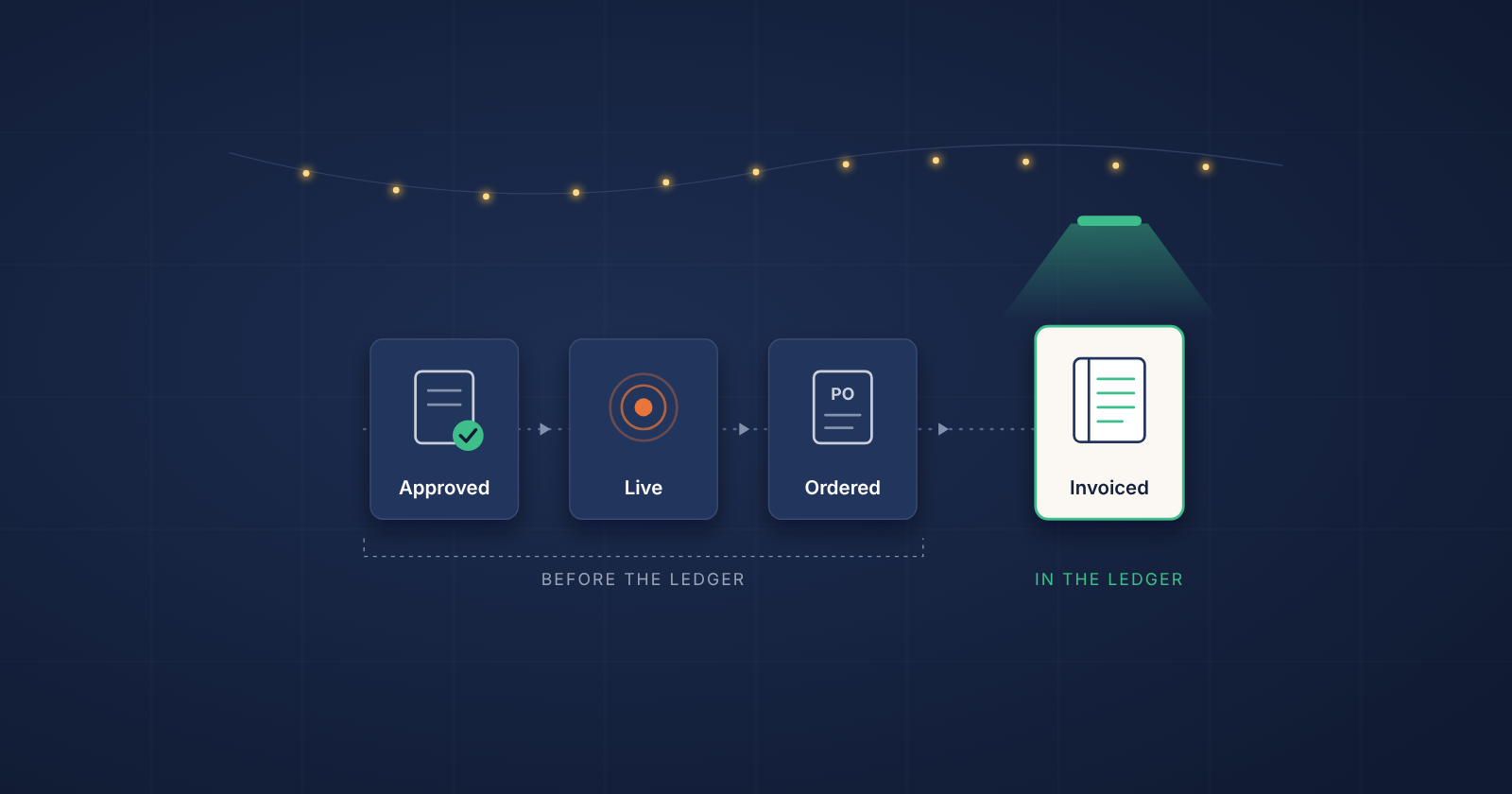
Proven work is what marketing confirms as done at month-end, so finance can provide for it and pay against it without having to chase you.
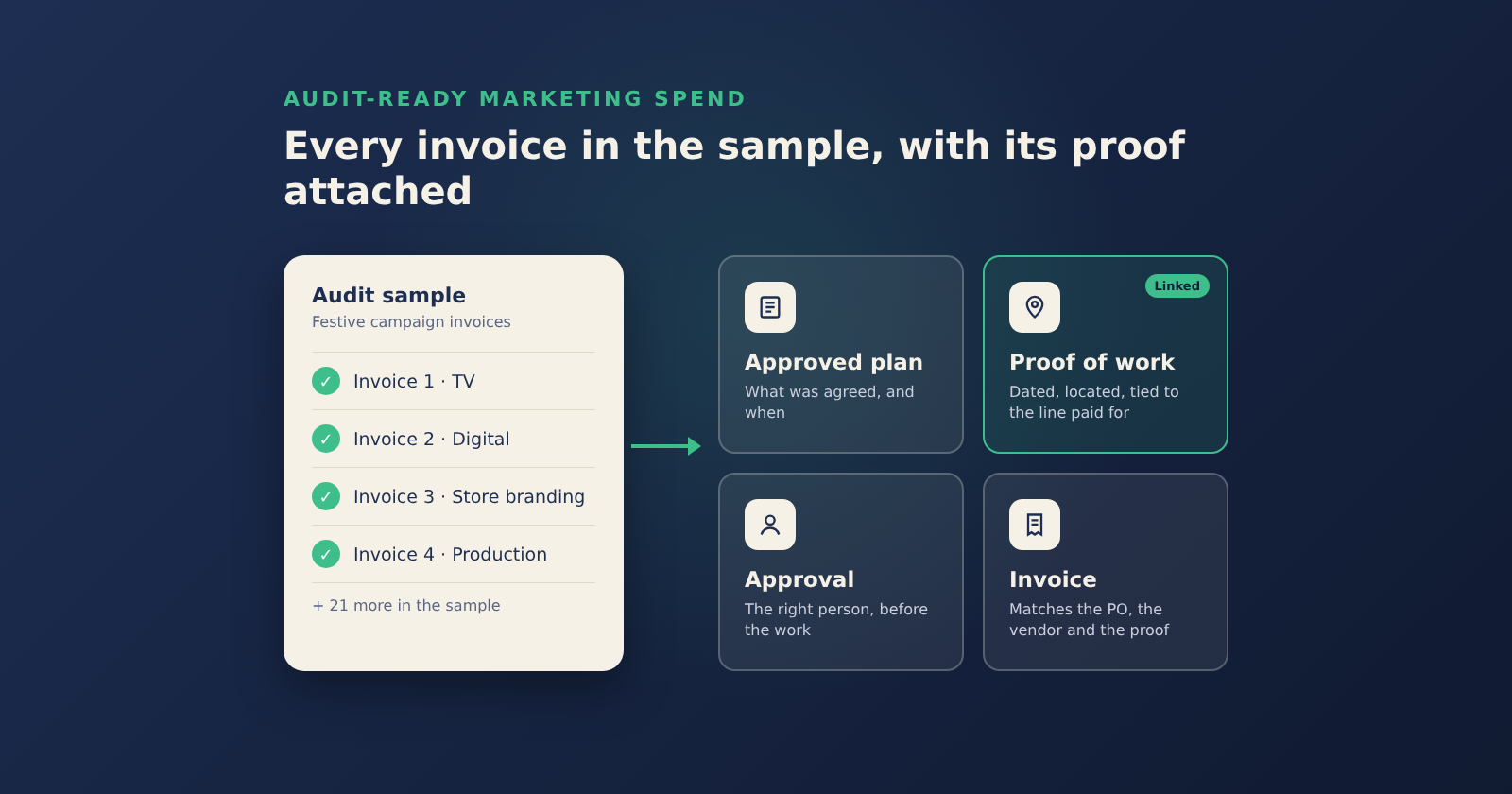
You already tell finance each month which work has been completed, so they can book it before the invoice arrives. If the proof is checked and attached at that same moment, the 462 proven outlets go into the month-end confirmation with their photos, the 26 and the 12 go in as pending with a reason, and finance closes the books on numbers you can defend. We've written about what month-end proof looks like for marketing teams, and there's a separate guide for finance teams on what auditors ask for in marketing spend and how to have it ready. The festive invoices are the ones most likely to be picked in the year-end audit sample, and the photos you accept or query this month are exactly what finance will be asked to show then.