
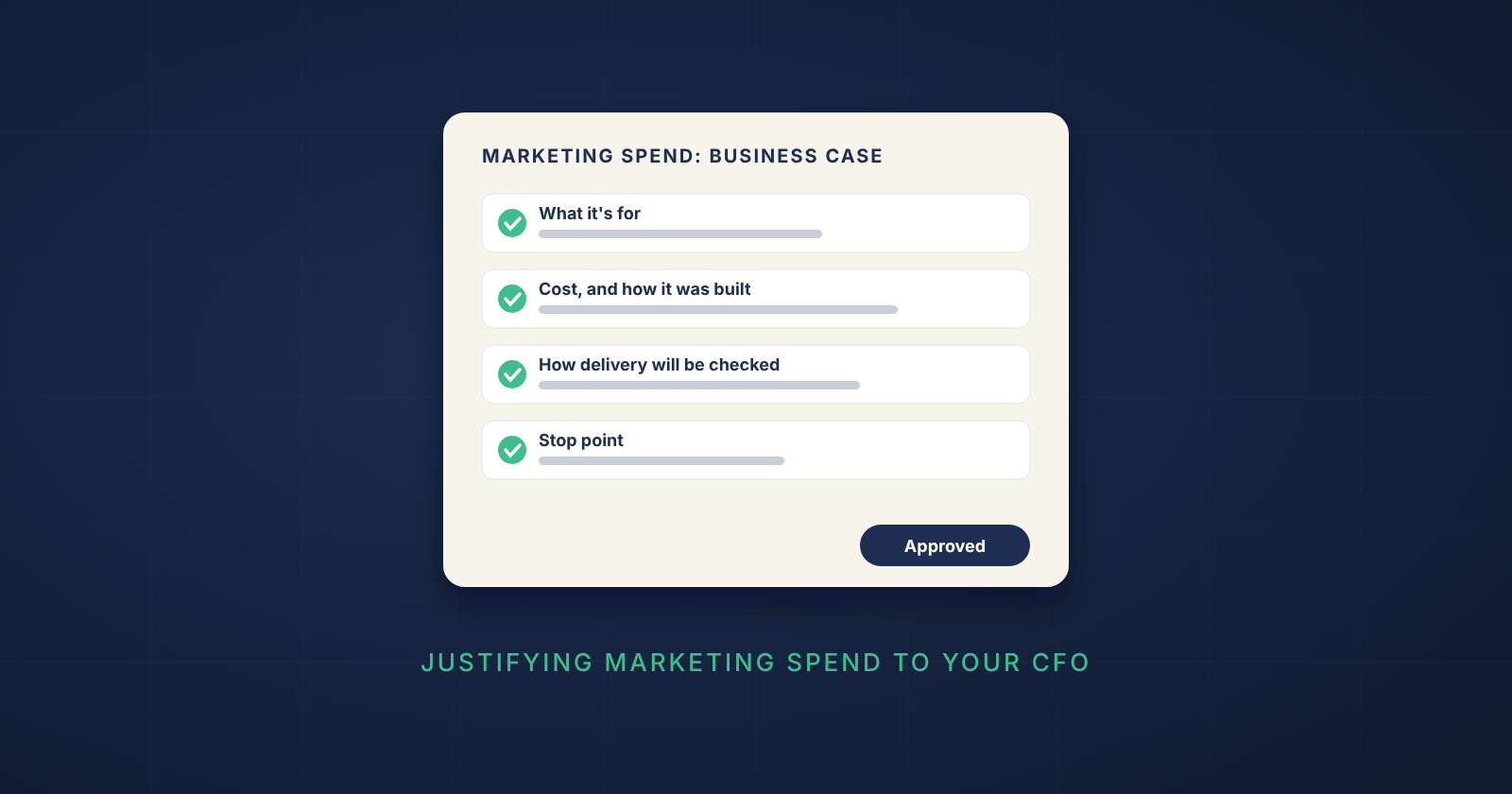
To justify marketing spend to your CFO, show four things: what the spend is for, how the cost was built, how you'll check it was delivered, and when it can be stopped if it isn't working. A forecast of return helps, but on its own it rarely wins, because both sides know it's an estimate. CFOs approve spend that comes with its own controls.
Most advice on justifying marketing spend starts and ends with return on investment: build an attribution model, speak the CFO's language, show the revenue. That's useful for a performance marketer with a direct line from click to sale. For a marketing leader in a large company running brands across TV, digital, events, agencies and on-ground activity, the return on most lines can only be estimated, and the CFO knows it.
What wins approval is a case the CFO can control. This article sets out what a CFO needs to see before approving marketing spend, the evidence each type of spend needs, how to protect a line in a cost review, and a one-page business case you can fill in before your next request.
What does a CFO need to see before approving marketing spend?
A CFO needs to see a clear purpose, a cost built from the plan, a way to check delivery, and a point where the spend can be stopped. Together, these tell finance the money is under control even when the return is uncertain.
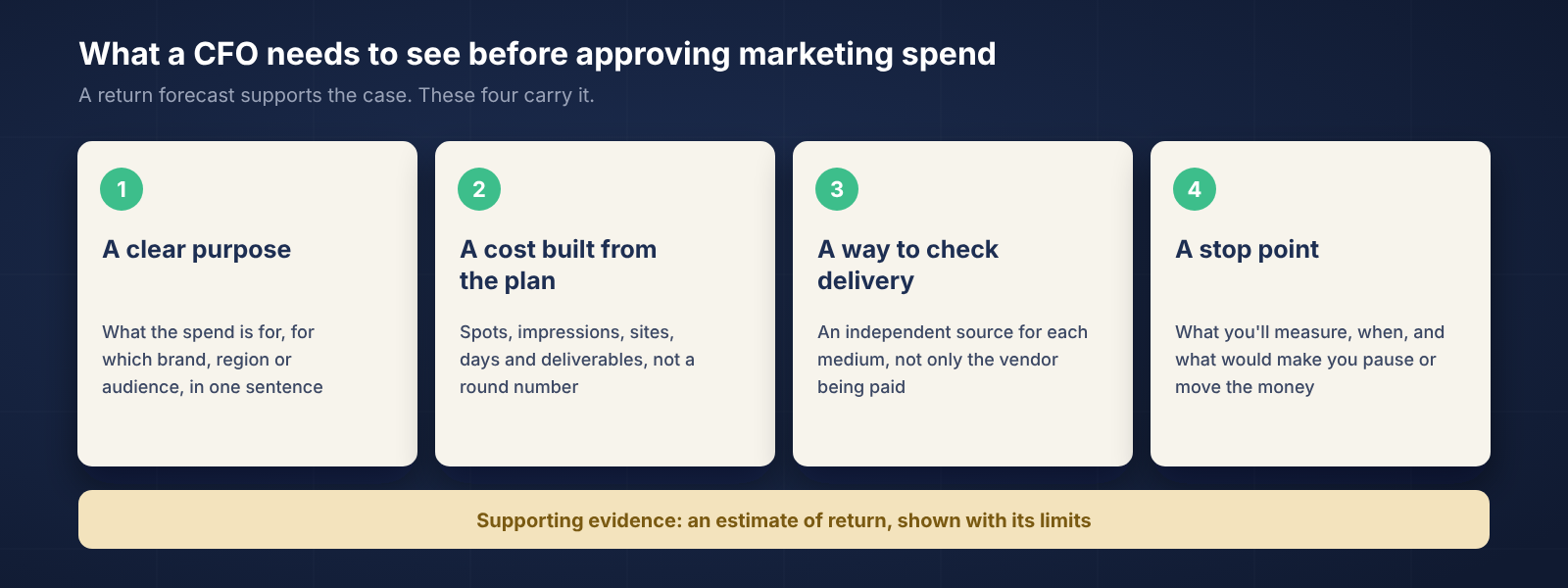
A clear purpose. What the spend is meant to achieve, for which brand, region or customer, in one sentence. "Brand building" isn't a purpose; "hold share in the south during the competitor's launch window" is.
A cost built from the plan. The number comes from the activity: spots, impressions, sites, days, deliverables. A round number tells the CFO the plan came after the budget.
A way to check delivery. How you'll know the activity ran as bought, from a source other than the vendor being paid.
A stop point. What you'll look at, when, and what result would make you pause or move the money. It shows you're willing to be held to the case.
How do you build a business case for marketing spend?
Use this: a one-page business case for marketing spend. Fill it in before you take any request to finance, whether it's new budget, more budget, or keeping a line through a cost review.
Field | What to write | Example (illustrative) |
|---|---|---|
What it's for | The purpose in one sentence, with the brand, region or audience | Hold share in the south during the competitor's launch window |
What we'll do | The activity, by medium | TV in four southern markets, regional digital, 60 retail activations |
Cost, and how it was built | The number and the build behind it | Spots and rates by channel; impressions by platform; cost per activation × sites |
Already committed | What's contracted or in flight | Annual TV deal in two of four markets |
How delivery will be checked | The independent source for each medium | Ratings and ad-monitoring for TV, platform data for digital, on-location photos for activations |
What we'll measure, and when | The measure and the review date | Share and sell-out in the four markets at week six |
Stop point | What would make you pause or move the money | No share movement by week six: move the remaining digital to the north |
What we'd cut first | The line you'd give up if the budget were smaller | Activations in the smallest market |
Owner | One name in marketing, one in finance | Brand head; finance business partner |
How to use it:
Write the purpose first. If it takes more than one sentence, the request isn't ready.
Build the cost from the activity, not from last year's figure.
Fill in "What we'd cut first" honestly. It's the field CFOs read most closely, because it shows you've ranked your own plan.
Agree the stop point with your finance business partner before the meeting. A stop point finance helped set is one they'll back.
What evidence does each type of marketing spend need?
Different kinds of marketing spend need different evidence. The CFO wants to see that you know what proof fits what you're buying.
Type of spend | What the CFO will ask | Evidence that holds | Evidence that doesn't |
|---|---|---|---|
Media (TV, digital, print, outdoor) | Will we get what we pay for? | The plan by medium, how delivery will be checked against it, and what happens to any shortfall | The agency's estimate alone |
Agency fees and retainers | What exactly are we paying for? | The scope, what's included and excluded, how hours or outputs are tracked, and the review point | A single monthly fee with no defined outputs |
Events and on-ground activations | Did it happen, and what did it serve? | Sites and dates, proof captured on location, and the sales or leads it was meant to support | A photo deck from the vendor after the event |
Content and production | Will it be used, and for how long? | Where each asset will run, rights and usage period, and cost per finished asset | A production quote with no usage plan |
Marketing technology and platforms | What does it replace, or catch? | The manual work it removes, the errors or leakage it catches, and the audit or compliance work it supports, measured on your own numbers | A vendor's industry benchmark |
For media, our articles on checking a TV campaign ran as planned and verifying digital ad invoices show what checking delivery looks like in practice. For activations, see proof of execution for BTL activities.
The platform row applies to Brandintellé too. A marketing spend governance platform is justified by your own numbers: the hours your teams spend reconciling invoices and rebuilding trackers, the invoices paid without matching proof, and the evidence you have to assemble for audit. Brandintellé checks TV delivery four ways and matches every invoice to the PO and the proof through invoice reconciliation, so those numbers are visible from the first quarter.
How do you protect a marketing budget line in a cost review?
Rank your plan by purpose, mark what's already committed, and offer the cuts you'd make first. A marketing leader who ranks their own plan keeps more of it than one who defends every line.
In a cost review, the CFO is looking for lines that can go without damaging the business. If marketing defends the total, the CFO has to cut across the board, and the essential lines suffer with the rest.
Rank every line by what it's for: defending a core brand, supporting a launch, testing something new.
Mark committed spend separately. Contracted media and retainers often can't be cut this quarter, and showing that early stops the CFO counting on savings that aren't available.
Offer the first cuts yourself, with what you expect to lose from each.
Ask for a review point on the lines you're protecting, so the decision can be revisited with evidence rather than reopened by argument.
Our guide to marketing budget allocation covers how to record why each brand or region got its share, which is what you'll need when that share is challenged.
CFOs don't say no to marketing. They say no to spend they can't control. Bring the controls with the request, and the conversation is about the plan, not the trust.
See how Brandintellé gives finance control over marketing spend