
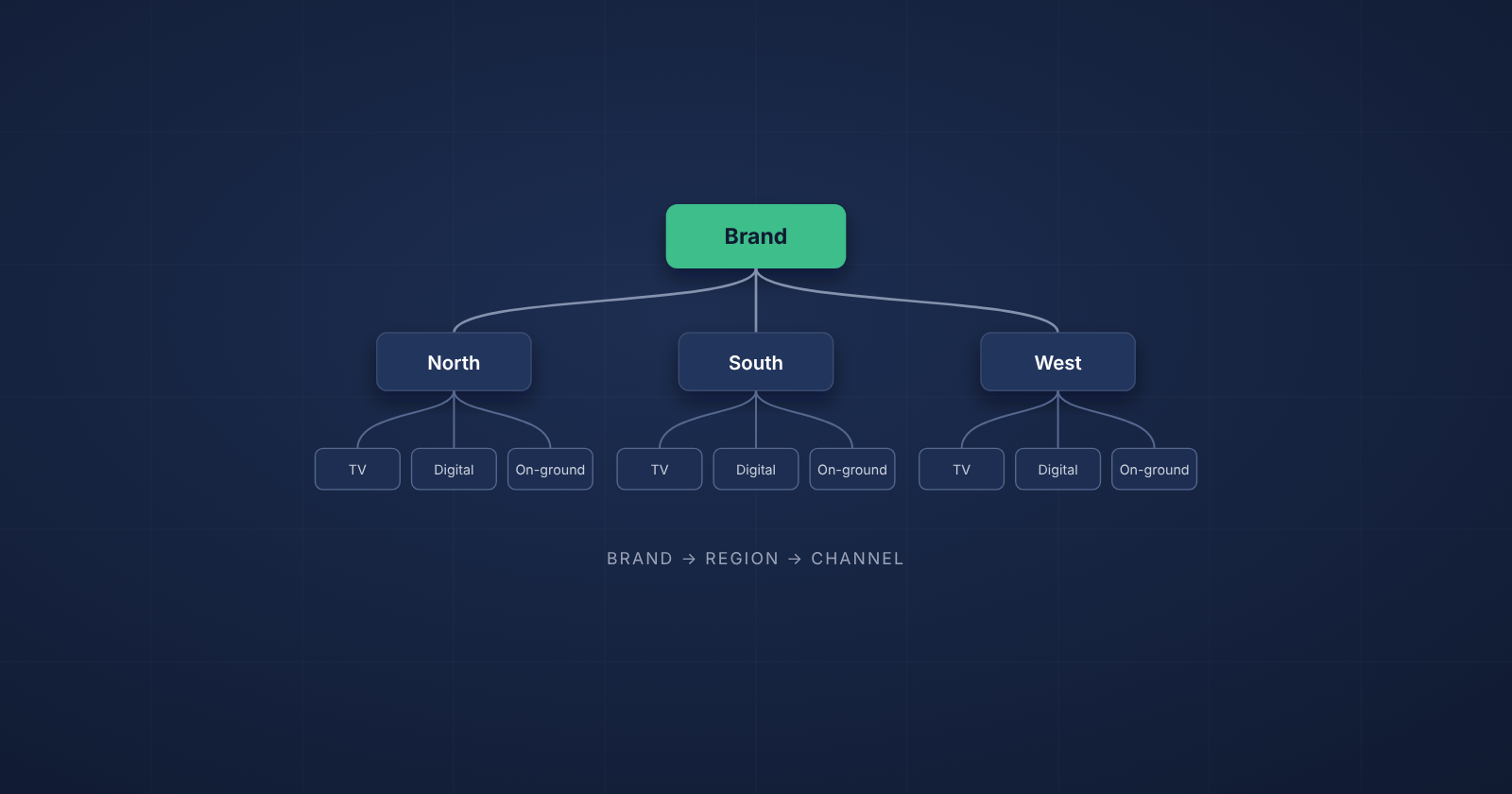
Getting the total approved is only half the job. Splitting it across brands, regions and channels is where the year is really decided, and there is more than one way to do it.
If you run marketing for a company with several brands, regions or businesses, you know that the hardest conversation is often not with finance about the total. It is the one that follows, about who gets what. Every brand head has a case, every region has a reason, and the split you agree in February will shape what each of them can do for the whole year.
Most large companies use one of five methods to make that split, often without naming it. Each one works well in some situations and badly in others, so the useful question is not which method is best but which one fits your portfolio this year. This guide compares the five, gives you a simple way to choose, and then looks at how the split works at each level, from brands down to channels.
Key takeaways -
Large companies usually split the marketing budget using one of five methods, and most combine two or three of them.
The five methods are last year’s split, share of sales, objective and task, defend and invest, and a ring-fenced test budget.
Choose the method that fits your portfolio this year. A launch or a change of strategy calls for objective and task; a mix of mature and growing brands calls for defend and invest.
Write down why each brand or region got its share, so the split holds when someone challenges it mid-year.
Keep part of the budget unallocated at brand or category level, so you can move money later without taking it back from someone.
The five allocation methods, compared
Method | How it works | Best when | The risk | What finance will ask |
|---|---|---|---|---|
Last year's split | Each brand or region keeps roughly its share from this year | The portfolio is stable and nothing major is changing | Locks in old priorities; growing brands stay underfunded | "Has anything changed that should change the split?" |
Share of sales | Each brand or region gets budget in line with its revenue | Brands are similar in maturity and role | Starves new or growing brands, which have small sales by definition | "Are we funding where we earn, or where we will earn?" |
Objective and task | Each team costs out what it needs to hit agreed goals | Launches, new markets, or a clear change in strategy | Plans add up to more than the total; needs firm prioritising | "What result does each line buy?" |
Defend and invest | Brands are given roles: some defend share, some are invested in for growth | A mixed portfolio of mature and growing brands | Defend brands can be cut too far and lose share | "Which brands are which, and for how long?" |
Ring-fenced test budget | A small share is held for new channels or ideas, judged on results | Trying new channels, markets or formats | Becomes a permanent pot that nobody reviews | "What did last year's tests prove?" |
In practice most large companies combine two or three of these. A common pattern is last year's split or share of sales as the starting point, defend-and-invest roles to adjust it, and a small test budget on top.
Choosing your method: a simple decision guide
Work through these questions in order. The first one you answer "yes" to tells you which method should lead.
Ask yourself | If yes, lead with |
|---|---|
Are you launching a brand, entering a new market or changing strategy this year? | Objective and task, for the new activity at least |
Do your brands play clearly different roles, some mature and some growing? | Defend and invest |
Are your brands and regions broadly similar in maturity and role? | Share of sales |
Is the portfolio stable, with no major change expected? | Last year's split, reviewed line by line |
Are you trying channels or formats you have not used at scale? | Add a ring-fenced test budget on top of whichever method leads |
Whichever method leads, you will need to defend the result, so write down why each brand or region got its share. That short note is what makes the split hold when someone challenges it in July, and it gives you a starting point for next year's conversation.
How the split works at each level
Across brands
This is where the defend-and-invest choice matters most. You can see the logic in public results: in the nine months to December 2025, Marico raised its advertising and promotion spend by about 19% even as its margins fell, a move analysts linked to investment in its newer digital-first brands, while several FMCG peers held their growth under 5%, as Storyboard18 reported. There is long-run evidence that the investment matters too: a Thapar Institute study of 100 Indian FMCG companies over ten years found that advertising spend had a positive effect on sales, profitability and firm value.
Across regions
Regions rarely deserve the same treatment, because distribution, competition and even regulation differ from state to state. Splitting by share of sales alone tends to keep strong regions strong and weak ones weak, so many companies combine it with a small amount set aside for priority markets where they want to grow share.
Across channels
Here the useful distinction is between money that reaches the customer, such as media and on-ground activity, and the money needed to make it, such as production, research and fees. Both are necessary, but if the second grows faster than the first year after year, the budget is buying less reach than it appears to.
Keep part of the budget unallocated
However carefully you split the budget, the year will not go to plan. So keep part of it at brand or category level instead of splitting all of it between regions and channels on day one. Moving money out of that pool later is far easier than taking it back from someone who has already planned to spend it, and it is the simplest way to stay flexible without asking finance for more. When you do need to move money during the year, phase large shifts rather than moving everything at once, a point McKinsey made back in 2015 that still holds, and our guide to reallocating marketing budget mid-quarter shows how to get those moves approved quickly.
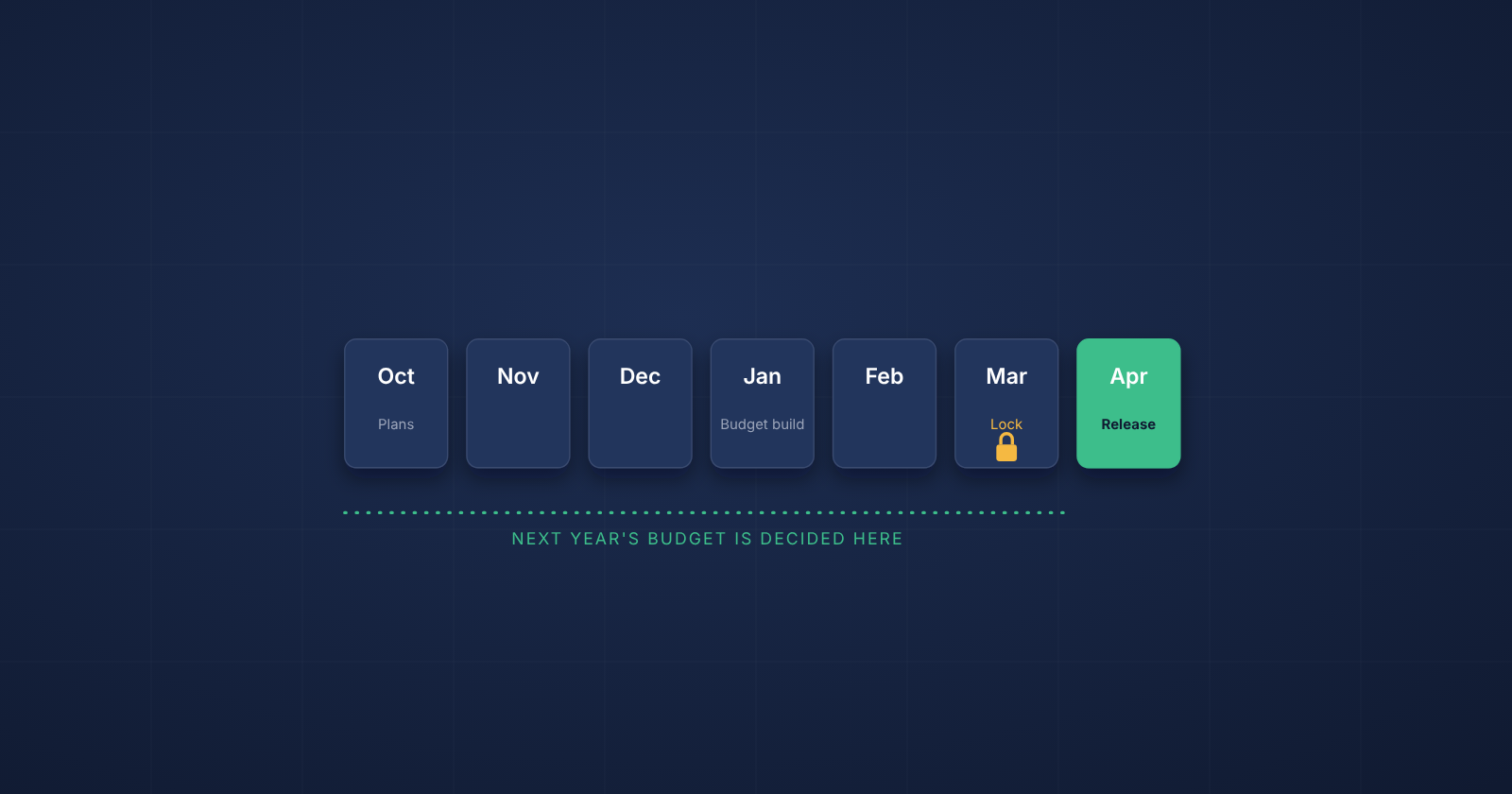
The split is one part of a longer season, and our CMO's guide to budget season shows where it fits, from October's review to March's sign-off.
Frequently asked questions
How do large companies allocate marketing budget across brands?
Most start from last year's split or each brand's share of sales, then adjust by the role each brand plays: mature brands are funded to defend share, and growing or new brands are invested in ahead of their sales. Many also keep a small ring-fenced budget for testing new channels, and hold part of the total back at brand or category level for use during the year.
What are the methods of marketing budget allocation?
The five most common are last year's split, share of sales, objective and task (costing out what is needed to hit agreed goals), defend and invest (giving brands different roles), and a ring-fenced test budget. Large companies usually combine two or three of them rather than relying on one.
How should marketing budget be split between regions?
Start with each region's share of sales, then adjust for where you want to grow share, where competition or distribution differs, and any state-level rules that affect what you can spend. Keeping a small amount aside for priority markets stops the split from simply keeping strong regions strong and weak ones weak.
How much of the marketing budget should stay unallocated?
There is no fixed figure, but many large companies keep part of the budget at brand or category level rather than splitting all of it at the start of the year. The right amount depends on how predictable your market is; the more seasonal or volatile it is, the more it pays to hold back.
How does a marketing spend governance tool like Brandintellé help with budget allocation?
It holds the budget in the structure you allocate in, by brand, region, channel and activity, with as many levels as the business needs, and shows each line's budget, outlook, available balance and consumed spend. Moves between lines during the year go through your own approval limits, so the split you agreed stays visible as it changes.
There is no perfect split. There is only one you can explain, and one you can change without starting the argument again.
See how Brandintellé structures marketing budgets by brand, region and channel.