
CFOs ask two kinds of questions about marketing spend. Control questions ask where the money is: what's committed, whether campaigns ran as paid for, why budget moved and what's owed at month-end. Value questions ask what the money returned and where the next rupee should go.
If you run marketing in a large company, you've had the meeting. You come ready to talk about reach, brand health and the campaign that worked. The CFO asks how much of the budget is committed but not yet invoiced, and whether last quarter's TV ran as bought. You promise to come back with the numbers, and the conversation about what's working never happens.
This guide covers the ten questions CFOs ask most often about marketing spend, why each one gets asked, the answer that costs you credibility, the answer that holds, and what to bring. At the end is a prep sheet to fill in before your next conversation with finance.
Why do CFOs question marketing spend?
A CFO questions marketing spend to establish control first and value second. Until finance trusts where the money is, any answer about what it returned sounds like an opinion.
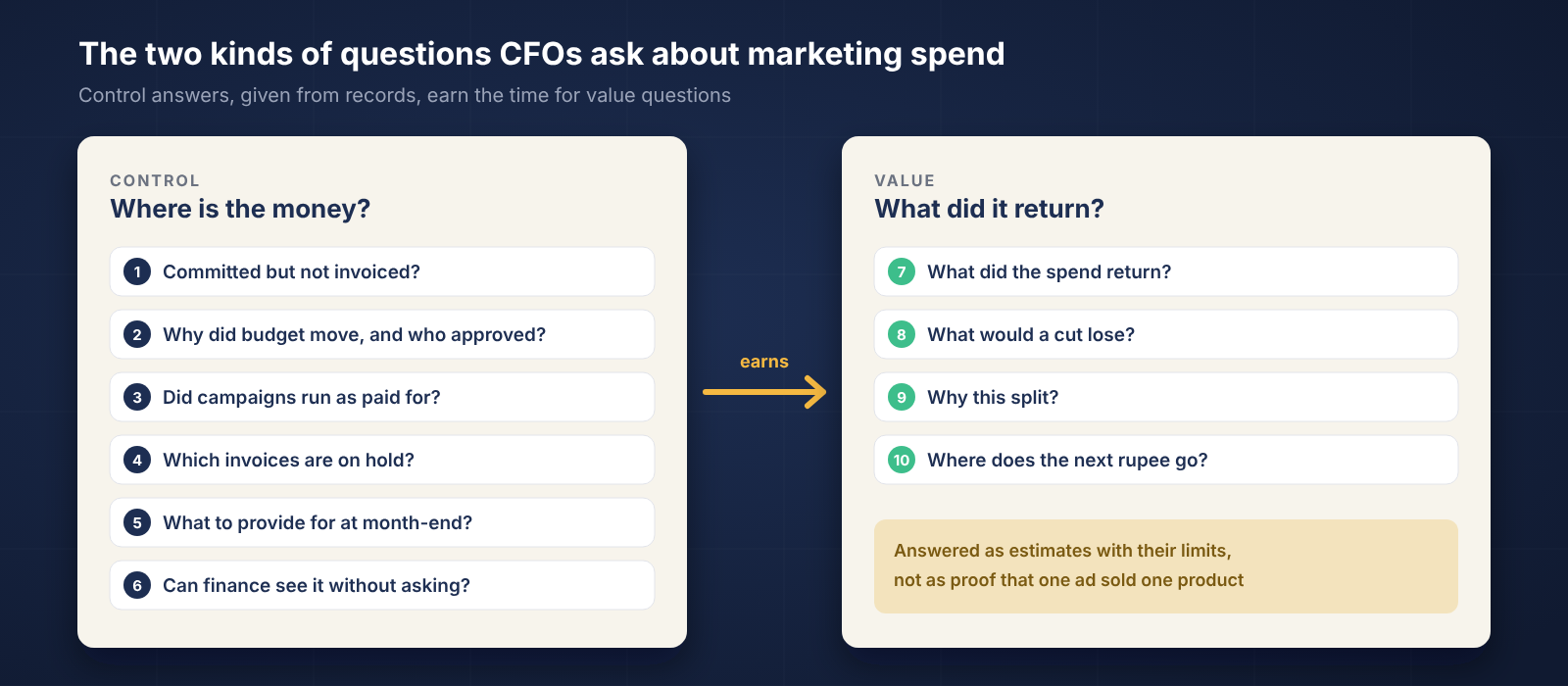
Marketing is one of the largest discretionary costs a CFO signs off, and most of it is spent through agencies and vendors that finance never speaks to. Finance sees invoices. Marketing sees plans, commitments and campaigns. The control questions are how finance closes that gap. Answer them from records, quickly, and the conversation moves on to value. Answer them with estimates, and it stays on control.
What control questions do CFOs ask about marketing spend?
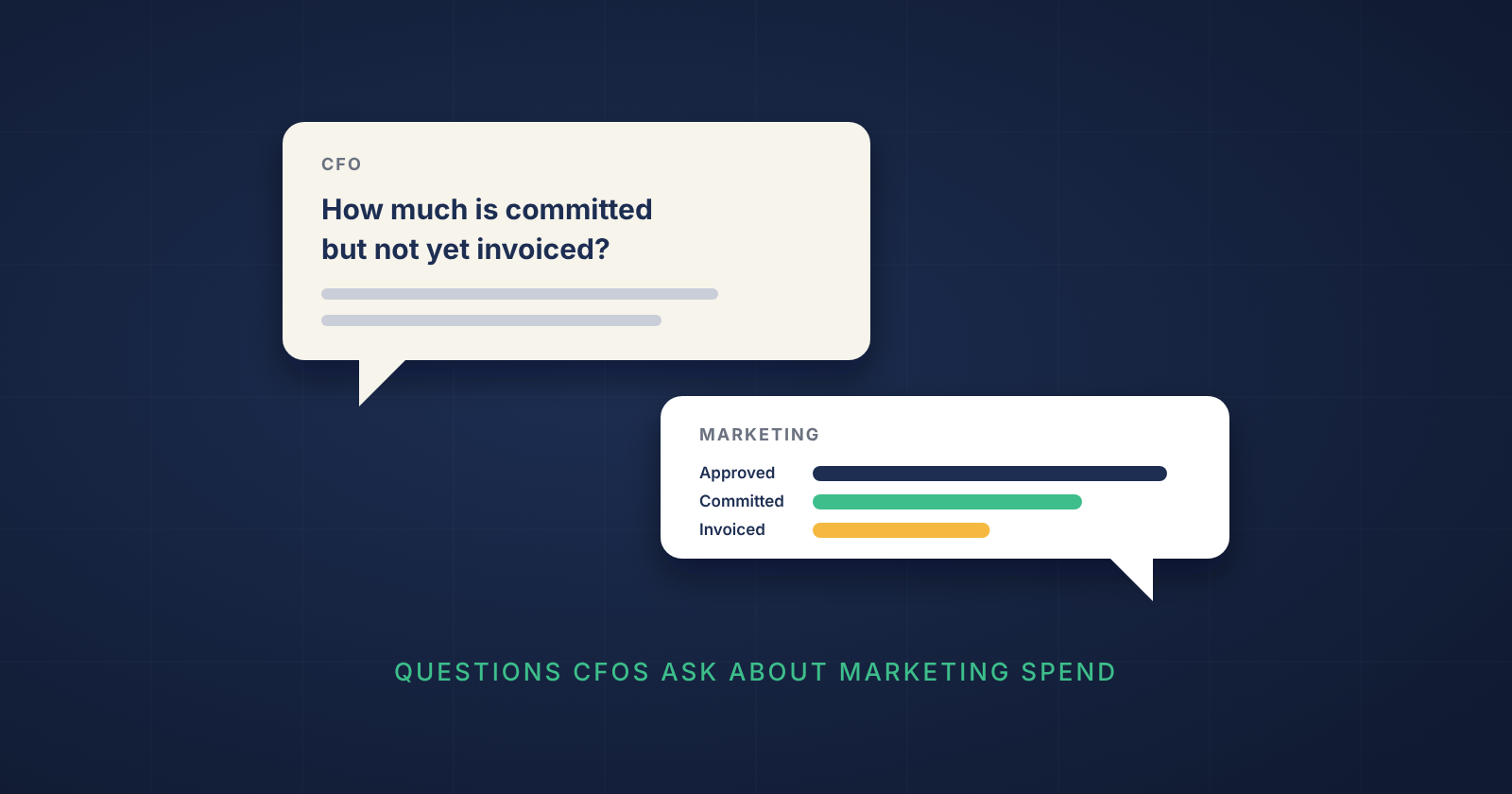
How much of the marketing budget is committed but not yet invoiced?
Give the CFO a number for each budget line: approved, committed by PO, invoiced, and still open, as of today.
Why they ask: finance sees spend only once it's invoiced. Commitments to agencies and vendors that haven't been billed are invisible in the ledger, and they're the part of the budget a CFO can least plan for.
The answer that loses credibility: "We're broadly on track." Or a total from your tracker that doesn't match anything finance has.
What to bring: the committed-vs-invoiced position by brand or budget line. Our guide to committed vs actual marketing spend explains the stages. In Brandintellé's budget planning, every line shows them without rebuilding a spreadsheet.
Why did the budget move between brands or quarters, and who approved it?
List every move: from which line, to which line, how much, why, and who approved it.
Why they ask: reallocation is normal; unexplained reallocation is what finance pushes back on. The CFO wants to know the budget is being managed, not drifting.
The answer that loses credibility: "The brand team needed it for the launch." True, but with no approval behind it, it reads as a workaround.
What to bring: a reallocation log for the period. See how to reallocate marketing budget mid-quarter for a process that keeps the approval and the reason on the record.
Did the campaign run as we paid for it?
Show planned against delivered for each medium, with the deviations and what was done about each: accepted, made good, or credited.
Why they ask: before anyone debates whether a campaign worked, finance wants to know it ran. Spots, impressions and on-ground activity that were paid for but not delivered are the cleanest saving a CFO can find.
The answer that loses credibility: the agency's post-campaign report on its own. It comes from the party being paid.
What to bring: delivery checked against an independent source, medium by medium. Brandintellé checks TV four ways, against the estimate, the schedule, ratings data and the channel's bill, and pulls digital delivery from the platforms directly.
Which marketing invoices are on hold, and why?
For every open invoice, give the PO, what it's waiting for, and who owns the next step.
Why they ask: invoices stuck in marketing damage vendor relationships and distort finance's numbers. The CFO wants to know whether the hold-up is a control working or a process failing.
The answer that loses credibility: "We're waiting on the agency." Without the reason, it sounds like nobody's chasing.
What to bring: the open-invoice list with reasons: missing proof, a rate mismatch, a corrected invoice due. Brandintellé's invoice reconciliation checks each invoice against the PO and the proof, so the reason for every hold sits on the line.
What marketing work was done this month that hasn't been billed yet?
For each PO, list the work delivered this month that the agency or vendor hasn't invoiced yet, and what it's worth. Finance uses this to book the cost in the right month.
Why they ask: the cost of marketing belongs in the month the work happened, not the month the invoice arrives. A TV campaign that aired in March but is billed in April still has to appear in March's accounts. Finance books that cost as a month-end provision, but only marketing knows what was actually delivered, so finance has to ask.
The answer that loses credibility: the PO value, or the plan. If a ₹50 lakh PO is half delivered, the work done is worth ₹25 lakh, not ₹50 lakh, and nothing is owed for work that hasn't started.
What to bring: confirmed delivery by PO. Our article on month-end marketing provisions shows how to count it by medium, and Brandintellé's provisioning calculates it from work completed against each PO.
Can finance see this without asking marketing for a spreadsheet?
The strongest answer is yes: finance and marketing look at the same record of spend.
Why they ask: every time finance has to ask, it waits days and gets a number it can't check. The question is really whether marketing's numbers can be trusted without marketing in the room.
The answer that loses credibility: "We'll send you an update every month." It solves the symptom and keeps the dependency.
What to bring: a shared view of budget, commitments, delivery and invoices. This is what a system of record for marketing spend does; see our guide on marketing operations governance for how the controls fit together.
What value questions do CFOs ask about marketing spend?
What did this marketing spend return?
Answer with an estimate and its limits: how spend and results moved together by brand, region and period, and what else could explain the change.
Why they ask: the CFO has to decide whether to keep funding the activity.
The answer that loses credibility: a precise return claimed for a single campaign, or a chain of platform metrics with no link to sales. CFOs know sales move for many reasons: price, distribution, competitors, season.
What to bring: spend next to sales for the same brands, regions and periods, and where possible a comparison of markets or periods where the activity ran with similar ones where it didn't. Present it as statistical evidence, not proof. Brandintellé's impact analytics shows spend by media, brand and geography alongside sales where your sales data is connected.
What would we lose if we cut this budget?
Name what stops, where, and what you expect to happen as a result, line by line, rather than defending the total.
Why they ask: in a cost review, every discretionary line is tested. A CFO asking about a cut, say 20%, wants to see which parts of the plan are essential and which aren't.
The answer that loses credibility: "Everything is essential." It forces the CFO to cut across the board.
What to bring: your plan ranked by what each line is for, with the committed lines that can't be cut marked separately. The lines you'd cut first are your credibility.
Why does this brand, region or channel get this share of the budget?
Give the reason each share was set: the method, the objective behind it, and when it was last reviewed.
Why they ask: the split decides more than the total does. A CFO who can't see the reasoning will assume it's last year's split rolled forward.
The answer that loses credibility: "That's how it's always been."
What to bring: the allocation method and the reason for each major share. Our guide to marketing budget allocation compares five methods.
Where would you put the next rupee, and why?
Propose two or three specific moves, each with the evidence behind it and what you'd watch to know it worked.
Why they ask: this is the question the CFO actually wants to discuss. Everything above earns the time for it.
The answer that loses credibility: "More of everything that's working." It isn't a decision.
What to bring: the moves, the reasoning and the measure. Brandintellé's AI Insights suggests where to move budget from the same dashboards; it's advisory only, and your team still moves money through the normal approvals.
How should you prepare for a conversation with your CFO about marketing spend?
Use this: fill in this prep sheet before your next budget meeting, review or cost discussion with finance. It takes about an hour the first time.
# | CFO's question | My answer (one line) | Where the answer comes from | Ready? (ready / partly / not yet) | What to chase, and from whom |
|---|---|---|---|---|---|
1 | Committed but not invoiced | ||||
2 | Why the budget moved, and who approved it | ||||
3 | Did campaigns run as paid for | ||||
4 | Invoices on hold, and why | ||||
5 | Month-end provisions | ||||
6 | Can finance see it without asking | ||||
7 | What the spend returned | ||||
8 | What a cut would lose | ||||
9 | Why this split | ||||
10 | Where the next rupee goes |
How to use it:
Fill in rows 1 to 6 first. If more than two say "not yet", expect the meeting to stay on control.
Look at the "where it comes from" column. Every "my tracker" or "email" is a number finance can't check, and will ask about again.
Share rows 1 to 6 with your finance business partner before the meeting. Agreeing the numbers in advance leaves the meeting free for rows 7 to 10.
If your company runs a formal quarterly review, our article on the eight questions in an FMCG quarterly marketing review goes deeper on that meeting.
CFOs don't distrust marketing. They distrust numbers they can't check. Answer the control questions from records, and the conversation finally gets to the part you came to talk about.
See how Brandintellé gives marketing and finance the same record of spend